"Reason is always a kind of brute force; those who appeal to the head rather than the heart, however pallid and polite, are necessarily men of violence. We speak of 'touching' a man's heart, but we can do nothing to his head but hit it." --G.K. Chesterton
Showing posts with label City of Coquitlam. Show all posts

Friday, July 22, 2016

Some context, please, Mr. Horgan

Housing affordability and its associated issues, including "demo-victions," comprise one of the most pressing economic and social issues in the Lower Mainland. Little wonder, then, that the opposition New Democrats have mounted a campaign for more government action on the problem.
BlueSky's proposed development on Foster, east of Clarke.
It might help their cause, however, if they picked a more suitable example of demo-viction malfeasance than the one they highlighted in Coquitlam earlier this week.
In fact, the example they showcased, the big BlueSky Properties Inc. development on Foster Ave. in Burquitlam, could and should be held up, not as a dramatic example of corporate greed and provincial government inaction, but as a heartening example of corporate responsibility, successful community engagement, and enlightened municipal policy.
Here's the story.
As part of its housing-affordability campaign, the New Democrats staged a press conference earlier this week against the backdrop of the aging apartments in Coquitlam that will be demolished to make way for the BlueSky development at North Road and Foster Avenue.
Supported by NDP MLA Selina Robinson and one-time NDP candidate and current Coquitlam Councillor Chris Wilson*, NDP leader John Horgan pointed out that the apartments are slated for demolition to make way for condo towers that are coming as part of the densification of Burquitlam now happening in anticipation of the arrival of the Evergreen Line early next year.
With reportedly scant reference to the specific details of the BlueSky redevelopment, Mr. Horgan declared, "People and families are scrambling to find affordable rental housing here in Coquitlam and across the Lower Mainland, and they aren't getting any leadership from Christy Clark. People want to know why the Christy Clark government has not acted to protect renters and increase the number of rental homes in this overheated property market."
Fair enough comment on the provincial level. But, on the municipal level, the suggestion that old rental buildings are demolished with little regard for the future of the tenants is completely off base.
In fact, the BlueSky development is notable for the developer's care and attention to ensure that the renters in the existing 112 units are cared for. The company's commitment to this was so thorough that the development proposal won the support of both the Burquitlam Community Association and the Tri-Cities Homelessness and Housing Task Group.
The 873-unit project will eventually comprise three condo towers boasting 816 for-sale units (many of which will, of course, be put on the rental market) and a purpose-building, five-storey, 57-unit rental building, in which rents will be similar to the rents in the existing complex. (Please click here to read the full Coquitlam staff report on the project.)
Furthermore, with Coquitlam's Transit-Oriented Development Strategy and (then-old but since-updated) Housing Affordablity Strategy guiding them, city officials worked with BlueSky to ensure that several other important steps were taken to assist in the relocation of the existing renters who would not find space in the new rental building or one of the condos. The company:

  • Hired an on-site rental relocation coordinator.
  • Instituted ongoing communication and meetings with tenants, including relocation information.
  • Provided tenants with a six-month eviction notice, rather than the provincially required two months.
  • Promised to waive multiple months' rent, rather than the one-month required by law. Two months' rent would be waved if the tenant relocates within four months of receiving notice; three months' waved if relocation takes place between four and six months after notice is served.
  • Offered any tenant or member of their immediate family the opportunity to purchase a unit within the BlueSky, or any Bosa Properties development, with 12 months' worth of rent going towards the down-payment on their new home.

The press release accompanying Mr. Horgan's news conference said he believes, "fair tenant relocation policies are needed, and the province should lead. Standards for requiring relocation plans for tenants and replacing demolished units need to be in place around the province, not just in some communities."
Fair enough.
But it would have been infinitely more informative (if somewhat less dramatic) for him to have pointed out that the "fair tenant relocation policies" he is calling for already exist in the very community in which he chose to voice his concerns.

(*Unlike Mr. Horgan, Mr. Wilson provided some contextual background to at least one news outlet, as evidenced by this story.)

Tuesday, November 3, 2015

A city-wide CAC would worsen affordability problem

What is the best way for cities to raise funds for amenities that are needed as communities grow? Higher property taxes? Spending-authorization referendums? Increased fees?

Cities in B.C. raise all their basic money through property taxes and also get to levy Development Cost Charges against developers to fund some basic infrastructure. But, by provincial law, those DCCs cannot be used for amenities such as fire halls, community centres and swimming pools.

In Coquitlam, we also have a Density Bonus system through which the city collects revenue from developers who, in exchange, get to build their projects to a more-dense standard that normally allowed. In the City Centre and Burquitlam areas, this typically translates into higher condo towers than would otherwise be allowed.

The City also established a Community Amenities Contribution program in Burquitlam that accepted even more funds from developers. This money is being used to fund the City’s share of the proposed new YMCA.

Now, there’s a plan afoot to extend the CAC program throughout Coquitlam and to have it apply to all residential development that involves a rezoning, even on a single lot where, for example, the owner wants to subdivide in order to build two smaller houses. The proposed charge is about $5,000 for every new lot. All the details can be found by clicking here.

On Monday, Nov. 2, Council voted 6-2 to support the plan in principle; it will now go to the public and to the development industry for its feedback. I was one of the two (along with Councillor Asmundson; Councillor Reid was absent) who opposed its going forward. And my main concern is that I believe such a program worsens to the affordability problem.

Simply put, I don’t agree with the contention, advanced by staff and strongly supported by Mayor Stewart, that the CAC charge will ultimately be borne by the person who sells the land to the developer.

The argument that CACs do not negatively impact the cost of housing is a fragile one, but is one that has gained traction throughout Metro Vancouver because of one consultant who is not an economist, but is a planner. Our staff cites, on page 10 of the report to council, the consultant’s study concluding that CACs have not impacted home prices; however, it appears no economic analysis was put forward to support this conclusion.

Dr. Michael Goldberg, Dean Emeritus of the UBC Sauder School of Business and one of North America's most celebrated urban-land economists, has taken a contrary view. He has explained that, in a mythical, totally-elastic market, where land supply is infinite, the consultant’s claim that--land prices will fall to account for the CAC burden--could be realistic.

However, Metro’s developable land market is notoriously inelastic due to geographic and regulatory constraints on land supply, like Metro Vancouver’s Urban Containment Boundary, which I spoke about 10 days ago at the Metro Council of Council meeting; there, I asked about whether anyone had studied its impact on housing affordability. Apparently no one has, even though it surely must have a negative impact on affordability.

Continuing with Dr. Goldberg, he has said another reason the developable land market is inelastic is due to the political risk associated with obtaining land-use entitlements. Since there is a limited supply of developable land, a vendor of a development site will hesitate in selling if he believes he must discount his land, resulting in less land available and higher land costs overall in the market.

At a macro-economic level, CACs are simply inefficient. Altus Group has done a number of studies on this over the last decade for the Canadian Homebuilders' Association. In effect, if the CAC cost is built into the home price, the homeowner ends up financing that cost in the residential mortgage market. (In the case of an estimated $5,500 CAC cost, the homeowner repays the original $5,500 plus $3,405 in interest cost over the life of a 25-year mortgage -- assuming a 4.25% mortgage rate). So, $8,905 is the real cost of that contribution to civic infrastructure.

On the other hand, if we, as a municipal government, borrowed through the MFA to finance that infrastructure, our borrowing costs would likely be 2% to 2.5% lower and we would amortize the borrowing over the life of the infrastructure – more like 50 years instead of the limited 25-year amortization of residential mortgages.

But what about the political considerations? Yes, it’s easier for a council to charge CACs than to hike taxes or user fees to pay for a new swimming pool. But this doesn't really represent full disclosure. By hiding this tax burden in the cost of new housing, we’re fooling taxpayers. We are pretending we are limiting taxes, when we are really hiding part of it and targeting the burden on a select group of taxpayers.

Mayor Stewart launched a strong rebuttal to my anti-CAC speech last night. One of his main points was that, because of market pressures, the added CAC cost will not be reflected in the selling price of a home. The market is the market is the market, he essentially said. The implication is that either the seller of the land or the developer would eat the cost of the CAC.

I didn’t get an opportunity to reply to the mayor, but I will do so now with this single point: if, as the mayor declared, the retail market is the market is the market (and I don’t completely buy that, of course; instead, I believe the CACs will drive up the price), then surely the land-sale “market is the market is the market,” and the price of that land won’t be discounted in response to the CAC charge.

This being the case, it will be the developer who must bear the burden of the CAC – yet another charge, hoop, obstacle, and hurdle with which the developer must cope.

Pity the developer? No, not really. Instead, pity the prospective home buyer who will have fewer opportunities to buy a home when a developer concludes, reluctantly, that the CAC is the straw the breaks the camel’s back, making the proposed development economically unviable. I hope it doesn’t come to this.

Monday, November 24, 2014

They may be 'auxiliary,' but their work is essential

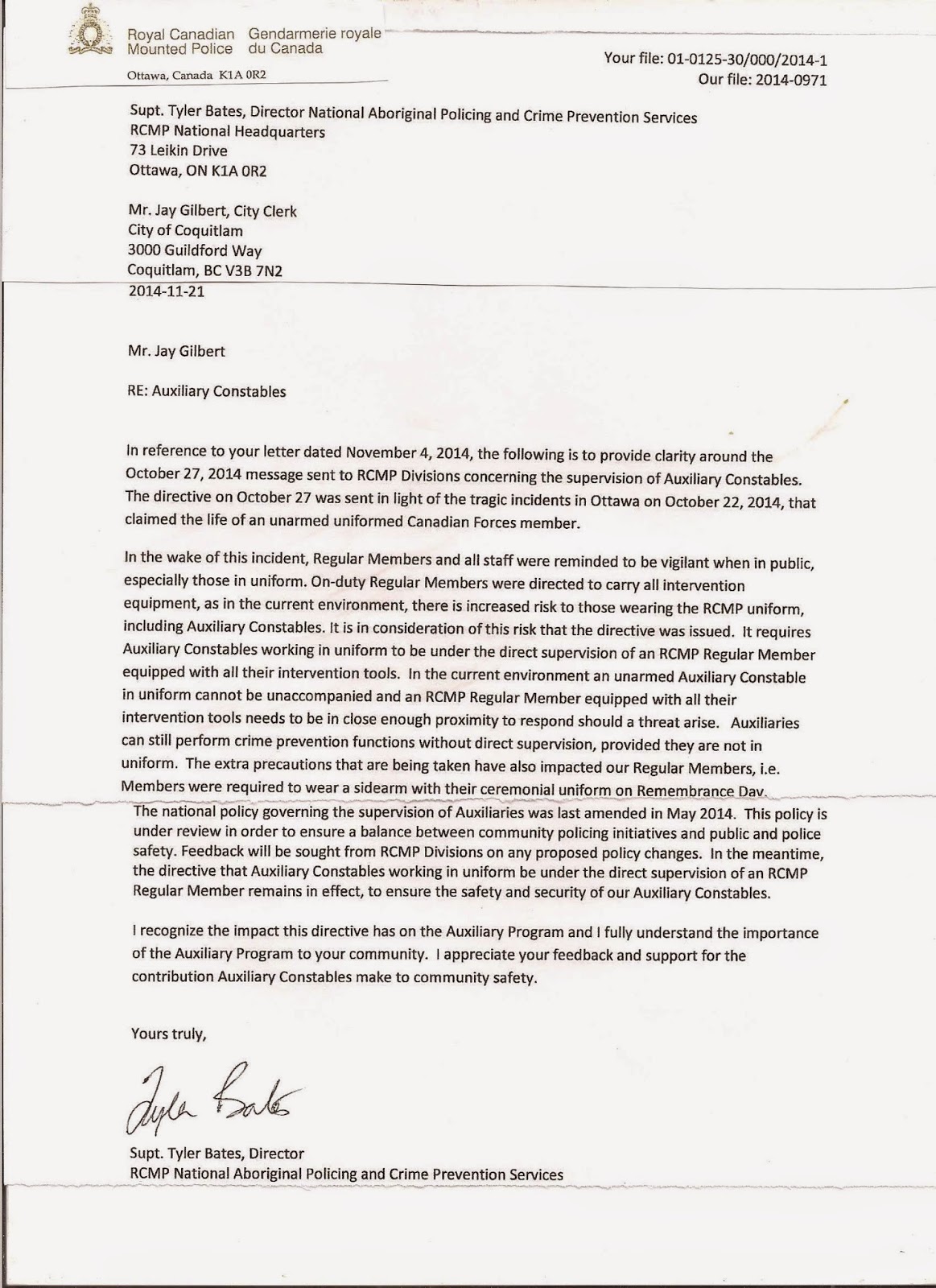
We're now getting some more clarity on the impact of last's month's edict from RCMP headquarters in Ottawa, informing us unilaterally (with no consultation)  that our 49 auxiliary officers would have to be under the "direct supervision" of a regular, armed member whenever the auxiliaries were performing their duties. And what we are being told is that the situation may not be quite as problematic as we had feared, and that all policy matters surrounding the use of auxiliaries are under review.

New letter from Supt. Bates.
 Here's a link to my previous posting about the issue; the link also includes other links to news stories about the edict, which Coquitlam Council made into a very public issue when it voted unanimously on Nov. 3 in support of my motion to ask Ottawa to overturn the edict.

At the time, we were concerned that the entire Auxiliary Constables program might be in jeopardy because the City simply couldn't afford to have a regular member shadow an auxiliary member who, for example, might be making a public-safety-related presentation to an elementary school. Similarly, the City couldn't afford to have regular members replace all the work currently done by auxiliaries.

In a letter dated Nov. 21 (see scanned copy of letter accompanying this story. I literally had to cut and paste the letter to have it fit on one page.), Supt. Tyler Bates, director of RCMP National Aboriginal Policing and Crime Prevention Services, explains that the edict was issued in response to the shootings on Parliament Hill. He explained: "...in the current environment, there is increased risk to those wearing the RCMP uniform, including Auxiliary Constables." And since auxiliaries are unarmed, it wouldn't be prudent to allow them to be unaccompanied by armed Regular Members.

That said, Supt. Bates added, "Auxiliaries can still perform crime prevention functions without direct supervision, provided they are not in uniform." He also added that the national policy governing the supervision of auxiliaries "is under review in order to ensure a balance between community policing initiatives and public and police safety."

He continued: "Feedback will be sought from RCMP Divisions on any proposed policy changes. In the meantime, the directive that Auxiliary Constables working in uniform be under the direct supervision of an RCMP Regular Member remains in effect, to ensure the safety and security of our Auxiliary Constables."

Bottom line: It's good to learn that unaccompanied auxiliaries will still be able to address students and youth groups, for example. But I'm also hoping that their educational presentations won't be rendered less-effective because they're being delivered by a non-uniformed auxiliary instead of one in the Mounties' garb.

I'm also saddened to learn that the the auxiliaries' effective crime-prevention patrols--which certainly are made more impactful by the fact the auxilaries are in uniform--cannot continue in their pre-edict form. And that's a real shame.


Thursday, November 13, 2014

New trail would extend Coquitlam Crunch northward

Crunch could be extended to Eagle Mountain Park. (Photo by me)
You might recall reading a story in the Tri-City News a week ago about Fortis BC's plans for some major work in northern Coquitlam. The story focused on Fortis's plans for some open houses, and then mentioned (in passing, or so it seemed) that Fortis was working with City of Coquitlam officials on a plan that would see the company build a hiking trail connection to link the top of the Coquitlam Crunch to the area around FortisBC’s new compressor station.
The story quotes James Lota of Fortis as saying, "Your staff have provided plans for the trail and the proposed configuration of what you want us to build. We have put a lot of thought into it and we are moving forward on the basis that we would like to help you out with that.”
Mr. Lota's comments came in response to my questioning of him on this subject, a subject that was first raised some months ago by our City Manager.
Here's the big take-away: This "moving forward" is, to my mind, all but tantamount to an agreement-in-principle that Fortis will, indeed, be building this new trail. And this, I think, is really great news.
Ever since the Crunch was improved with the addition of new landscape-tie stairs along its steepest section, usage on the Crunch has skyrocketed. Now, with the prospect that the trail could be extended even further north -- to Eagle Mountain Park at the top of Westwood Plateau -- it's bound to become even more popular. This is tremendous news for hikers, walkers and lovers of fresh air and exercise.
Better yet: it would come at no cost to the taxpayer. Fortis would likely foot the entire bill for this million-dollar-plus project!
Just thought I'd mention it.

Tuesday, November 11, 2014

A day on the campaign trail

Photographer Michelle Doherty followed me throughout the day on Nov. 10 to record what one of my typical campaign days was like. The brilliant, crisp weather was atypical, however....and thank goodness for that. Here are a few of the photos she took. For the full album, please visit my political Facebook page by clicking here.

The handshake at the door. Always a good way to finish.
A lovely way to start the morning with Mary.


Chatting with Mabel Chan about the untimely death of her son Leo.

Ready to plant a sign.
Sharing a light moment Exec. Asst. Carol Jones
With GM of Strategic Initiatives Perry Staniscia

Brother-in-law Bill, Mary, me and friend Ron greeted a.m. commuters.


Monday, November 3, 2014

Edict from RCMP brass strips auxiliary officers of independence/power, hurts Coquitlam

Council unanimously supported my motion.
UPDATES: Here are some links to media stories about this issue, including explanations from the RCMP and admissions that, as I charged, they failed to consult with us before issuing the edict. Here's CKNW's story. Here's 24hrs'. Here's CKWX's. Here the story in the Tri-City News. And here's the Tri-Cities Now's story. And, finally, the Vancouver Sun's.

Late last month, an RCMP director in Ottawa quietly issued an edict that will have a dramatic and detrimental effect on the delivery of community-safety and –education programs in Coquitlam.
I am not happy about this. And neither are my colleagues on Coquitlam Council, who voted unanimously in favour of my motion tonight (seconded by Brent Asmundson) to express our disappointment with the change.
The heretofore unpublicized edict originated from the office of the Director of the National Crime Prevention/Aboriginal Policing Services, which ordered on Oct. 24 that all Auxiliary RCMP Constables must now be under the “direct” supervision of a Regular Member when performing their duties. Until now, it has been merely “general” supervision.
Until the change, the City had been able to use auxiliaries to, for example, patrol Canada Day festivities on their own, while generally supervised by one Regular Member at a central location. Under the new edict, however, the auxiliaries won’t be able to do this, and will have to be accompanied almost lockstep by a Regular Member.
This would not make sense, of course. The bottom line is that the new edict will either cost the City (and taxpayers, of course) considerably more money – for all-Regular Member patrols—or lead to a reduction in service. We are not amused.
Rubbing salt into the wound is the fact there was absolutely no consultation from Ottawa about this—an astonishingly tone-deaf approach considering the commitment the RCMP made during the last round of contract talks to better communicate with contracting municipalities.
The change in the role of auxiliaries may be no big deal in Ontario, which has a provincial force (the OPP) and city forces dealing with most of their population. But it’s a big deal in B.C., and an especially big deal in Coquitlam, where we have almost 50 auxiliaries performing a wide range of duties, from crime-prevention to community-education. (See the notice of motion, below, for more detail.)
We have every right to be proud of the tremendous work our auxiliaries have done for Coquitlam, and we are certain that they are having a profoundly beneficial effect on the community.
To have Ottawa imperil all that with a stroke of the pen is simply not acceptable.

Notice of Motion regarding Auxiliary Constables
Whereas the Director of the National Crime Prevention/Aboriginal Policing Services (Ottawa) has, of as of the 24th of October 2014, changed the policy with respect to the deployment and engagement of Auxiliary Constables within Detachments across Canada, and
Whereas the policy change identifies a move from 'General Supervision' to 'Direct Supervision' with regard to the deployment of Auxiliary Constables, with 'General Supervision' meaning the Auxiliary Constable(s) may perform specific duties without being under the direct supervision of a Regular Member, and 'Direct Supervision' meaning the Auxiliary constable must be accompanied and supervised by a Regular Member, and
Whereas the Coquitlam Detachment’s Auxiliary Constable Program is responsible for: Crime Reduction Patrols; School Presentations at elementary schools; visits to programs with City Parks and Rec Departments; presentations to Community Youth groups (Girl Guides and Boy Scouts); and providing police presence at Community Events, and
Whereas the announced changes of Oct. 24 appear to have a detrimental effect on the ability of Coquitlam Detachment’s Auxiliary Constables to perform the above-stated duties,
Therefore be it resolved that Coquitlam Council send a letter to the Director of the National Crime Prevention/Aboriginal Policing Services (Ottawa), outlining the impact the policy change has on the safety and well-being of the city of Coquitlam and asking that the policy change be reconsidered.
                                                                                                                                                                                
Moved by Councillor Terry O’Neill           Seconded by Councillor Brent Asmundson
Nov. 3, 2014


Thursday, August 28, 2014

Closing a Riverview loophole. Phew!

Riverview landmark. (Photo by Terry O'Neill)
You might recall that Council and the City of Coquitlam spent a fair bit of time and effort earlier this year to commission and then distribute a major new report on the City's vision for the future of the Riverview lands.
However, when BC Housing's lastest public-consultation summary report was made public last week, I noticed that it made absolutely no mention of Coquitlam's detailed and well-received report -- this, even though Coquitlam's report was distributed during the most-recent period in which BC Housing had collected public input, and even though BC Housing's report summarizes the input it received, not only at open houses and from official advisory groups, but also from additional persons and organizations.
And, so, I set about to find out what exactly was going on and to fix the problem.
First, some background: Written by mental-health expert Dr. John Higenbottam, the City's report recommends the establishment of a health-and-wellness campus on the grounds.
Immediately after the report was made public in mid-June, city staff circulated it to all interested parties, including various departments of the provincial government.
And so, after noticing that the report wasn't mentioned in BC Housing's latest summary of the input it has received, I messaged the organization coordinating BC Housing's visioning exercise, Brook Pooni Associates Inc. The company answered that BC Housing's Consultation Summary Report "includes all the communications material that has been officially [emphasis added] submitted to BC Housing to date."
Yes, the City's vision had been received by BC Housing and was being reviewed and considered by the provincial body, the company added. However, "It [Coquitlam's report] was not ... submitted to be included in the report."
My immediate reaction upon reading this can be summed up in one word: Yikes! My more-detailed thought was: Well, we'd better take steps to close this little loophole, in order to ensure that the City's report becomes part of the official record. 
The message from Brook Pooni ends with these sentences: "The next set of Open Houses will take place at the end of September. We would be happy to include the City's Vision report as part of our next Consultation Summary Report following the upcoming events."
Yes, I think that would be exactly what the City would want to happen, and I have now taken steps at City Hall to ensure that this does, indeed, take place.
I would hate to think that provincial decision-makers, who may very well be buried in paperwork, might downgrade (or, worse yet, not even be aware of) Coquitlam's report because it hadn't gone through official channels.
In the end, it's looking like "no harm, no foul." And thank goodness for that.
AUGUST 29 UPDATE: The folks at Brook Pooni have sent me an email saying that, in the interim (that is, until the City report can be officially submitted), they will place on the Renewing Riverview website either the full Coquitlam report or a link to that report. Most appreciated!

Tuesday, June 17, 2014

Griping about GVRD governance

Ok, so here's what bugs me about the way the GVRD (aka Metro Vancouver) governance system works. 1. A candidate gets elected to a local council and is soon sworn in, pledging to do what's best for his or her community. 2. A few of those councillors and mayors are then selected by their councils to represent their community on the GVRD board of directors, where they are then sworn in, pledging to do what's best for Metro.
See the problem? You can't serve two masters. It's as simple as that. Yet, that's what's being asked of Metro directors. Not only are they not directly accountable to any electorate, they also find themselves in situations where, if they're doing what's best for Metro, they might not be doing what's best for the community that elected them.
This is why I tabled a Notice of Motion at last night's council meeting (seconded by Councillor Asmundson), seeking council backing to ask the provincial government to review GVRD governance. My motion follows a similar one passed last month at the BC Chamber of Commerce AGM.
You will find the text of my Notion of Motion below, as well as the background paper from the Victoria Chamber which explains the BC Chamber's motion.
I expect that Coquitlam council will deal with this issue at its next meeting.

NOTICE OF MOTION

Whereas concerns about the democratic accountability of the Board of Directors of the Greater Vancouver Regional District (Metro Vancouver) have arisen involving board members’ twofold roles as, first, politicians directly elected to serve their communities on local councils and, second, as representatives who are later selected by their respective councils to sit on the GVRD board; and

Whereas, at its May 2014 AGM, the B.C. Chamber of Commerce, citing issues related to the need for increased accountability and better local decision-making at the regional-government level, called on the provincial government to conduct an independent study of urban and rural regional governance models to identify best practices and efficiencies and determine the feasibility of implementing those in B.C.

Therefore, be it resolved, that Coquitlam Council call on the provincial government to conduct a study of regional governance models, not only to identify best practices and efficiencies but also to increase democratic accountability, so as to determine the feasibility of implementing these goals in B.C..; and that Council’s resolution be forwarded to the next meeting of the Union of B.C. Municipalities for its consideration and endorsement.

Here is the text from the Victoria Proposed Policy Resolution that was adopted during the BC Chamber AGM in May 2014. The final version of the policy statement is currently being edited, but this is the resolution as it was passed.

REVIEW OF REGIONAL GOVERNANCE MODEL IN URBAN AREAS

In 1966, the B.C. government established the regional district concept of local government in hopes of dealing with problems that transcended traditional municipal boundaries. These regional governments operate throughout the province as a local form of government, governed by the Local Government Act. Prior to the introduction of regional districts, land use and planning were done directly by the Province, whereas local services (such as fire protection and water management) were provided by independently incorporated improvement districts or municipalities under contract with the Province.
Today, there are 162 municipalities in B.C., plus 27 regional districts. Most regional districts inhabit primarily unincorporated rural areas (electoral areas). However, some urban areas, which have been deemed regionally unregulated because of numerous neighbouring municipalities, have become dependent on regional districts for certain regional responsibilities. In the Greater Victoria area alone, there are 13 municipalities with one encompassing Capital Regional District (CRD), serving a population of over 350,000. In the Lower Mainland the regional district, Metro Vancouver (Metro) represents 24 members including 22 municipalities, one electoral area, and one treaty First Nation and serves a population of 2.3 million.
The purpose of regional districts is three-fold: they are regional governments that deliver regional services; they are inter-municipal and provide a political and administrative framework for the delivery of services on a partnership basis; and they can offer local government services for unincorporated areas.
The CRD and Metro are both somewhat considered regional district anomalies because of their highly-populated urban areas. In these two districts, the regional governments primarily provide fully regional services like water supply and air quality management. In contrast, less populated regional districts are more focused on providing local services like planning, and fire protection. While both the CRD and Metro share regional problems, the province deals them with quite differently. Most notably, accessing capital and transportation management are two key issues handled legislatively in a different way from one another.
In 1988, the legislature adopted the Greater Vancouver Transportation Authority Act, which was the result of extensive negotiations between the province and the regional district. This was significant in a number of respects: it gave the GVRD new powers in transit, major roads, air care and Transportation Demand Management; and provided revenue sources to match. Significantly, it removed hospital financing as a regional district responsibility as one of the swaps necessary to achieve a balanced and mutually acceptable package. In contrast, the CRD, which is experiencing significant transportation challenges, has no governing transportation body overlooking the region.
The Municipal Finance Authority Act was created in 1971 and took advantage of the emergence of regional districts and mandated that all municipalities - with the exception of the City of Vancouver and special boards - had to borrow through their regional districts. This allowed local governments, through their regional districts, to pool their assets and borrowing requests and collectively approach the marketplace producing benefits in lower borrowing costs. Thus, while the CRD’s primary city, Victoria, must borrow money through its regional district, Metro’s primary city, Vancouver, is not mandated to do the same.
Metro’s unique agreements with the province have allowed some of its main issues to be somewhat mitigated. Particular areas of BC have grown and will continue to grow at unprecedented rates since the establishment of regional districts, including the CRD, Regional District of Central Okanagan, Regional District of Nanaimo, and Regional District of Fraser-Fort George. As these urbanized regions escalate, they may also benefit from similar agreements that the province holds with Metro.
A continuing concern of many residents in urban areas is the question of representation on regional district boards. Residents of electoral areas elect a representative to sit on the regional district board. Meanwhile, representation of municipal areas on the district’s Board of Directors is supposedly ensured by directors who are members of municipal council and appointed by their councils for terms of three years. In other words, municipal voters have no direct voice in deciding which of their elected representatives will be on their regional district’s Board of Directors.
A recent example of this need for increased accountability and better local decision-making is the concern over the proposed property tax increases outlined by BC Transit and the Victoria Regional Transit Commission in the coming years, echoing the concerns raised in the lower mainland over tax increases by Translink in 2010. While other regions are also experiencing unsustainable increases, the CRD’s example illustrates the problem most vividly. As published, the increases reflect a more than doubling of the property tax portion from just over $60 million in 2009/10 to over $113 million in 2015/16, increases that will hit businesses in the region particularly hard.
While the business community supports the goals of public transportation and the principles of sustainability, there are significant concerns that such increases are financially unsustainable. This most recent example continues to call for the formation of a regional transportation authority, one that encompasses all transportation modes and provides for increased accountability and local decision-making.
It appears the regional governance model does not serve the majority of districts well. The fine- tuning of the regional governance structure to meet the needs of particular areas is too short term an approach and longer-term solutions are required. The solution also needs to address the different issues and concerns facing both rural and urban regional districts. The regions need to be treated fairly and appropriately and review of this important governing body and its role is needed.
THE CHAMBER RECOMMENDS
That the provincial government conduct an independent study of urban and rural regional governance models to identify best practices and efficiencies and determine the feasibility of implementing those in B.C.

Kiddie play areas should be dog-free

Spirit Square (photo from bynettconstruction.com)
The City of Coquitlam has rules and regulations protecting sensitive habitat from dogs, but there's nothing stopping dog owners from letting their pets run rampant over the city's kiddie play areas, with the pets pooping and peeing as they go. And, of course, leaving a mess and a potential health hazard in their wake.
Even the most responsible dog owner, who dutifully scoops up his pet's doggy-doo, can't possibly remove the film of stinky residue that's left behind. Moreover, there's no clean-up possible when a dog does Number One.
A dog doing its business isn't much of a problem when it takes place in a big forested park or wide-open median. But when the dirty business takes place in a pocket park, like the highly used Spirit Square adjacent to the Glen Pine Pavilion, it's a significant issue.
Go there most any morning and you'll see all sorts of dogs running around, doing their morning business. And go there in the evening, and you'll see all sorts of young families whose children are running and rolling around on the grass. Something doesn't add up.
That's why I raised the issue at the end of Council in Committee yesterday afternoon. And I'm very pleased to report that, as a first step, council agreed that the City should begin posting signs around Spirit Square informing dog owners that the park is a children's play area and that they shouldn't let their pets dirty it.
I will watch to see how this trial works out. Down the road, we may want to look at bylaw banning dogs from pocket parks, children's play areas, and maybe even sports fields. Several communities in North America (Raleigh, North Carolina, for example) have instituted such rules, and I'm thinking that Coquitlam might want to, as well.
UPDATE: Here's a link to a Tri-Cities NOW story about this issue.
FURTHER UPDATE (July 2): The City has now installed signs on Spirit Square, asking the public to keep their dogs out of the area. Here's a photo of one of the signs:

Tuesday, May 27, 2014

If it ain't broke, don't fix it

If it ain't broke, don't fix it.
The above, in a nutshell, is my down-home philosophy when it comes to deciding on whether to support initiatives designed to change the way the City does business. In other words, if there's no evidence that the current way the City is going about its business is failing, then there's no good reason to enact a new policy or program to change.
Coquitlam business. (from coquitlam.ca)
And this is one of the main reasons why, at last night's council meeting, I opposed Councillor Bonita Zarrillo's motion to have the city adopt some sort of ill-defined "buy-local" policy. Thankfully, Councillors Asmundson, Reid and Hodge agreed with me, while only Councillors Wilson and the Councillor In Permanent Opposition sided with Ms. Zarrillo, so her motion failed.
Nowhere in the lengthy preamble to her motion and, moreover, nowhere in her lengthy prepared speech supporting her motion did Ms. Zarrillo present any evidence to suggest that local businesses did not support the City's current procurement policy--a policy that seeks to find the best value for the City of Coquitlam through open and competitive bid opportunities.
As our manager of financial services, Sheena MacLeod, said last night, it is proven that such competition leads to lower prices.
Moreover, as I pointed out in my speech on the matter, enacting some sort of buy-local campaign could actually end up hurting local businesses. This would occur because such an initiative would spark a mini trade war, one that would see other local municipalities enacting buy-local initiatives as well, thus limiting business opportunities for Coquitlam companies.
It's also clear to me that a "buy-Coquitlam" policy would add red tape to the City's procurement policy, placing onerous, time-consuming and expensive burdens on staff time. Ironically, the only jobs a "buy-Coquitlam" policy might, then, create would be within City Hall's administrative staff.
During her speech, Councillor Zarrillo expanded on her initial motion by suggesting that it implied that a "buy-local" policy would only kick in "when all things were equal." Well, if she meant that, she should have said so in the first place.
But, even if she had, I pointed out that "all things being equal" was either an extremely subjective criterion or, if it applied merely to the exact figure in a bid, likely to occur very rarely indeed. This being the case, it was hardly a compelling reason to support the motion.
The bottom line is that the current "best value" policy ensures that the City gets the best bang for the taxpayers' buck, while also creating a market in which good local suppliers can succeed both near to and far from home.

Here's a link to the Tri-City News' story about the debate. And here's a link to the Tri-Cities Now's story.


Tuesday, February 4, 2014

Council's pipeline-input decision

Coquitlam Council voted unanimously last night to apply to the National Energy Board for formal Intervenor status at the NEB’s upcoming hearings in to Trans Mountain Pipeline ULC’s application to twin its pipeline through B.C. (and Coquitlam) to a terminal in Burnaby. I reluctantly supported the motion—reluctantly, because I thought the far more realistic and responsible position for the City to take was to apply for formal Commenter status.
However, when my amendment to this effect was defeated 5-3 (with only Mayor Richard Stewart and Councillor Brent Asmundson supporting me), I decided that having Internevor status was better than having no formal input at all, and therefore supported the original motion.
By now, most informed citizens will know plenty about the TMP project (also known as the Kinder-Morgan pipeline), so I won’t go over all the details. Here’s a link that provides much of the background. And here's a Coquitlam-specific link. 
Importantly, the line will not parallel the existing pipeline, which cuts through the heart of southwest Coquitlam, but will trace a new route along the southern edge of the city, near Highway 1.
The issue facing the City was whether we should work behind the scenes to resolve any safety and routing issues with TMP, should it win approval to build the pipeline, or apply to the NEB to have formal input into the approval process as a Commenter or Intervenor.
The City of Coquitlam’s General Manager of Strategic Initiatives, Maurice Gravelle, said in a January 30 memo to Mayor and Council that, “it is important the city apply to either submit a letter of comment or to be an Intervenor.” This statement helped me reach the decision that, yes, the City should have a formal place at the hearing table.
However,  Mr. Gravelle also reported that there would be negligible costs to researching and writing a letter of Comment, while the costs for assuming Intervenor status would be between $50,000 and $100,000. He also said, “It is anticipated that any concerns the City may have with the proposed Project will be addressed by Trans Mountain prior to the hearing.”
My research into the subject determined that being an Intervenor gave the person or organization the following rights and responsibilities: The opportunity to present written evidence; the right to question others on their written evidence; the right to cross-examine other witnesses at the oral portion of the hearing; the right to give final argument; the responsibility to attend at least on opening days, and days of direct relevance; and the right to receive all documents.
A Commenter has the ability to write a Letter of comment which: comments on how the City would be impacted positively or negatively by the project; comments or makes suggestions for conditions that should be placed on any approval; and declares any information that explains or supports our comments.
Given all this background (not the least of which was the statement by Mr. Gravelle that he anticipated that all Coquitlam-specific issues would be worked out prior to the start of the NEB hearings) and given the fact that only a select number are chosen to be a formal Intervenor, I concluded that the City’s best chance to be selected would be as a formal Commenter.  But, as I stated above, the majority of Council did not agree.
My fear is that, if we are granted Intervenor status (and that’s a big “if”), the City may end up spending hundreds of thousands of dollars to duplicate what other levels of government, such as Metro Vancouver and the Provincial government, will already be doing.
Coquitlam’s input should be limited to site-specific, technical issues that directly impact the City. I suspect that some ardent environmental activists (of whom there were many in the audience on Monday night) will want to use any Coquitlam involvement as a springboard for broader arguments against the carbon economy, pipelines and the Alberta oil sands. If so, I will oppose them.

Wednesday, October 23, 2013

An opportunity delayed--or lost?

Strike while the iron is hot. You've all heard this expression and appreciate its worth. In the context of Coquitlam, the hot iron can been seen as the coming of the Evergreen Line, a rapid-transit link that is in the process of transforming our city.
For the most part, City Council has been moving quickly to take advantage of the Evergreen--striking while the iron is hot. Council and staff are doing this by moving ahead with development in the areas around the Evergreen line stations. This has many beneficial effects, not the least of which is to supply of more market housing, which helps moderate price pressure.
Things are moving especially fast in the Burquitlam area, which is seeing an explosion of medium-density construction, and in the core City Centre area, which is seeing major high-density (high-rises!) construction.
So, you'd think that a developer that was planning a medium-density mixed commercial-residential development in the shoulder area of a rapid-transit station, and also within the City's transit-development-friendly "Transit-oriented Development Strategy" (TDS) growth area (see the adjacent map), would be welcomed with open arms by Coquitlam.
But that was not the case on Monday night. The staff report on the proposal by Epix Developments strongly recommended that Council not approve the project because the "City Centre Area Plan Update" has not been completed, and because moving the proposal forward would strain the planning department's resources.
In the end, the majority of Council agreed and voted 4-3 to reject the plan. And that's a shame.
I voted on the losing side to move it forward because I believe the public has the right to have their say on this proposed development, which appears to be a fine fit for the area: it's close to Port Moody's Inlet Centre Station and will be even closer to a Falcon station, should one ever be built. It's on a piece of land that has been empty for decades. It's close to existing townhouses and commercial areas. And it's in the City Centre TDS Area (it is on the left side of the red City Centre TDS in the above map).
The developers have been told they now have to wait a few years--a delay that is sure to cost them hundreds of thousands of dollars in carrying costs.
In a way, Epix is a victim of Coquitlam's success in attracting Evergreen-related development. I have no doubt that the planning department is up to its eyeballs in work. But it's still a pity that we couldn't find the time and resources to allow this project to move ahead.
Here's a link to the Tri-City News' story on the issue.

Tuesday, December 4, 2012

Good news about the Coquitlam River

You might remember that, several months ago, an enviro-activist included the Coquitlam River on a list of allegedly "endangered" rivers in B.C., and I responded in council by saying that, in fact, the river was doing very well.

Heavy natural runoff in a Coquitlam stream in
the Westwood Plateau area, Dec. 4. (photo by Terry O)
However, I was challenged by some local residents to explain how I could conclude this when the City itself didn't know what was being discharged into the river from its storm sewers. It turns out that they had a good point.

One thing led to another and, after some meetings with City staff during which I, acting as chair of the Coquitlam River Aggregate Committee, pressed for the sort of testing that the residents were suggesting , I am proud to say that the City has now started a comprehensive testing program.

This should finally be able to determine to what extent any siltation that gets into the river (and much less siltation is taking place in recent years, anyway) is attributable to natural sources, storm-sewer discharges, or the aggregate (gravel) operations alongside the river in the north-central portion of the City.

Here's the text of the press release that the City issued about the testing program this morning:

Coquitlam River Water Quality Monitoring Underway


COQUITLAM, BC, December 4, 2012 – City of Coquitlam has begun water quality monitoring of the Coquitlam River to help build a reliable and current database of water quality information. The resultant data will be a huge tool to inform the community about the watershed's health in its urban environment.

“The City has looked at the monitoring and habitat restoration projects that have been undertaken along the Coquitlam River in recent years by various agencies and the many stewardship groups to see what kind of water quality monitoring data is available. While there's great work being done, consistent monitoring of the lower reaches of the River from the Coquitlam Dam to Colony Farm has not been occurring, so the City has developed a sampling program to help fill that gap," confirms Steffanie Warriner, Manager, Environmental Services.

The program involves a series of five sampling days at seven locations along the length of the Coquitlam River. Sampling will take place in the the late spring and the late fall so that both dry and wet season conditions are captured. The tests were selected on the basis of their importance to fisheries values and as indicators of healthy streams.

“Coquitlam River is a vital local asset, and Coquitlam has been taking the lead on a number of environmental stewardship projects for the river,” says Coquitlam Mayor, Richard Stewart. “One important activity is the role the City plays chairing the Coquitlam River Aggregate Committee, an advisory body with a mandate to monitor responsibility by all levels of government, the aggregate industry and other stakeholders to improve the health of the Coquitlam River. This work is contributing to some of the important improvements we're starting to see in the river."

Other improvements the City will be undertaking in 2013 include upgrading existing culverts on Fulawka Creek that flows into Coquitlam River in order to prevent flooding and debris jams. A larger project includes compiling a repository of information on the activities that the many different groups within the watershed have been involved in as they relate to gathering data or restoring habitat along the River.These groups include: stream keepers, BC Hydro, Department of Fisheries and Oceans Canada, Metro Vancouver and representatives of the aggregate industry.

The City of Coquitlam has also played a leadership role in the development of the Coquitlam River Watershed Roundtable. The Roundtable coordinates and implements activities aimed at promoting the long-term sustainability of the Coquitlam River watershed. Now entering its second year, the Roundtable Core Committee began work on new projects including an educational watershed cafe series, and the first steps towards developing a Coquitlam River Watershed Plan. More information about the Roundtable, and opportunities to become involved, can be found on their website, www.coquitlamriverwatershed.ca

-30-

For more information, contact:
Steffanie Warriner
Mnager, Environmental Services
P: 604-927-3536

Tuesday, March 27, 2012

Council's balancing act explained


The more experienced I become in civic politics, the more I come to understand that the job calls for balancing the minuscule and the gigantic, the intimate and the public, and the practical and the visionary. Nowhere is this more apparent than when council must deliberate on a rezoning application, as we often do—particularly when it involves densification in an existing and well-established old neighbourhood.
Exactly such an issue was on our agenda on Monday night, March 26, as council took part in a public hearing on an application from Springbanks Development (Dogwood) Corp. of Surrey to rezone two lots at 730 and 734 Dogwood Street to allow for the construction of a 22-unit stacked townhouse building.
The lots are half a kilometre from the planned Burquitlam station on the Evergreen Line, a project that is already driving up land prices all along its projected route. The City has long anticipated that increased demand for housing near the line, especially affordable housing of the kind facilitated by multi-family developments, would lead to the redevelopment of existing neighbourhoods and the overall densification of the area.
Although the neighbourhood in question is primarily composed of single-family dwellings, its present designation in the Official Community Plan is “Medium Density Apartment” and its present zoning is RT-2 Townhouse Residential. Springbanks’ application asks for a rezoning to RM-2 Three-Storey Medium Density. Significantly, the OCP would allow for RM-3 zoning, which is even denser.
It is also significant that most of my colleagues on council and I campaigned in favour of taking action to further housing affordability, and that one of the most important and direct actions we can take in this regard is to allow for the construction of more multi-family dwellings, from duplexes and townhouses, to condominium complexes and high-rises.
And so we proceeded with the public hearing, at which several residents of the neighbourhood expressed their heartfelt concerns about the adverse effects of densification. None of them was especially specific about just what those impacts would be, but it was clear that all were worried about how the development would unsettle their neighbourhood and change its character for the worse.
The developer, on the other hand, explained that his project fit into what the City is planning for the area, and that the company had, in fact, gone to great lengths to limit the complex’s profile so that it appeared from one side, at least, to be just two-and-a-half storeys high, not three. I’ve reproduced an architect’s sketch, above.
Ultimately then, our votes would hinge on decisions we would make about the minuscule (one neighbour’s concern that the development would block the breeze) and the gigantic (the City’s vision for redevelopment of Burquitlam), the intimate (a young man’s worry that he would lose the neighbourhood in which he grew up) and the public (supporting the process which led to the development of the OCP), and the practical (local residents’ concern about increased traffic) and the visionary (our commitment to providing low-cost housing).
I realized while considering all of the above that we will be faced with scores, if not hundreds, of such applications over the next three years. We’ll consider each one on its merits, weighing the pros and cons, listening intently, asking questions when necessary, and then attempting to make the best decisions possible.
In the case of the application for the Dogwood Street rezoning, council convened following the public hearing and voted unanimously in favour of giving Second and Third Readings to City of Coquitlam Zoning Amendment bylaw No. 4293, 2012, thus bringing the development two steps closer to reality.

Saturday, February 25, 2012

Seven Myths of Local Government

One of the presenters at the Local Government Leadership Academy (aka "boot camp for council rookies") that I attended earlier this week in Richmond told us about what he considers to be the Seven Myths under which newly elected Local Government politicians labour. They are humorous and insightful, so I thought I'd share them:
1. Your election was a certainty.
2. You have to fit in to be effective.
3. You are effective if you are busy.
4. You need to lay low for the first year.
5. Your administration was loyal to the last council and therefore can't be trusted.
6. If change is needed, everybody will be on board.
7. This role is more important than anything else you might do.
I must say, I wasn't burdened by misconceptions 1-4, and I think my actions to date speak to that. I have found through experience that 5 isn't the case, I never believed 6, and 7 might tempt me, but Mary keeps me grounded.
Nevertheless, good insights and advice.

Tuesday, February 21, 2012

Yes, I support the new Coquitlam budget


On Monday night, seven of my council colleagues and I voted in favour of a new budget for the City of Coquitlam. Only one councilor, the perpetually opposed Lou Sekora, voted against it. The budget wasn’t perfect but, all in all, I am satisfied that it is responsible in two important ways: it relieves some of the ever-upward pressure on taxpayers, and it provides for all the important services that our residents need, including new firefighters and police officers.
During the run-up to the election last fall, my main campaign pledge was to cut back on the high rate of property-tax increases. A look at some of the figures over the past five years shows the problem: In 2007, the average tax rate increase was 5.42%; 2008, 5.175; 2009, 7.11%, 2010, 4.96%, 2011, 3.18%.
On Monday, we passed a budget calling for an average tax rate increase of just 3.16%. I would have liked to have seen the figure under 3% and, indeed, worked hard to achieve that figure during our closed-door budget deliberations, but I’m just one voice on council and I couldn’t always persuade the majority of my colleagues to see things my way.
You might also remember that, in late September of last year, I signed the Canadian Federation of Independent Business’s Taxpayer Pledge. Here’s how the three-point pledge reads, with my analysis following each section.
1) Property Tax Fairness – by committing to reduce the gap between what commercial property and residential property owners pay, you would be committing to help create conditions that enable small businesses in your community to thrive.
PROMISE KEPT: While council has been working slowly to lessen the gap, by implementing a 0.75% tax shift annually for the past several years, the pressure from the CFIB and pledgers such as me clearly got through, and council increased the shift this year to 1.0% percent. The result will be that, while the average tax rate increase will be 3.16%, it will be 2.56% for commercial properties, and 3.56% for residential properties. Worth noting is that the business-tax rate reduction will bring the rate to 4.66 times that of the residential rate, as opposed to 4.85 times larger last year. It’s still one of the highest rates in the region, but the actual tax bite is in the middle of the pack because of assessment differentials.
2) Reasonable Spending – by committing to keep operating spending increases reasonable, i.e., at or below the level of population growth and inflation or the rate of growth in disposable income, you are giving yourself the fiscal room to reduce taxes and fees, not increase them.
PROMISE KEPT. Here’s the calculation. The Consumer Price Index for last year registered a 1.9% increase, while Coquitlam’s population grew by 2.1%. Add those two figures together, and you get 4%, which would be the maximum allowed increase in operational spending. So, what is Coquitlam’s operating spending increase for 2012? There are two ways of looking at it. First, if you add up all operational spending, even including spending for which the city is receiving grants or transfers from other levels of government, our spending will increase 3.92%. Second, if you look at only operational spending that is directly supported by the taxes we raise ourselves, our increase will be 2.92%. Either way, we’ve bettered the target.
3) Transparency, Openness and Accountability – by supporting in principle, the creation of a Municipal Auditor General for BC, you are building on and enhancing your already existing systems of financial reporting, and standing to benefit from the best practices identified through performance audits.
PROMISE KEPT. I supported the Local Government Auditor General from the outset, and am pleased that the provincial government has now enacted legislation to bring this position to life.
I am pleased that we have a budget that allowed me to meet the CFIB pledge. But there’s work to be done. For starters, I’d like to see the average annual residential property-tax increase to be more in line with the average or median rise in household income. With this in mind, it appears the 2012 tax increase is about one percentage point too high.
And there’s one more word of caution here, and that’s the unknown impact of the upcoming contract talks with the city’s 1,400-plus CUPE workers. I ended my budget speech last night with a request to CUPE to restrain their contract demands. They’re coming out of a contract that saw CUPE members enjoying very large annual increases (in the 4% range) for several years. CUPE salaries are now considerably higher than those paid to comparable workers in the private sector. Personally, I’d favour a “net zero” contract over three years. This would be prudent and positive.

Thursday, December 8, 2011

The Red Hand of O'Neill


As a newly elected Councillor in the City of Coquitlam, I was looking forward to my inauguration ceremony, to which I had invited several relatives and friends. The event promised to be a memorable one and, in the end, it was certainly all that, but not completely for the reasons I had anticipated.

My newly elected and re-elected council colleagues and I assembled at City Hall in the late afternoon for formal individual and group portraits. That done, we sat down for a meal, during which we chatted and exchanged campaign anecdotes.

The talk turned to family. Thinking of my father and three of my brothers who would be at the inauguration, I trotted out one of my favourites: the story of how the Red Hand came to be the family crest for O’Neills around the world.

It’s a bloody tale from ancient Irish times, featuring rival kings and some quick but ruthless thinking by an O’Neill ancestor that saw him chopping off his own hand and throwing it across a body of water to win a race and claim a crown. And thus, the Red Hand of O’Neill became a part of Irish folklore, if not history.

After dinner, we pinned on our white-rose corsages or boutonnieres – or, in my case, asked a staffer for help in doing it—and assembled for a formal procession into council chambers. The bagpiper-led march went off without a hitch, as did all other aspects of the ceremony, including our oath-taking, the mayor’s speech, and the short addresses from individual council members, during which I made note of my 83-year-old father’s importance as my own personal safety net.

After all this was done, and as we were rising from our seats to process out of council chambers, I picked up the pen given to me after I signed my oath and, with my right hand, put it into the inside pocket of my suit jacket, brushing my boutonniere in the process. With the bagpiper once again in the lead, we then made our way out of the chamber and into the lobby for a reception.

And then it happened. I noticed that my right hand was feeling a little wet. Thinking someone had spilled some water or I had stood too close to a just-watered plant, I thought nothing of it and, without looking down, simply brushed my hand against my jacket to dry it off. This happened a second time, and I had the same response.

But when the hand felt wet a third time, I lifted it up to see what was going on and, to my shock, discovered that it was covered with blood flowing from an inch-long gash across the top of my right pinkie finger. The blood was all over my hand, the cuff of my shirt and the side of my (thankfully dark-blue) suit jacket.

Ever at the ready, my father took only seconds to produce a bandage from his pocket and patch me up. But then came a mystery: how had I cut myself? I retraced the steps of our final procession to see if I could spot a place where I might have brushed my hand against a sharp object of some sort, but found nothing.

Finally, a friend suggested I examine my boutonniere. Sure enough, I discovered that the sharp end of the pin, affixing it to my jacket, was pointing to the exact place that my right hand had been when I put the keepsake pen in my pocket.

The mystery solved, I could only smile at the coincidence—or was it a jest of the gods?—that saw an event, that had begun with my telling a tale about a bloody hand becoming integral to an ancestor’s becoming a king of Ireland, ending with a real-life story of how my own bloody hand had become a memorable part of my becoming a City Councillor many centuries later and half a world away.

Monday, December 5, 2011

Inauguration Night in Coquitlam


Well, it's official. I'm now a Councillor in the City of Coquitlam. I'll write about the evening some more tomorrow. But, for starters, I wanted to share these photos on our website/blog (and not on Facebook), because a Web.1 site is easier for my parents and parents-in-law to visit.
The photos show me at the oath-taking ceremony with Judge Wood, and then some candid shots at the reception, including photos of Mary, my brothers and dad, my in-laws, and friends. A great night!

Tuesday, November 22, 2011

There's no place like home


Barring any last-minute applications for a recount (and candidates have until November 28 to ask for a judicial recount), the results of last Saturday's election are now official. The actual moment of record was at 4 p.m. today when Lauren Hewson (pictured), the City's Chief Electoral Officer, stood in the centre of council chambers and declared the results official. The event was witnessed by four people: Richard Stewart, Linda Reimer, defeated school board candidate Humera Ahsanullah, and me.
Hewson also released the poll-by-poll results of the election. You can examine them in detail yourself by clicking here and scrolling to the bottom of the page. My scanning of them has turned up the following tidbits:
*I received votes on 42% of the 17,961 ballots that were cast.
*My strongest poll was Eagle Ridge Elementary (very close to where I live), where I received votes on 58% of the ballots. My 287 votes put me behind only two other candidates, Selina Robinson (308) and Ms. Reimer (288).
*The poll in which I finished highest was, not surprisingly, at another school that is very close to where I live, Bramblewood Elementary. My 389 votes (51%) placed me second, behind only Ms. Reimer (417).
*I also did quite well at the Walton Elementary poll--also located fairly close to my home, and in the midst of an area where I did a lot of door-knocking. My 344 left me with the third highest total, and gave me the support of 49% of the voters there.
*My sorriest showing was at the Banting Middle School polling station, where my 186 votes meant that only 32% of voters chose me, and the total left me in 11th place. My placing in this strongly NDP/Left/Labour riding isn't all that surprising, but the figures are still rather sobering.