"Reason is always a kind of brute force; those who appeal to the head rather than the heart, however pallid and polite, are necessarily men of violence. We speak of 'touching' a man's heart, but we can do nothing to his head but hit it." --G.K. Chesterton
Showing posts with label housing affordability. Show all posts

Thursday, December 8, 2016

In my books, the biggest city issue is....

City Council gave unanimous approval to the first readings of the 2017 budget bylaws this past Monday. The Tri-City News' coverage (most of which is not yet online) focused on our policies and usage of reserve funds. My focus, however, was on a more pressing issue. Here is the text of the speech I delivered.

Graphic: City of Coquitlam
The first readings of the budget bylaws are traditionally accompanied by statements from the mayor and councillors about the general state of affairs in the city and the specific level of such things as tax rates and municipal spending. The mayor has very adroitly covered all of this ground and more in his address.

And I want to declare now that I agree with him that the budget before us tonight is well worth supporting. I am especially pleased that, for the eighth consecutive year, the rate of increase has declined; this year it’s 2.17 per cent, the lowest in 25 years.

While there are parts of it with which I don’t agree, on the whole it strikes a commendable balance between, on one hand, provision of needed services and amenities, and, on the other, the sort of fiscal responsibility that our residents expect of council.

I am proud to be part of a council that takes its duty in this latter area seriously. Ours is a council that, unlike so many other political bodies, works hard to avoid political gamesmanship, posturing and pandering; instead, it really does focus on doing the best for the whole community – making decisions based on principle and strong policy, rather than on prejudice and political pressure. And that’s a very good thing.

I must point out, however, that, while having sound budget policies and practices is absolutely central to the work that we do here – and, moreover, that it is, in fact, the foundation upon which is built the entire edifice of services that the city provides – it actually isn’t the single, most pressing issue that concerns me…. and confronts us all.

The issue isn’t the tax rate; it isn’t the level of government services; it isn’t the numbers of workers on city payroll; it isn’t parks, arenas, tennis courts, artificial-turf fields or a museum; it isn’t laying more pipe and filling more potholes; it isn’t water quality, air pollution, or safe streets, either.

Those are all areas of importance. But, surely, the most pressing issue is one that affects us, literally, where we live. It’s housing affordability.

The measures that council has taken over the past few years --- and will, one hopes, continue to take in the years to come – will be a critical part of this council’s legacy.
This council has long stated that the primary responsibility for providing “deep affordability” rests with the two senior levels of government. Nevertheless, through adroit use of the city’s re-energized Housing Affordability Fund, the city is set to do its part in this crucial area. Especially noteworthy is our support of the Talitha Koum housing project.

To be clear, though, housing affordability has always been an issue for lower-income individuals and families. On the other hand, the now fully-emerged crisis that is upon us now is a more contemporary phenomenon – the large gap between what middle-income earners can afford and what the market demands they pay.

Consumers have had to adjust their expectations. Many looking for a single-family home have had to set their sights on a townhouses or condo. Those who might, in a more affordable market, be looking to buy a condo now might, instead, look to rent. And so it goes.

The single most important thing the city can do to assist those in the market is to facilitate the construction of new housing, whether it’s for sale or for rent.
That has certainly been a main focus of mine over the five years I have spent on council, and I am pleased to say that, in most cases, it is a focus that is shared by the majority of council. Whether it’s approving townhouse developments on Burke Mountain, Condo Towers in the city Centre, rental projects in Burquitlam, or subdivision of lands in Maillardville, this is a good thing.


Yes, amelioration of adverse community impacts must always remain a concern, but I believe our paramount responsibility in the face of an unprecedented crisis is – and must continue to be -- to keep a clear focus on making good land-use decisions that lead to the creation of more places that people, young or old, poor or rich, single or married, can call home.

Friday, July 22, 2016

Some context, please, Mr. Horgan

Housing affordability and its associated issues, including "demo-victions," comprise one of the most pressing economic and social issues in the Lower Mainland. Little wonder, then, that the opposition New Democrats have mounted a campaign for more government action on the problem.
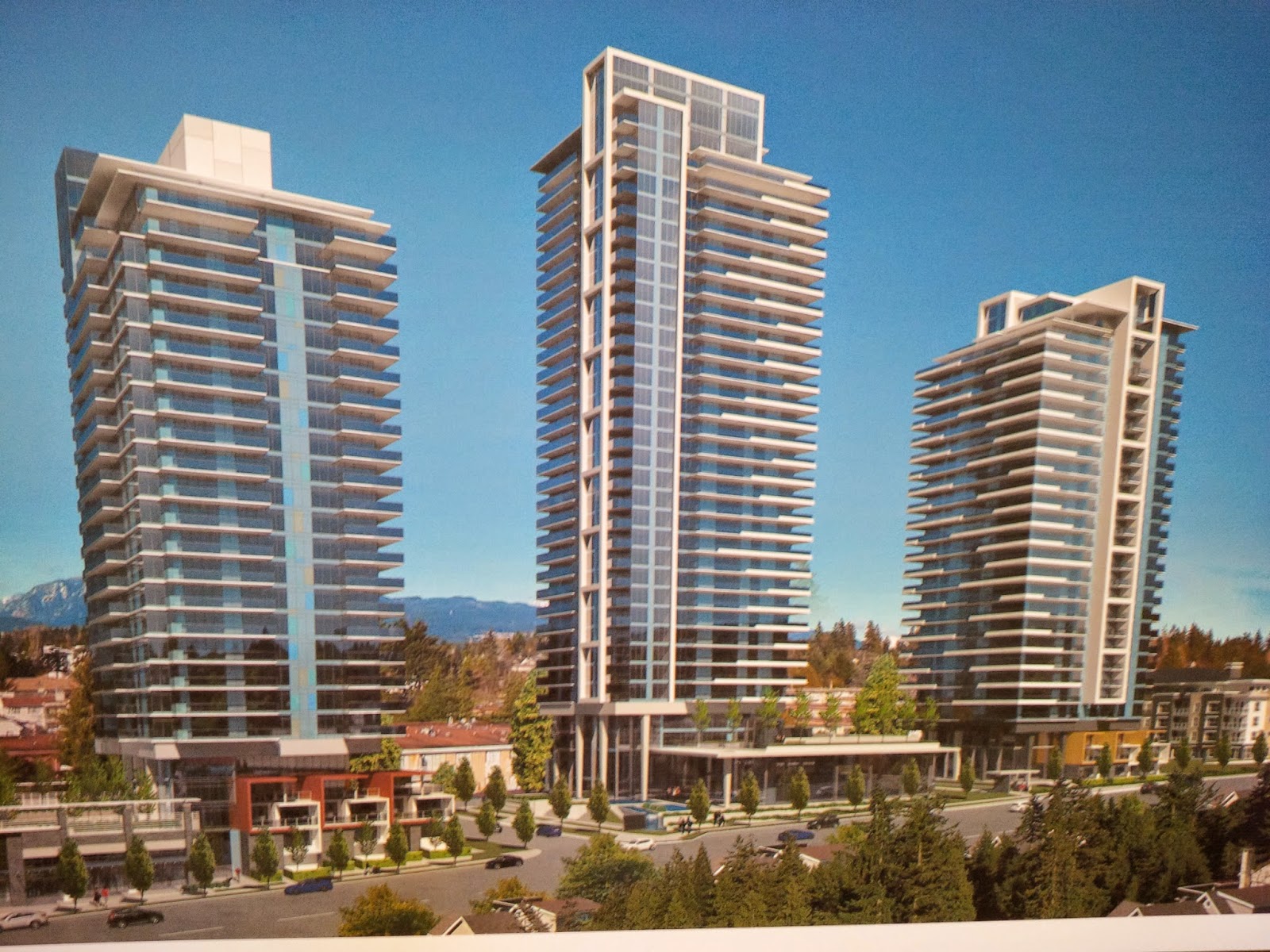
BlueSky's proposed development on Foster, east of Clarke.
It might help their cause, however, if they picked a more suitable example of demo-viction malfeasance than the one they highlighted in Coquitlam earlier this week.
In fact, the example they showcased, the big BlueSky Properties Inc. development on Foster Ave. in Burquitlam, could and should be held up, not as a dramatic example of corporate greed and provincial government inaction, but as a heartening example of corporate responsibility, successful community engagement, and enlightened municipal policy.
Here's the story.
As part of its housing-affordability campaign, the New Democrats staged a press conference earlier this week against the backdrop of the aging apartments in Coquitlam that will be demolished to make way for the BlueSky development at North Road and Foster Avenue.
Supported by NDP MLA Selina Robinson and one-time NDP candidate and current Coquitlam Councillor Chris Wilson*, NDP leader John Horgan pointed out that the apartments are slated for demolition to make way for condo towers that are coming as part of the densification of Burquitlam now happening in anticipation of the arrival of the Evergreen Line early next year.
With reportedly scant reference to the specific details of the BlueSky redevelopment, Mr. Horgan declared, "People and families are scrambling to find affordable rental housing here in Coquitlam and across the Lower Mainland, and they aren't getting any leadership from Christy Clark. People want to know why the Christy Clark government has not acted to protect renters and increase the number of rental homes in this overheated property market."
Fair enough comment on the provincial level. But, on the municipal level, the suggestion that old rental buildings are demolished with little regard for the future of the tenants is completely off base.
In fact, the BlueSky development is notable for the developer's care and attention to ensure that the renters in the existing 112 units are cared for. The company's commitment to this was so thorough that the development proposal won the support of both the Burquitlam Community Association and the Tri-Cities Homelessness and Housing Task Group.
The 873-unit project will eventually comprise three condo towers boasting 816 for-sale units (many of which will, of course, be put on the rental market) and a purpose-building, five-storey, 57-unit rental building, in which rents will be similar to the rents in the existing complex. (Please click here to read the full Coquitlam staff report on the project.)
Furthermore, with Coquitlam's Transit-Oriented Development Strategy and (then-old but since-updated) Housing Affordablity Strategy guiding them, city officials worked with BlueSky to ensure that several other important steps were taken to assist in the relocation of the existing renters who would not find space in the new rental building or one of the condos. The company:

  • Hired an on-site rental relocation coordinator.
  • Instituted ongoing communication and meetings with tenants, including relocation information.
  • Provided tenants with a six-month eviction notice, rather than the provincially required two months.
  • Promised to waive multiple months' rent, rather than the one-month required by law. Two months' rent would be waved if the tenant relocates within four months of receiving notice; three months' waved if relocation takes place between four and six months after notice is served.
  • Offered any tenant or member of their immediate family the opportunity to purchase a unit within the BlueSky, or any Bosa Properties development, with 12 months' worth of rent going towards the down-payment on their new home.

The press release accompanying Mr. Horgan's news conference said he believes, "fair tenant relocation policies are needed, and the province should lead. Standards for requiring relocation plans for tenants and replacing demolished units need to be in place around the province, not just in some communities."
Fair enough.
But it would have been infinitely more informative (if somewhat less dramatic) for him to have pointed out that the "fair tenant relocation policies" he is calling for already exist in the very community in which he chose to voice his concerns.

(*Unlike Mr. Horgan, Mr. Wilson provided some contextual background to at least one news outlet, as evidenced by this story.)

Tuesday, October 7, 2014

Towards an affordable housing-affordability strategy

A proposed Bosa project that would replace old rental units.
Last night, Council gave unanimous approval to a draft Housing Affordability Strategy, an action that sends the HAS into the public realm for comment and consultation. I seconded the motion because it is important to hear what the community -- taxpayers, homeowners, renters, activist groups, industry, etc. -- has to say about the issue. 

My vote doesn't mean that I support all possible initiatives spelled out in the HAS. On the contrary. I'll explain why.

The Provincial government says each municipality must have an affordable housing strategy, but doesn’t specify what is in that strategy. Local governments are given a variety of tools to address housing affordability challenges through the Local Government Act and Community Charter.  The City of Coquitlam does not have the mandate or capacity to build and operate affordable housing. 

However, the City does have a role in promoting the creation of affordable housing in the community
Approaches can and do vary. There are essentially two models: One exemplifies activism, expense and something I call “up-grabbing”,  the opposite of downloading, in that it willingly takes upon itself responsibilities that are more properly the federal or provincial governments’.

Activism is exemplified by Victoria, for example, which boasts a Civic Housing Fund, a Regional Housing Trust Fund, a Social Housing Permissive Property Tax Exemption, a Secondary Suites Incentive Program, has issued two development permits for the creation of private sector low income rental suites and signed 11 housing agreements that either limit restriction on rentals (in the case of strata projects) or create rental units and rent restrictions for a prescribed period of time. And it has even bought old motels and converted them to housing. But none of this is cheap. An average of $1.34 million a year for three years ending 2010. That’s about $4.1 million.  

Another model is exemplified by the City of Langley. It issued a paper in 2009 discussing a wide range of possible actions, but in the end chose a responsible, and taxpayer-friendly model  to: 1.      Support Density; 2.  Encourage the creation of secondary suites; 3.  Maintain tough regulations on the conversion of rental stock to condominiums.

Keep in mind: property tax is the least-fair, least-equitable way to tax people. It is not based on one’s ability to pay, but on the assessed value of the home you are living in. Yet, an interventionist, up-grabbing approach to housing affordability has the ultimate effect of putting more of a burden on the shoulders of property-tax payers, instead of on the shoulders of the consumption or income taxpayers—the sort of tax collected by the provincial and federal governments.

There are a great deal of good, common-sense, non-burdensome options lists in our proposed new HAS. See page four of the document for the broad outline and 16 to 26 for details.  For example, the proposed Rental Housing Strategy is, as I interpret it, basically a continuation of existing policies which – while placing quite a burden on developers, also seeks to find a balance with a general public concern to protect displaced renters.  What it doesn’t do is compel a re-developer to replace, one-for-one, every purpose-built rental unit that is lost to redevelopment, which is something that at least one Coquitlam councillor/mayoral candidate is calling for. (And, anyway, every economist and expert that I have talked with, says that buildings in which condos are sold end up having upwards of 40% of their units put on the rental market.)

And so, what are the possible burdens to the taxpayer of Coquitlam? Most come down to the Affordable Housing Fund.  Page 19., 3.1.4. 1.  Many on council want to expand the affordable housing fund, skimming off a portion of density bonus, with no cap. I oppose this; it should be capped.

The draft strategy asks the public to  “consider other options”  to add to the fund. What might those be:  Massive infusion into AHF through other sources such as proceeds of sales of city land, is the leading one.

Thankfully, no one is suggesting hiking property taxes!  I oppose this, and I urge voters to ask each and every candidate where they stand, and further, to ask them, why they think it’s fair to the already overburdened residential property taxpayer to deny them the benefits of such potentially redirected monies, when there are so many other options that the city can and should take. Such proceeds can and should be used for general well-being, such as land-sales reserves or maybe even directly for capital costs of new cultural or sport facilities.

We must also watch closely to ensure that working families, who are just barely able to put together enough money to afford a downpayment on a new condo in Burquitlam, for example, aren’t pushed out of the market entirely because the cost of their unit is hiked as a result of a neighbouring project escaping some civic charges because it is promising to provide cheap housing to low-income families. That’s simply not fair.

On the other hand, 1.2.4 on page 21 – “considering exempting rental floor space form maximum density allowances…” seems a less-burdensome, more-equitable alternative.

There are a great many other options and ideas in this report, and I urge the public to get involved in what I hope will be a full and fruitful discussion about this important such.

We need a grounded, responsible Housing Affordability Strategy, one that is rooted, not in a sky’s-the-limit attitude towards redistribution of public money, but in respect for all citizens – be it the young couple looking to put down roots, the working-class family endeavouring to make ends meet, or the newly-retired homeowner on a fixed income.

.


Monday, June 2, 2014

Increasing supply makes housing more affordable

Proposed Miller Avenue quadruplex: Helping on housing affordability.
A week rarely passes without the question of affordable housing being raised somewhere in the Metro Vancouver region. One day, it's a story about the ever-worsening "affordability index." The next, it's news of a court decision involving a City of Vancouver plan to provide incentives for the construction of rental housing. 
The issue is almost always on our minds here in Coquitlam, as we slowly work our way through a process to update our Affordable Housing Strategy. The last public iteration of the plan saw the presentation, in committee, of a draft Housing Affordability paper about a year-and-a-half ago. A good summary of the City's efforts to date can be found by clicking here.
But just because there's no movement on the official housing-affordability-update front doesn't mean that the issue doesn't arise in other forms. At last Monday's council meeting, for example, we were presented with two initiatives that both had the potential to ease the housing-affordability crunch. Both issues received majority support from council, but the sad fact is that both initiatives attracted opposition as well.
Before I describe the specific council issues, I want to share a little bit of background about the political landscape surrounding the "affordable-housing" issue. On one side, we see the interventionists and big spenders who favour strong local government financial action to support market rental housing, not just housing for the hardest cases. On the other side -- my side, in fact -- we have the more market-oriented types who understand that the best way to ease the price crunch for market housing and rents is to increase the supply.
And that brings us to last Monday, when Council was presented with two items which had the potential to increase housing supply, thus lowering the upward pressure on price.
The first dealt with a preliminary report for an application to rezone a residential property at 763 Miller Avenue from RT-1 Two-Family Residential to RT-3 Triplex and Quadruplex Residential. Council was being asked to give the bylaw First Reading and to forward the issue to a Public Hearing.
The proposed development would see the construction of four compact homes on one large residential lot, upon which there is currently a single home. The City allows such densification in this area under its Housing Choices policy, which encourages smart densification because it embodies better land use, is more environmentally friendly and, importantly, provides more opportunity for more people to afford to live in this community. (See the illustration, above, for a view of what the four compact homes would look like.)
Under the terms of the bylaw allowing this, each unit has to be accompanied by a minimum of 1.5 parking spaces. Practically speaking, most Council members also look to the surrounding neighbourhood to ensure that on-street parking is available, as well.
Anyway, last Monday, Council voted 6-1 in favour of moving the matter to a Public Hearing. Ironically, however, the lone vote in opposition came from a Councillor who often speaks very passionately and sincerely in favour of the City taking more action on the housing-affordability front. His vote against the Miller Avenue proposal was based on his concern that not enough parking was being provided. Fair enough. But it seems to me that the very important issue of housing affordability should be a major factor in our thinking on this.
Of course, we'll all be keeping our minds open on the issue as we head into the Public Hearing, and we won't make our final decisions until that hearing ends.
The second issue we dealt with last Monday concerned a text amendment bylaw regarding lot-area calculation. This amendment allows developers to build to the full, allowable density on their properties, and not to be penalized in making that calculation by way of the land they lose in building lanes or roads surrounding their property.
It's a complicated issue, but, in some cases, it might come down to a developer being allowed to build a 22-floor condo tower instead of a 20-floor one, for example. During our discussion of the issue at the fourth-and-final-reading stage, I said I supported the amendment because it would have the beneficial effect of increasing housing supply, thus easing upward price pressure. My comments came in response to one of my council colleagues who complained generally about the way the city deals with high-density developments, but whose comments didn't address what I thought was the most compelling issue in support of the text amendment--how it would have the effect of increasing supply, thereby easing upward pressure on prices.
Ultimately, this motion passed by a 6-1 vote as well, so no damage was done.
My final comment on this is to urge everyone on Council, at City Hall and in the community to take a broad view of the housing-affordability issue, so as to recognize that much can be done without using the heavy and expensive hand of government intervention.


Monday, January 28, 2013

Towards housing affordability

Well, we were hard at it again this afternoon, talking yet again about affordable housing in response to this report. I had originally planned to deliver a formal speech in response to the report, but the discussion ended up being directed towards six specific questions, so I put my speech aside and dealt with the questions one by one. Much of the content of my address paralleled the speech I had prepared, however, so I've decided to reproduce it here. I should add that I was quite satisfied with the direction our discussion took this afternoon, as it is clear that council supports a move away from the vision statement I critique below, and also embraces the idea that we should focus our attention on "housing affordability" instead of the creation of subsidized "affordable housing." Progress is most definitely being made.
Graphic created with wordle.net


“The Reformer is always right about what's wrong. However, he's often wrong about what is right.” ― G.K. Chesterton

So here we go again. This is at least the third time we have been asked to have a wide-ranging discussion on affordable housing – albeit, one of those occasions being centred on the more defined issued of rental housing.  We have heard many broad policy philosophies and just as many narrow policy points from staff and from around the council table. Now is the time to refine our discussion even further.
Let’s start by looking at the framework in which we operate. It is important to note that, constitutionally, we are creatures of the Provincial Government, and our particular provincial government has enacted the Local Government Act. In turn, this act says that every community such as ours must have an Official Community Plan, and moreover, that every Official Community Plan must include local government policies for affordable housing, rental housing and special needs housing. [Interestingly, Table 1, on Page nine, the “municipal scan” shows that several municipalities, including our immediate neighbor to the east, do not have Affordable Housing Strategies.] The LGA does not, however, say what those policies must be.
A previous council here in Coquitlam adopted an Affordable Housing Strategy in 2007, and it is that document we are now revisiting. There is much good in that strategy and I congratulate those who came before me – some of whom are still here on council today – for their fine work.
However. …..I believe that the 2007 policy has a fundamental flaw at its very heart – and that is its vision statement, which envisions a community in which, QUOTE, “All residents of Coquitlam will be able to live in safe, appropriate housing that is affordable for their income level.”  The discussion paper before us today asks whether this is still an appropriate vision to have. My answer, in a word: NO.
It is completely unrealistic, wholly untenable, absolutely unreachable – as long, that is, as we living in a free society in which our residents are taxed at a reasonable rate, and in which our desire to serve the less fortunate in our community is balanced with our ability to pay,…. and with our desire NOT to bring havoc to natural market forces that give birth to our economic prosperity and quality of life.
This vision statement is actually dangerous. Dangerous, not only because it would make micro-managing activists of city planners and cash cows out of taxpayers, but also because, in its breathtakingly broad imprecision, it blinds us to more practical, more targeted and, ultimately more attainable goals.
It is clear to me that, as it now stands, the vision statement would have the City enact a strategy that would see the city waste time and energy trying to reach a Utopian goal. Let’s back up for a minute and put this into context: Land prices are very high in Metro Vancouver. Our land supply is limited because of two natural and two man-made barriers, the natural being the ocean to the west and the mountains to the north, the man-made being the US border to the south and the agricultural land reserve, primarily to the east.
The problems associated with our limited land supply are exacerbated by our temperate climate and pleasing geography. Simply put, people want to live here, it’s getting crowded, and land values are skyrocketing because of it.  In a healthy economy, as ours is, this is entirely natural and unavoidable.
Where such circumstances lead to decreasing affordability, I suggest that there are limited actions that a municipal level government can and should embark upon, and one of them certainly isn’t to strive to ensure that, essentially, anyone at any income level who finds themselves in Coquitlam should be able to live in “appropriate housing” – whatever that means.
Moving forward with such a Utopian policy would have many adverse effects: it would surely put upward pressure on property taxes; it would surely divert resources from areas which are a city’s proper field of endeavor; and it would distort the social fabric of our community.
Why the latter? Because, it seems to me that it is inevitable that the burden of paying for an aggressive housing-affordability scheme would be shouldered by average-income property owners. But we know that the property-tax burden is already straining our typical homeowner’s resources. Adding to that burden will only make living in Coquitlam that much more unaffordable for them.  Ultimately, it will drive evermore middle-income families out of Coquitlam.
A further distortion occurs regarding land use. Every parcel of land that we give away or subsidize to allow “all residents to live in appropriate housing” will be taken out of the free market. Those parcels of land that are left in the market will, of course, be that much rarer, and, as a result, their price will rise.
Another way of looking at this is to recognize that if the market is deprived of downward pressure (which would normally be provided by lower-income people, but would have now left the market because their needs would have been met by subsidized housing), then prices on open-market lands will be higher, thus making them even more unaffordable for middle-income earners.
I am also concerned about the diversion of resources away from projects and programs that are more properly in the civic purview. I’m speaking here of such fundamental things as police services, fire protection, parks, recreational and cultural facilities, and maintenance of transportation networks.
Look at our annual Ipsos Reid poll. These are the areas the people of Coquitlam want us to focus our energies on. We should do what we were elected to do, not carry out the schemes of social alchemists.
So what do I see a commonsense Affordable Housing Strategy entailing? The primary answer is already alive and well in Coquitlam, and that is the city’s densification and housing-choices policies. Our recent decision to reduce parking-stall requirements for two-bedroom apartments in rapid-transit zones will also help.  We can do more. We must redouble our efforts to reduce red tape in all areas of civic endeavor.  Time is money, and, for example, the more efficiently homebuilders can do the job in Coquitlam, the more affordable housing will be. Finding ways to fast-track a non-profit agency’s plan for an affordable rental project is a great example of the work we should be doing.
Let’s also take a fresh look at how we can encourage the construction of secondary suites in our community.   We’re already doing a pretty good job of it, but tapping more deeply into this resource could prove to be a bonanza. I support the report’s suggestion to explore “lock off suites”.
At the same time, we can and should continue to help the most vulnerable and needy in our society. Our donation of the property at 3030 Gordon, for a homeless shelter and transition home, is the best example of a well-targetted, well-intentioned, well-delivered action. So too the Como Lake single-mothers’ building being run by the Y.
And this leads to a related point. The city is growing an affordable-housing fund which has now reached $1 million. Yet, this fund remained untouched while the city participated in the two projects I just mentioned. I don’t understand why. Could not the fund have been used to reimburse the city – that is, the taxpayer – for the land it donated to the two aforementioned projects?
It’s also important to note that the discussion paper before us today suggests that even if the fund were to reach $25 million or so, it would be able to make only a very small dent in the affordability issue. Perhaps, then, the best course is to collapse the fund, move the monies into general revenue for the benefit of all citizens, and concentrate our direct efforts elsewhere. I think the time has come to see how this money can be put to better use – in the service of all Coquitlam residents and for the common good.