"Reason is always a kind of brute force; those who appeal to the head rather than the heart, however pallid and polite, are necessarily men of violence. We speak of 'touching' a man's heart, but we can do nothing to his head but hit it." --G.K. Chesterton
Showing posts with label RCMP. Show all posts

Monday, November 24, 2014

They may be 'auxiliary,' but their work is essential

We're now getting some more clarity on the impact of last's month's edict from RCMP headquarters in Ottawa, informing us unilaterally (with no consultation)  that our 49 auxiliary officers would have to be under the "direct supervision" of a regular, armed member whenever the auxiliaries were performing their duties. And what we are being told is that the situation may not be quite as problematic as we had feared, and that all policy matters surrounding the use of auxiliaries are under review.

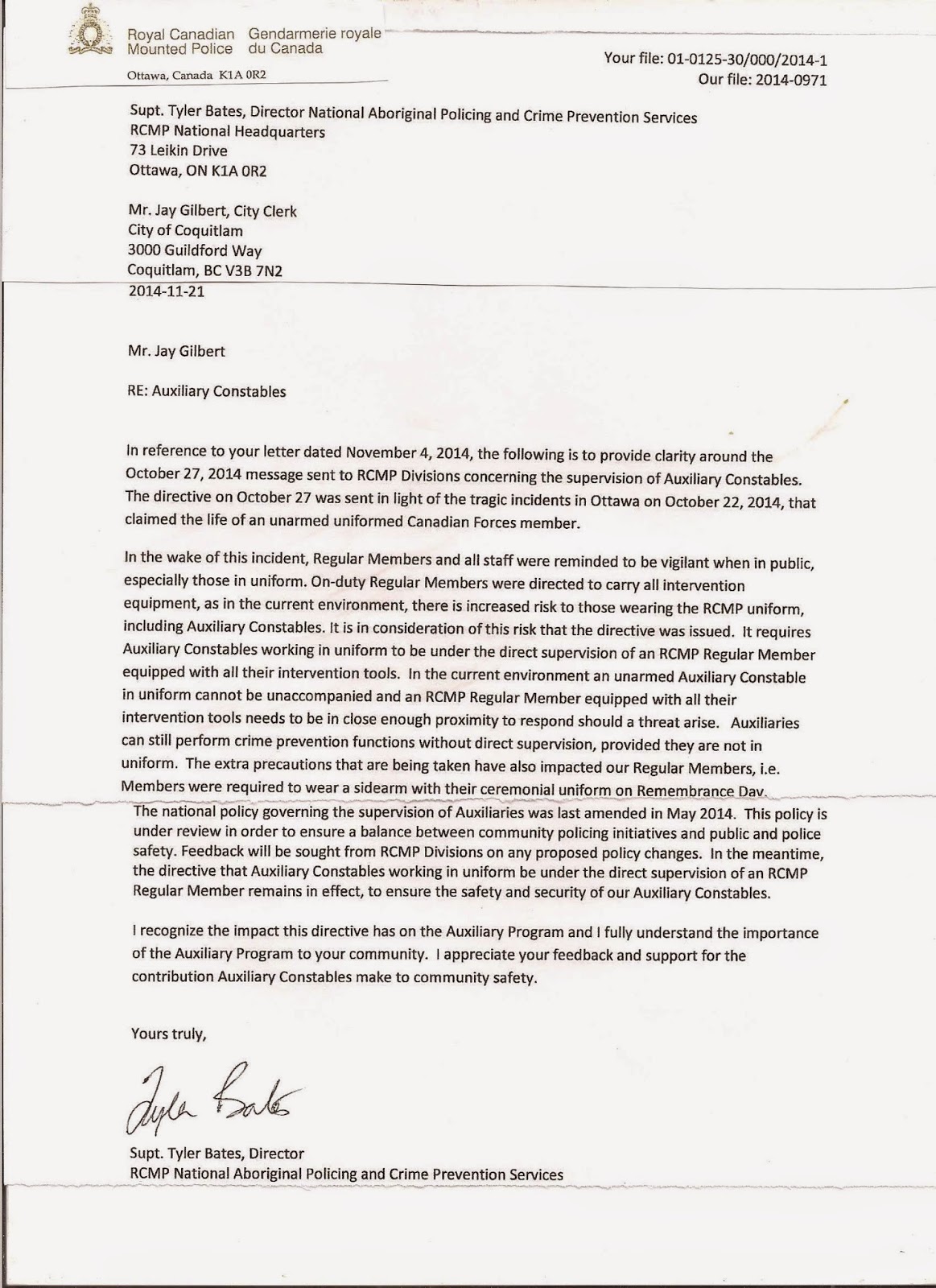
New letter from Supt. Bates.
 Here's a link to my previous posting about the issue; the link also includes other links to news stories about the edict, which Coquitlam Council made into a very public issue when it voted unanimously on Nov. 3 in support of my motion to ask Ottawa to overturn the edict.

At the time, we were concerned that the entire Auxiliary Constables program might be in jeopardy because the City simply couldn't afford to have a regular member shadow an auxiliary member who, for example, might be making a public-safety-related presentation to an elementary school. Similarly, the City couldn't afford to have regular members replace all the work currently done by auxiliaries.

In a letter dated Nov. 21 (see scanned copy of letter accompanying this story. I literally had to cut and paste the letter to have it fit on one page.), Supt. Tyler Bates, director of RCMP National Aboriginal Policing and Crime Prevention Services, explains that the edict was issued in response to the shootings on Parliament Hill. He explained: "...in the current environment, there is increased risk to those wearing the RCMP uniform, including Auxiliary Constables." And since auxiliaries are unarmed, it wouldn't be prudent to allow them to be unaccompanied by armed Regular Members.

That said, Supt. Bates added, "Auxiliaries can still perform crime prevention functions without direct supervision, provided they are not in uniform." He also added that the national policy governing the supervision of auxiliaries "is under review in order to ensure a balance between community policing initiatives and public and police safety."

He continued: "Feedback will be sought from RCMP Divisions on any proposed policy changes. In the meantime, the directive that Auxiliary Constables working in uniform be under the direct supervision of an RCMP Regular Member remains in effect, to ensure the safety and security of our Auxiliary Constables."

Bottom line: It's good to learn that unaccompanied auxiliaries will still be able to address students and youth groups, for example. But I'm also hoping that their educational presentations won't be rendered less-effective because they're being delivered by a non-uniformed auxiliary instead of one in the Mounties' garb.

I'm also saddened to learn that the the auxiliaries' effective crime-prevention patrols--which certainly are made more impactful by the fact the auxilaries are in uniform--cannot continue in their pre-edict form. And that's a real shame.



Monday, November 3, 2014

Edict from RCMP brass strips auxiliary officers of independence/power, hurts Coquitlam

Council unanimously supported my motion.
UPDATES: Here are some links to media stories about this issue, including explanations from the RCMP and admissions that, as I charged, they failed to consult with us before issuing the edict. Here's CKNW's story. Here's 24hrs'. Here's CKWX's. Here the story in the Tri-City News. And here's the Tri-Cities Now's story. And, finally, the Vancouver Sun's.

Late last month, an RCMP director in Ottawa quietly issued an edict that will have a dramatic and detrimental effect on the delivery of community-safety and –education programs in Coquitlam.
I am not happy about this. And neither are my colleagues on Coquitlam Council, who voted unanimously in favour of my motion tonight (seconded by Brent Asmundson) to express our disappointment with the change.
The heretofore unpublicized edict originated from the office of the Director of the National Crime Prevention/Aboriginal Policing Services, which ordered on Oct. 24 that all Auxiliary RCMP Constables must now be under the “direct” supervision of a Regular Member when performing their duties. Until now, it has been merely “general” supervision.
Until the change, the City had been able to use auxiliaries to, for example, patrol Canada Day festivities on their own, while generally supervised by one Regular Member at a central location. Under the new edict, however, the auxiliaries won’t be able to do this, and will have to be accompanied almost lockstep by a Regular Member.
This would not make sense, of course. The bottom line is that the new edict will either cost the City (and taxpayers, of course) considerably more money – for all-Regular Member patrols—or lead to a reduction in service. We are not amused.
Rubbing salt into the wound is the fact there was absolutely no consultation from Ottawa about this—an astonishingly tone-deaf approach considering the commitment the RCMP made during the last round of contract talks to better communicate with contracting municipalities.
The change in the role of auxiliaries may be no big deal in Ontario, which has a provincial force (the OPP) and city forces dealing with most of their population. But it’s a big deal in B.C., and an especially big deal in Coquitlam, where we have almost 50 auxiliaries performing a wide range of duties, from crime-prevention to community-education. (See the notice of motion, below, for more detail.)
We have every right to be proud of the tremendous work our auxiliaries have done for Coquitlam, and we are certain that they are having a profoundly beneficial effect on the community.
To have Ottawa imperil all that with a stroke of the pen is simply not acceptable.

Notice of Motion regarding Auxiliary Constables
Whereas the Director of the National Crime Prevention/Aboriginal Policing Services (Ottawa) has, of as of the 24th of October 2014, changed the policy with respect to the deployment and engagement of Auxiliary Constables within Detachments across Canada, and
Whereas the policy change identifies a move from 'General Supervision' to 'Direct Supervision' with regard to the deployment of Auxiliary Constables, with 'General Supervision' meaning the Auxiliary Constable(s) may perform specific duties without being under the direct supervision of a Regular Member, and 'Direct Supervision' meaning the Auxiliary constable must be accompanied and supervised by a Regular Member, and
Whereas the Coquitlam Detachment’s Auxiliary Constable Program is responsible for: Crime Reduction Patrols; School Presentations at elementary schools; visits to programs with City Parks and Rec Departments; presentations to Community Youth groups (Girl Guides and Boy Scouts); and providing police presence at Community Events, and
Whereas the announced changes of Oct. 24 appear to have a detrimental effect on the ability of Coquitlam Detachment’s Auxiliary Constables to perform the above-stated duties,
Therefore be it resolved that Coquitlam Council send a letter to the Director of the National Crime Prevention/Aboriginal Policing Services (Ottawa), outlining the impact the policy change has on the safety and well-being of the city of Coquitlam and asking that the policy change be reconsidered.
                                                                                                                                                                                
Moved by Councillor Terry O’Neill           Seconded by Councillor Brent Asmundson
Nov. 3, 2014


Wednesday, October 1, 2014

Crime and the Evergreen Line: No new Transit Police

Evergreen Line construction. (Photo by Terry O'Neill)
Today's Vancouver Sun and Tri-City News each have stories about an interesting report, prepared for the Transit police, about the possible impact of new Evergreen Line SkyTrain stations on crime rates around the station. In short, the study predicts no increase in crime rates.
That's fine as far as it goes, and I have no reason to doubt the veracity of the report. However, neither the stories nor the report itself tell the whole story.
First point: Even though the Evergreen Line will add six new stations to Metro's rapid-transit system, and even though an additional 70,000 riders will use the system once the line opens in the summer of 2016, the Transit Police force will not add a single new officer to its force in response to the opening of the new line.
Chief Officer Neil Dubord confirmed this fact with me in a telephone conversation I had with him earlier today. Instead, the force will realign its services to establish what Dubord calls "hubs of safety," at "high-visibility points" at which Transit Police, Transit security personnel, and SkyTrain attendants can cluster, and from which they can quickly respond to reports of problems.
For the Evergreen Line, the "hub of safety" will be at the Lougheed Station. "It's almost like a hub and spoke [system]," Dubord told me.
Fair enough, and I'm sure these hubs will be staffed with high-quality professionals. But I hope this doesn't mean that Coquitlam RCMP will be forced to respond to incidents that have heretofore been handled on existing lines by Transit Police. If Coquitlam Mounties are, indeed, called into action in such circumstances, it will undoubtedly increase the City of Coquitlam's costs and will thereby represent a downloading of costs onto municipal taxpayers.
Second point: Note that the report talks about crime rates, with an emphasis on rates. Given that populations are already increasing rapidly around planned Evergreen Line stations, and that the populations will continue to increase once those stations are open for business, we will undoubtedly see an increase in the real number of actual crimes committed in and around those stations if the rate stays the same--which it is predicted to do.
Moreover, experience with other rapid-transit systems suggest there will be a high number of quasi-criminal or near-criminal disturbances in and around Evergreen Line stations.
Bottom line: the number of real crimes will increase because of population growth around Evergreen Line stations, 70,000 new riders a day will use the Evergreen Line, but authorities are adding no new Transit Police officers to the system.