Monday, February 16, 2015
Today is Coquitlam Foundation's grant-application deadline day
Just a quick reminder: today is the last day you (students, community groups, non-profits and the like) can apply to the Coquitlam Foundation for grants, scholarships and bursaries. Deadline is 4 p.m. Please visit the foundation's website for all the information on how to apply. Www.coquitlamfoundation.com


Thursday, January 29, 2015
About those schools on Burke Mountain
NOTE: The information, below, is out of date. I've now written an updating piece on the current status of schools on Burke Mountain please CLICK HERE to read it -- Nov. 9, 2016.
Last Monday's public hearing, on the proposal to rezone land on Burke Mountain to facilitate the development of the first full neighbhourhood in the Partington Creek area, as well as to zone land for a school there, elicited much interest from the public, specifically on the issue of why no new schools had been built on Burke Mountain, even though the city had designated so many sites for schools.
Both the News and the Now devoted quite a lot of coverage to the subject, as you will see if you click on the links. But there's still some information I'd like to get on the record to allow the public to better understand the situation.
Many members of council, including myself, spent a fair bit of time during that public hearing explaining that it is not the city's job to build the schools; that responsibility rests with the Ministry of Education and School District 43. Nevertheless, we acknowledged that the City does have a role: we designate land in our Official Community Plan and our Neighbhourhood plans as (possible or potential) school sites, and we rezone land to allow school construction once the SD is prepared to move ahead.
 But we recognized that the OCP and the NPs can create uncertainty, in that some people interpret them as meaning schools WILL be built in the designated areas, when, in fact, the identified sites are only potential sites.
Also, it appears the SD communication on the issue, as to the number and timing of schools on Burke Mountain, has not been noticed by many members of the public.
So, for the record, here's what's happening:
1. Our OCP shows eight potential school sites on Burke Mountain, as per the map above. However, the school board announced in December 2012 that it would be needing only five -- not eight -- schools on Burke Mountain. I have circled the three sites that are "not preferred" by the School District.
2. Of the five preferred sites, the E site in the Smiling Creek area is now in the process of being acquired. In fact, the City and the SD announced last fall that the land acquisition was proceeding for a joint school-park site.This is the Smiling Creek Elementary School. Here a link to a story about that site.
 3. The S site in the Lower Hyde Creek is where a new high school will, in fact, be built. That's firm.
4. The E site in the upper Partington Creek area is the site that was the subject of Monday's public hearing and eventual rezoning vote (unanimously in favour).
5. The School District has also released a projected time line for the construction of the five schools. See the nearby chart. The black bars indicate planning-to-construction-to-opening. Please note that the Smiling Creek project is already a year behind this schedule and likely won't be completed now until sometime in 2017 according to the board.
Stay tuned for more information from the School District in the coming weeks and months. Burke Mountain residents are rightly frustrated by the slow pace of school construction, and it's high time that the process for approval and construction was speeded up. It simply isn't right that, as we heard on Monday, every child on one street is attending a different school -- a half dozen or more schools in total. That's no way to build a neighbourhood!
Last Monday's public hearing, on the proposal to rezone land on Burke Mountain to facilitate the development of the first full neighbhourhood in the Partington Creek area, as well as to zone land for a school there, elicited much interest from the public, specifically on the issue of why no new schools had been built on Burke Mountain, even though the city had designated so many sites for schools.
Both the News and the Now devoted quite a lot of coverage to the subject, as you will see if you click on the links. But there's still some information I'd like to get on the record to allow the public to better understand the situation.
Many members of council, including myself, spent a fair bit of time during that public hearing explaining that it is not the city's job to build the schools; that responsibility rests with the Ministry of Education and School District 43. Nevertheless, we acknowledged that the City does have a role: we designate land in our Official Community Plan and our Neighbhourhood plans as (possible or potential) school sites, and we rezone land to allow school construction once the SD is prepared to move ahead.
But we recognized that the OCP and the NPs can create uncertainty, in that some people interpret them as meaning schools WILL be built in the designated areas, when, in fact, the identified sites are only potential sites.Also, it appears the SD communication on the issue, as to the number and timing of schools on Burke Mountain, has not been noticed by many members of the public.
So, for the record, here's what's happening:
1. Our OCP shows eight potential school sites on Burke Mountain, as per the map above. However, the school board announced in December 2012 that it would be needing only five -- not eight -- schools on Burke Mountain. I have circled the three sites that are "not preferred" by the School District.
2. Of the five preferred sites, the E site in the Smiling Creek area is now in the process of being acquired. In fact, the City and the SD announced last fall that the land acquisition was proceeding for a joint school-park site.This is the Smiling Creek Elementary School. Here a link to a story about that site.
3. The S site in the Lower Hyde Creek is where a new high school will, in fact, be built. That's firm.4. The E site in the upper Partington Creek area is the site that was the subject of Monday's public hearing and eventual rezoning vote (unanimously in favour).
5. The School District has also released a projected time line for the construction of the five schools. See the nearby chart. The black bars indicate planning-to-construction-to-opening. Please note that the Smiling Creek project is already a year behind this schedule and likely won't be completed now until sometime in 2017 according to the board.
Stay tuned for more information from the School District in the coming weeks and months. Burke Mountain residents are rightly frustrated by the slow pace of school construction, and it's high time that the process for approval and construction was speeded up. It simply isn't right that, as we heard on Monday, every child on one street is attending a different school -- a half dozen or more schools in total. That's no way to build a neighbourhood!
Thursday, December 18, 2014
We're Number Three in BC!
We were all excited to learn earlier today that BC Business magazine had named Coquitlam as #3 in its new list of "Best Cities for Work in B.C." Here is the magazine's press release:
BCBUSINESS UNVEILS FIRST-EVER “BEST CITIES FOR WORK IN B.C.”
 |
| Coquitlam's Lafarge Lake.(Photo by me) |
Burnaby B.C. –
BCBusiness editor-in-chief Matt O’Grady is excited to announce that Coquitlam has ranked #3 in BCBusiness’s inaugural list of the “Best Cities for Work in
B.C.”
The exclusive list was developed in concert with Environics Analytics, weighing seven
economic indicators to reflect the health of a city’s job market: income growth, average
household income, population growth, unemployment, labour participation and the
percentage of people with degrees and taking transit.
“Developing the first-ever list of this kind in B.C. has been an extraordinary project,“
says O’Grady. “We expect the results to attract a lot of attention and provoke a lot of
discussion across the province.” The driving force behind the Best Cities project,
BCBusiness associate editor Trevor Melanson, adds: “This ranking will undoubtedly be
considered controversial by some, but there’s appeasement in the fact that, no matter
how we sliced the data, the ranking came up mostly the same. High income and
population growth, low unemployment—all the indicators we measured tended to go
hand-in-hand.”
The top 10 cities in BCBusiness’s 2014 list of Best Cities for Work in B.C. are:
1. Fort St. John
2. North Vancouver
3. Coquitlam
4. Burnaby
5. Dawson Creek
6. New Westminster
7. Langley
8. Richmond
9. Surrey
10. Vancouver
A complete list of the top 36 cities as well as details on the methodology and supporting
stories on the impact of LNG, what cities are booming and declining, and why Metro
Vancouver will always dominate the list’s Top 10 can be found in the January 2015
issue of BCBusiness – available online at BCBusiness.ca/BestCities and in the iTunes
store now and on newsstands as of December 31st.
About BCBusiness
Published for more than 40 years, BCBusiness is British Columbia’s foremost business
authority and the most widely read business publication in the province. Focusing
exclusively on business in British Columbia, BCBusiness provides unparalleled behindthe-
scenes coverage, chronicling major deals and putting faces to the major players.
BCBusiness is published by Canada Wide Media Limited, the largest independent
publisher in Western Canada.
Contact Information:
Media Inquiries:
Holly Pateman
T: 604-637-3472
E: hpateman@canadawide.com
Friday, December 5, 2014
Let freedom reign in campaigns!
Here is the full text of my submission to the B.C. Government's Special Committee on Local Election Expense Limits. The deadline for public submission is today.
Opening Comments
 |
| Graphic from news1130.com |
The committee may recall that in January, 2014, I submitted
a brief on the question of campaign-expense limits. With the new call for submissions on the
subject, the deadline for which is December 5, 2014, I feel compelled to
restate my opinion on the subject, which I will do today.
As well, I will add
to it in response to the increasing calls to ban corporate and union
donations. In short, I oppose expense
limits and I oppose banning corporate and union donations.
First, though, let me state that, If there are to be new
campaign-expense rules, I believe that the
Province should set expense limits and that Elections BC should enforce
the limits. This body is already involved in election monitoring; enforcing campaign-expenditure rules would be
a natural extension of its current work.
Furthermore, if expense limits are enacted, they should apply
in school-board elections. It’s only
fair to have them applied to the election of trustees as well as mayors and
councillors.
As well, population size should be taken into account in
setting expense limits. Moreover, if
there are to be limits, they must take into account not only the population of
the jurisdiction, but also the physical size.
A candidate running for office in a town of 10,000 that is
concentrated into one square kilometre would likely have an easier time
reaching voters during a campaign than a candidate in a community of 10,000
that is spread over a 100-square-kilometre area. The former might be able to
easily hand-deliver flyers, for example, while the latter might have to employ
a more expensive delivery method, such as Canada Post.
Finally, if there are to be expense limits, they should
apply not only to candidates, but also elector organizations and third-party
advertisers. If there is to be a new
regulatory system, then it seems fair to have it applied to all aforementioned
groups.
A question of free
speech
Irrespective of the above, I actually oppose the concept of
campaign-expense limits. I believe such
restrictions would infringe on fundamental freedoms as found in the Canadian
Charter of Rights and Freedoms, Section 2. I quote:
“Everyone has the following fundamental freedoms:
- freedom
of conscience and religion;
- freedom
of thought, belief, opinion and expression, including freedom of the press
and other media of communication;
- freedom
of peaceful assembly; and
- freedom
of association.”
Specifically, I believe that any restriction on campaign
spending would be a direct attack on Section 2.2, “freedom of thought, belief,
opinion and expression, including freedom of the press and other media communication.”
Allow me to explain:
Since the major part of one’s campaign involves communicating with the
electorate, and since such communication involves the transmission of thoughts,
beliefs, opinions and expressions through the press and other forms of communication
such as flyers and posters, a restriction on campaign spending would have the
effect of restricting the “fundamental right” of an individual to engage in
that communication.
I understand that “reasonable restrictions” to Charter
rights have been enacted, but I do not believe that something (an election
campaign) that involves two such fundamental aspects of our democracy – free
elections and free speech – should face the sort of restrictions being
considered in the current exercise.
If a citizen decides to spend her life savings on an
advertising campaign to support a civic cause or oppose a candidate, then let
it be. If a candidate feels that being elected is so vital that he must take
out a second mortgage to pay for a massive advertising campaign, then so be it.
What’s important in both cases is that these people have the full and
unfettered right to participate in democracy.
Practical objection to spending limits
Here, my objection to campaign-spending limits comprises
related issues: unfair obstacles that such limits put in the way of new
candidates; unfair obstacles that such limits put in the way of lone or
unaffiliated candidates.
First, the new candidate. It’s a given that name recognition plays a
large role in all politics, but it is an especially significant factor at the
municipal level. For the new candidate, the biggest challenge is not only
getting his or her platform in front of voters; it’s also—and, arguably, more
importantly—getting his or her name known. Either way, one sure-fire way
of presenting oneself to voters is to spend money on advertising, signage and
other promotional devices. It’s less important for incumbents to “put their
name out there” because they are already relatively well-known.
But campaign-spending limits would fetter a new candidate’s
ability to spend freely to have his or her name become as well-known as an
incumbent’s. Therefore, I submit that campaign-spending limits would have the
unintended consequence of diminishing the opportunity for electoral success for
newcomers, while favouring incumbents.
Second, the lone or
non-affiliated candidate. Consider the situation facing the lone,
non-affiliated candidate who is running against a candidate or candidates from
a well-organized campaign slate, party or endorsement mechanism. In all likelihood, that lone candidate does
not have an “election machine” supporting his or her candidacy—no supporter
lists to work from, and no election-day teams to “get out the vote,” for
example.
What such a lone candidate would have the ability to do,
however, is to match or even exceed the campaign spending of his or her rivals.
But if that spending were limited by force of law, that lone candidate would
face an unfair restriction on one of the only ways by which he or she might be
able to achieve a level playing field.
We need to look deeper into the mechanics of a
well-organized party, slate or endorsement body to truly appreciate the
advantage they would be given over independent candidates should
campaign-spending limits be put in place. Such bodies can attract many
volunteers and often have extensive lists of possible supporters for those
volunteers to call by phone, contact by email, or send letters to. With voter
turnout for municipal elections being relatively low, these well-organized
campaigns give their candidates a very tangible edge over any independent
candidate.
This situation is both legal and fair under the current
system because non-affiliated candidates always have the option to counter the
“election machine” they are facing by spending more money on advertisements,
automatic phone calls, and the like.
That leveler disappears in a universe of campaign-spending
limits, however. Such limits would not likely place any limit on the number of
volunteers working for parties, slates or endorsement bodies, nor would they
place any limit on the amount of hours those volunteers could work. But they
would limit the opportunities for non-affiliated candidates to level the field
by spending extra funds to buy advertising and otherwise promote their
candidacy.
In conclusion, I would argue that a campaign-expense limit
would have the unintended consequence of handicapping both new and lone,
independent or non-affiliated candidates, while inadvertently giving incumbents
and slate- or party-backed candidates an advantage.
Therefore, practically speaking, campaign-expense
limitations would be unfair.
Donation sources
I understand that many individuals and organizations are
calling for a ban on all corporate and union donations. I do not support this call
for reasons that echo some of my positions, above. I believe that the banning
of such donations would have the effect of hamstringing lone, independent or
new candidates. This is because those organizations or incumbents that have
extensive lists of committed supporters and volunteers would have a big head
start when seeking donations, as they would be able to immediately tap into an
already-existing database of likely individual donors.
On the other hand, the new candidate or the lone,
independent one would have no such existing database and would be severely
handicapped in his or her fundraising efforts.
I believe that there would be less concern over corporate
and union donations if voters were given full and timely information about the
source of all campaign donations. On this subject, at present, campaign-donation
documents need not be filed until several months after the campaign has ended.
I believe that the Provincial Government should examine the feasibility of
establishing a real-time, campaign-donation-reporting mechanism to enable
voters to have access to information on the source of a candidate’s funds before they
cast their ballots, not after.
One other idea that might be considered is to place special
limits or reporting requirements on candidates who receive donations from
corporations or unions with which the candidates’ city has a direct and ongoing
contractual/financial relationship. I am thinking here of companies such as
private garbage-collection services, and unions such as those that represent
city workers.
I personally will not accept donations from such organizations
because of the appearance of conflicted loyalties or interests. On the other
hand, I have no difficulty accepting a donation from a corporate citizen that,
like my neighbor, does business from time to time in the city, or even does
business on a continual basis. As long
as there is not a direct and ongoing contractual/financial relationship, this
is acceptable.
In Conclusion
Thank you for the opportunity to present this advice. These
are important issues and deserve careful consideration.
Monday, November 24, 2014
They may be 'auxiliary,' but their work is essential
We're now getting some more clarity on the impact of last's month's edict from RCMP headquarters in Ottawa, informing us unilaterally (with no consultation) that our 49 auxiliary officers would have to be under the "direct supervision" of a regular, armed member whenever the auxiliaries were performing their duties. And what we are being told is that the situation may not be quite as problematic as we had feared, and that all policy matters surrounding the use of auxiliaries are under review.
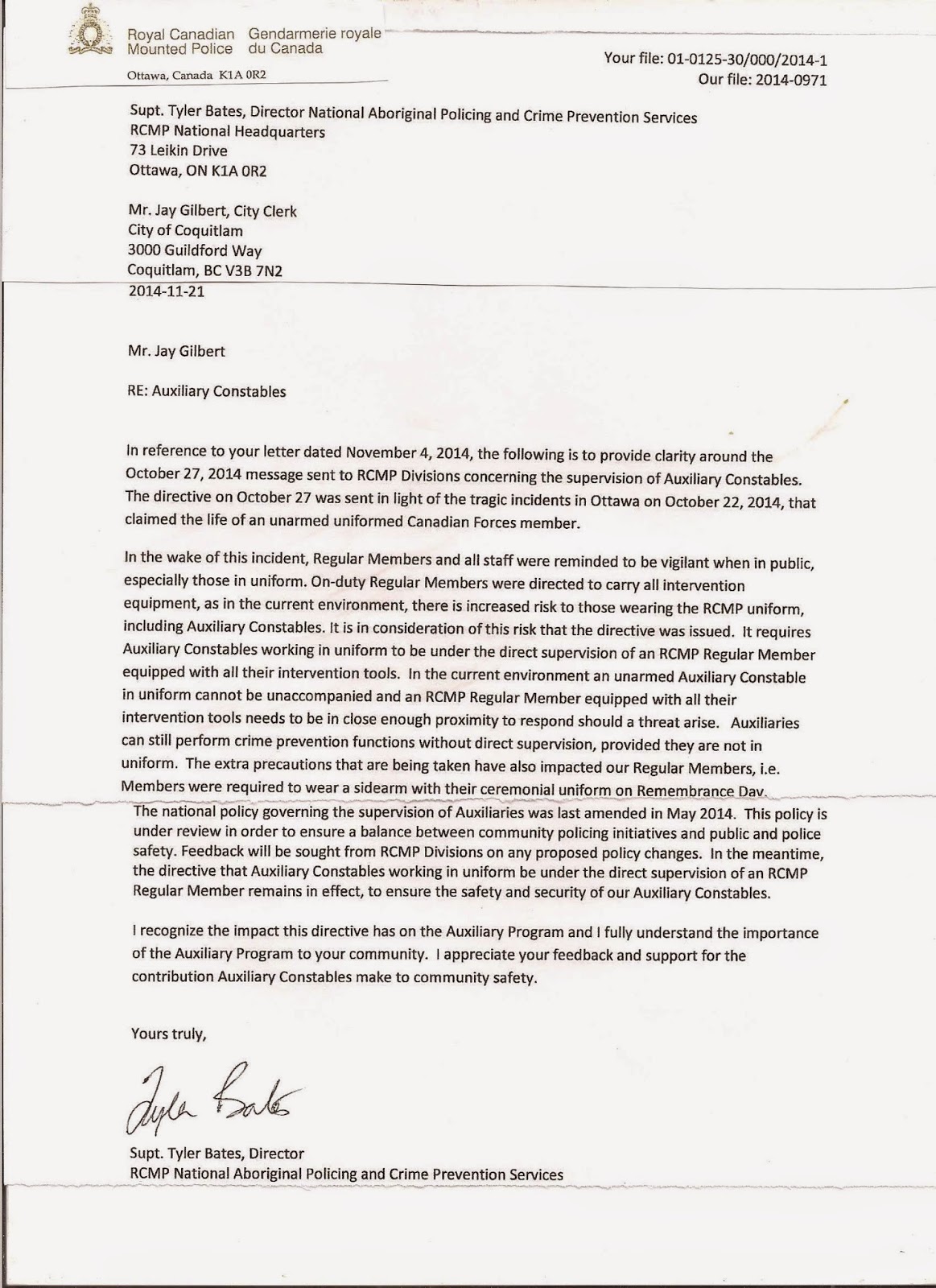 |
| New letter from Supt. Bates. |
Here's a link to my previous posting about the issue; the link also includes other links to news stories about the edict, which Coquitlam Council made into a very public issue when it voted unanimously on Nov. 3 in support of my motion to ask Ottawa to overturn the edict.
At the time, we were concerned that the entire Auxiliary Constables program might be in jeopardy because the City simply couldn't afford to have a regular member shadow an auxiliary member who, for example, might be making a public-safety-related presentation to an elementary school. Similarly, the City couldn't afford to have regular members replace all the work currently done by auxiliaries.
In a letter dated Nov. 21 (see scanned copy of letter accompanying this story. I literally had to cut and paste the letter to have it fit on one page.), Supt. Tyler Bates, director of RCMP National Aboriginal Policing and Crime Prevention Services, explains that the edict was issued in response to the shootings on Parliament Hill. He explained: "...in the current environment, there is increased risk to those wearing the RCMP uniform, including Auxiliary Constables." And since auxiliaries are unarmed, it wouldn't be prudent to allow them to be unaccompanied by armed Regular Members.
That said, Supt. Bates added, "Auxiliaries can still perform crime prevention functions without direct supervision, provided they are not in uniform." He also added that the national policy governing the supervision of auxiliaries "is under review in order to ensure a balance between community policing initiatives and public and police safety."
He continued: "Feedback will be sought from RCMP Divisions on any proposed policy changes. In the meantime, the directive that Auxiliary Constables working in uniform be under the direct supervision of an RCMP Regular Member remains in effect, to ensure the safety and security of our Auxiliary Constables."
Bottom line: It's good to learn that unaccompanied auxiliaries will still be able to address students and youth groups, for example. But I'm also hoping that their educational presentations won't be rendered less-effective because they're being delivered by a non-uniformed auxiliary instead of one in the Mounties' garb.
I'm also saddened to learn that the the auxiliaries' effective crime-prevention patrols--which certainly are made more impactful by the fact the auxilaries are in uniform--cannot continue in their pre-edict form. And that's a real shame.
Saturday, November 15, 2014
Thanks! Thanks! And Thanks!
The results are in, and 11,712 citizens voted for us! Wow. We're re-elected. We're in a strong second place of eight elected councillors. And we're back for four years.
All we can say is Thank You! Thanks to the voters of Coquitlam, thanks to my volunteers and supporters, and thanks to Coquitlam!
All we can say is Thank You! Thanks to the voters of Coquitlam, thanks to my volunteers and supporters, and thanks to Coquitlam!
Friday, November 14, 2014
Just 12 more hours of Internet campaigning left!
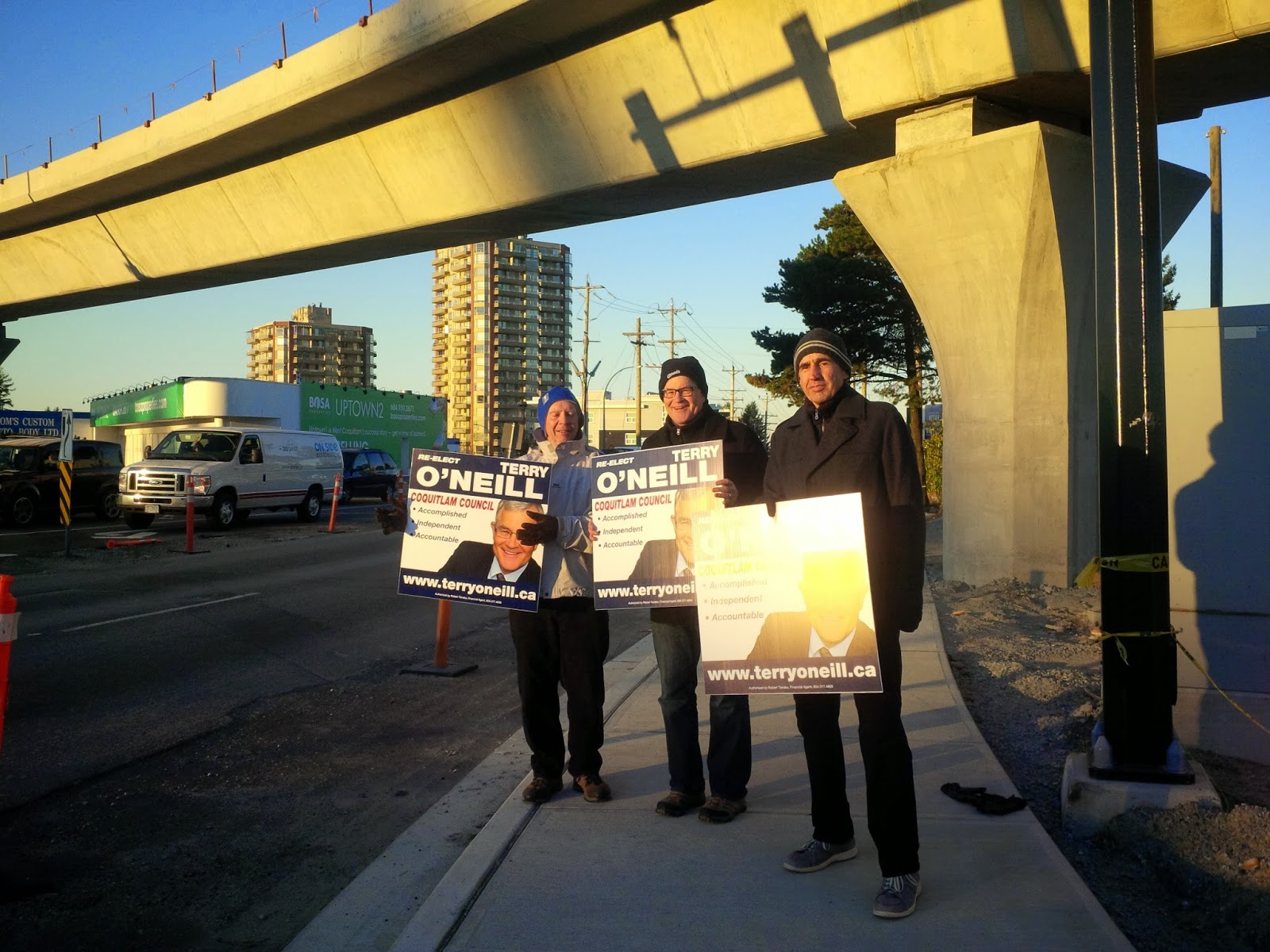 |
| This sort of 'sign-and-wave' event will be allowed tomorrow. |
On General Voting Day, candidates and elector organizations cannot:
· sponsor newspaper, television or radio advertising
· sponsor new election advertising
· change their existing advertising on the Internet, including tweets and Facebook messages
· use social media including transmitting messages about getting out to vote
· use automated dialers (e.g., robo-calls)
Candidate and elector organizations are allowed to solicit votes on General Voting Day in the following ways:
· live person-to-person telephone calls
· door-to-door canvassing
· handing out brochures
· placing election signs or posters
· “mainstreeting” and “sign-and-wave”
However, these activities must not take place within 100 metres of a voting place.
Thursday, November 13, 2014
New trail would extend Coquitlam Crunch northward
 |
| Crunch could be extended to Eagle Mountain Park. (Photo by me) |
The story quotes James Lota of Fortis as saying, "Your staff have provided plans for the trail and the proposed configuration of what you want us to build. We have put a lot of thought into it and we are moving forward on the basis that we would like to help you out with that.”
Mr. Lota's comments came in response to my questioning of him on this subject, a subject that was first raised some months ago by our City Manager.
Here's the big take-away: This "moving forward" is, to my mind, all but tantamount to an agreement-in-principle that Fortis will, indeed, be building this new trail. And this, I think, is really great news.
Ever since the Crunch was improved with the addition of new landscape-tie stairs along its steepest section, usage on the Crunch has skyrocketed. Now, with the prospect that the trail could be extended even further north -- to Eagle Mountain Park at the top of Westwood Plateau -- it's bound to become even more popular. This is tremendous news for hikers, walkers and lovers of fresh air and exercise.
Better yet: it would come at no cost to the taxpayer. Fortis would likely foot the entire bill for this million-dollar-plus project!
Just thought I'd mention it.
Tuesday, November 11, 2014
A day on the campaign trail
Photographer Michelle Doherty followed me throughout the day on Nov. 10 to record what one of my typical campaign days was like. The brilliant, crisp weather was atypical, however....and thank goodness for that. Here are a few of the photos she took. For the full album, please visit my political Facebook page by clicking here.
 |
| The handshake at the door. Always a good way to finish. |
 |
| A lovely way to start the morning with Mary. |
 |
| Chatting with Mabel Chan about the untimely death of her son Leo. |
 |
| Ready to plant a sign. |
 |
| Sharing a light moment Exec. Asst. Carol Jones |
 |
| With GM of Strategic Initiatives Perry Staniscia |
 |
| Brother-in-law Bill, Mary, me and friend Ron greeted a.m. commuters. |
Thursday, November 6, 2014
The elephant in the room
I'm home now from the Chamber of Commerce's all-candidates' meeting, where my opening speech enjoyed the loudest and most prolonged applause I've received for any of the speeches or answers I've given in any of the all-candidates' meetings.
No surprise that the speech also generated some strong --even emotional -- responses/rebuttals from two members of the Protect slate later in the evening during the wrap-up session. Here are the notes from my opening speech:
Hi, I'm Terry O'Neill, and I’m seeking re-election to council.
This is our fourth all-candidates’ meeting, and there have been plenty of big issues discussed: services, densification and taxes. But there’s one we haven't talked about. There’s an elephant in the room, and it’s this:
The NDP is trying to take over City Hall.
*It’s no coincidence that every member of the Protect slate, aka Coquitlam Citizens Alliance, is also an NDPer.
*It’s no coincidence that our local NDP MLA and MP have endorsed the slate.
*It’s no coincidence that CUPE, which represents the city’s unionized workforce and is closed aligned with the NDP, has endorsed the slate, too.
We all know what damage the NDP did to the provincial economy when it was in power. Let’s not let it happen in Coquitlam too.
As an independent, I’ll work hard to keep Coquitlam safe and financially sound. That’s my promise, and you can count on it!
This is our fourth all-candidates’ meeting, and there have been plenty of big issues discussed: services, densification and taxes. But there’s one we haven't talked about. There’s an elephant in the room, and it’s this:
The NDP is trying to take over City Hall.
*It’s no coincidence that every member of the Protect slate, aka Coquitlam Citizens Alliance, is also an NDPer.
*It’s no coincidence that our local NDP MLA and MP have endorsed the slate.
*It’s no coincidence that CUPE, which represents the city’s unionized workforce and is closed aligned with the NDP, has endorsed the slate, too.
We all know what damage the NDP did to the provincial economy when it was in power. Let’s not let it happen in Coquitlam too.
As an independent, I’ll work hard to keep Coquitlam safe and financially sound. That’s my promise, and you can count on it!
'Real consultation is crucial'
 |
| A good-sized audience at Summit community centre for the meeting. |
Meanwhile, here are my notes from my opening address at last night's Westwood Plateau Community Association all-candidates meeting--a meeting that went off very well. My speech was fairly general, hitting on my usual themes:
Hi, I'm
Terry O'Neill, and I’m seeking re-election to Council.
My
background in journalism and volunteering taught me the importance of standing
up for what you believe in, and for working hard to support others.
That’s why I
helped found the Eagle Ridge Residents Association. And that's why I'm proud of
the role I played on Council in shrinking tax increases over the past three
years. I certainly intend to continue keeping
a close watch on the bottom line if re-elected.
I also hope
you give me the chance to build on the successes I helped initiate in the area
of democratic reform. Real consultation is crucial!
As Coquitlam
keeps growing, we need councillors with good judgement and solid experience to
ensure that services and amenities keep pace. You can count on me to work hard
and be prepared, so you receive the high-quality government you deserve.
And one more
thing: As an independent candidate, I am not beholden to any slate, team or
party. Instead, my priority is you, the taxpayer, the voter, the citizen.
That's my promise, and you can count on it!
Wednesday, November 5, 2014
O'Neill and O'Neill: What's in a name?
 |
| Terry O'Neill |
 |
| Shari O'Neill |
The short answer to the ubiquitous question is: we are not married; we are not even related.
The long answer is: we are not married; we are not even related. Hope that makes everything perfectly clear.
Meantime, I'm wishing Shari all the best in the election!
Tuesday, November 4, 2014
Actions speak louder than words
 |
| A large and motivated audience in Burquitlam. (Photo by me) |
It was a well-attended affair: almost 200 were in the audience. All the mayoral and council candidates showed up except for Mr. Mandarino and Mr. Kopahi. A big thank-you to the organizers and volunteers who made the event such a big success. Here are the notes for my opening, one-minute speech:
I know that
Burquitlam residents are worried about the rapid rate of change here – the densification
and the arrival of the Evergreen Line.
Everyone at
this table will tell you that they are concerned, too. But I’ve always believed that actions speak louder than words.
And that’s
why I was one of only three council members who voted last summer AGAINST a
plan to turn Como Lake Avenue-- from Mariner to Clarke -- into a full truck
route for at least two months.
Our GM of
engineering opposed it, and the public had not even been consulted on a move
that would have steered more heavy-truck traffic into the very heart of Burquitlam.
Thankfully, after
a public outcry, council finally listened to reason and voted unanimously stop the experiment in
its tracks.
I can assure
you that there will be MORE of this kind of independent-minded and principled
decision-making if you return me to council for a second term. That's my
promise, and you can count on it!
Monday, November 3, 2014
Edict from RCMP brass strips auxiliary officers of independence/power, hurts Coquitlam
 |
| Council unanimously supported my motion. |
UPDATES: Here are some links to media stories about this issue, including explanations from the RCMP and admissions that, as I charged, they failed to consult with us before issuing the edict. Here's CKNW's story. Here's 24hrs'. Here's CKWX's. Here the story in the Tri-City News. And here's the Tri-Cities Now's story. And, finally, the Vancouver Sun's.
Late last month, an RCMP director in Ottawa quietly issued an edict that will have a dramatic and detrimental effect on the delivery of community-safety and –education programs in Coquitlam.
Late last month, an RCMP director in Ottawa quietly issued an edict that will have a dramatic and detrimental effect on the delivery of community-safety and –education programs in Coquitlam.
I am not happy about this. And neither are my colleagues on Coquitlam
Council, who voted unanimously in favour of my motion tonight (seconded by Brent Asmundson) to express our
disappointment with the change.
The heretofore unpublicized edict originated from the office
of the Director of the National Crime Prevention/Aboriginal Policing Services,
which ordered on Oct. 24 that all Auxiliary RCMP Constables must now be
under the “direct” supervision of a Regular Member when performing their
duties. Until now, it has been merely “general” supervision.
Until the change, the City had been able to use auxiliaries to, for example, patrol Canada Day festivities on their own, while generally
supervised by one Regular Member at a central location. Under the new edict, however,
the auxiliaries won’t be able to do this, and will have to be accompanied
almost lockstep by a Regular Member.
This would not make sense, of course. The bottom line is
that the new edict will either cost the City (and taxpayers, of course) considerably
more money – for all-Regular Member patrols—or lead to a reduction in service. We are not amused.
Rubbing salt into the wound is the fact there was absolutely
no consultation from Ottawa about this—an astonishingly tone-deaf approach
considering the commitment the RCMP made during the last round of contract
talks to better communicate with contracting municipalities.
The change in the role of auxiliaries may be no big deal in
Ontario, which has a provincial force (the OPP) and city forces dealing with
most of their population. But it’s a big deal in B.C., and an especially big
deal in Coquitlam, where we have almost 50 auxiliaries performing a wide range
of duties, from crime-prevention to community-education. (See the notice of
motion, below, for more detail.)
We have every right to be proud of the tremendous work our
auxiliaries have done for Coquitlam, and we are certain that they are having a
profoundly beneficial effect on the community.
To have Ottawa imperil all that with a stroke of the pen is
simply not acceptable.
Notice of Motion regarding Auxiliary Constables
Whereas the
Director of the National Crime Prevention/Aboriginal Policing Services
(Ottawa) has, of as of the 24th of October 2014, changed the policy with
respect to the deployment and engagement of Auxiliary Constables within
Detachments across Canada, and
Whereas the policy change identifies a move from 'General
Supervision' to 'Direct Supervision' with regard to the deployment of Auxiliary
Constables, with 'General Supervision' meaning the Auxiliary Constable(s)
may perform specific duties without being under the direct supervision of a
Regular Member, and 'Direct Supervision' meaning the Auxiliary constable must
be accompanied and supervised by a Regular Member, and
Whereas the Coquitlam Detachment’s Auxiliary Constable Program is
responsible for: Crime Reduction Patrols; School Presentations at elementary
schools; visits to programs with City Parks and Rec Departments; presentations
to Community Youth groups (Girl Guides and Boy Scouts); and providing police
presence at Community Events, and
Whereas the announced changes of Oct. 24 appear to have a detrimental effect
on the ability of Coquitlam Detachment’s Auxiliary Constables to perform the
above-stated duties,
Therefore be it resolved that Coquitlam Council send a letter to the
Director of the National Crime Prevention/Aboriginal Policing Services
(Ottawa), outlining the impact the policy change has on the safety and
well-being of the city of Coquitlam and asking that the policy change be
reconsidered.
Moved by Councillor Terry O’Neill Seconded
by Councillor Brent Asmundson
Nov. 3, 2014
Sunday, October 26, 2014
Signs of success!
The lawn signs going up this weekend are a real family affair: the photo was taken by my niece, Michelle; yesterday's lawn-sign-placement crew comprised my brother-in-law Bill and my wife Mary; today's crew features my son David and wife Mary once more. One other crew, doing the public-placement spots, was headed by staunch ally and friend, Ed R. Thanks to everyone for their help! And thanks to my many supporters who have agreed to give me a piece of their lawn for the next three weeks.

Thursday, October 23, 2014
Opening salvo in Maillardville
Here is my opening address to the Maillardville all-candidates meeting last night:
Thank-you.
I’m Terry O’Neill, and I'm seeking re-election to City Council.
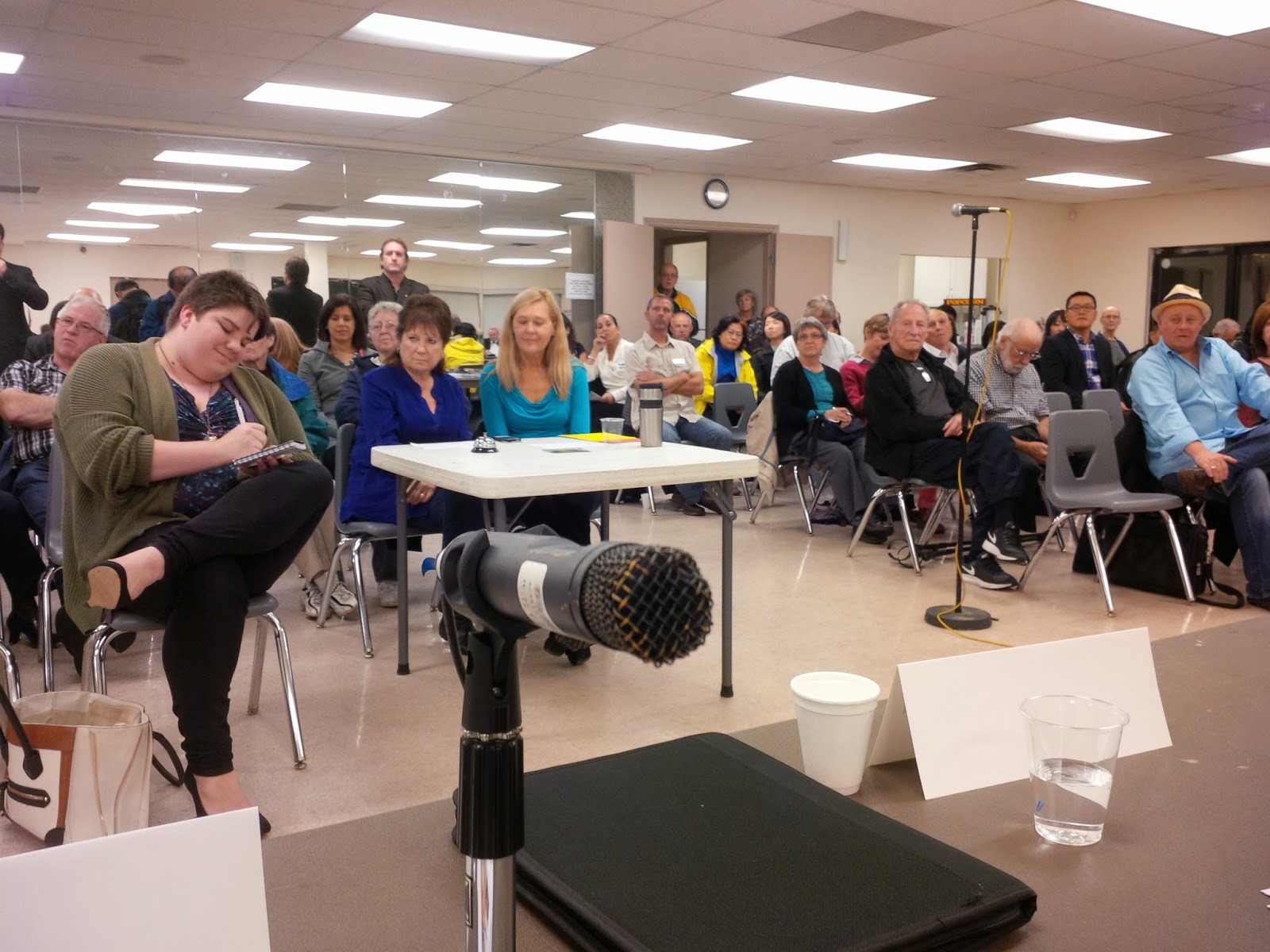 |
| The view from my spot. (Photo by Terry O'Neill) |
You know, my
background in journalism and community volunteering taught me the importance of
standing up for what you believe in, and for working hard to help others.
And that's
why I'm proud of the role I played in slowing down tax increases during my time
in office. When I was first elected, those increases had averaged more than 5%
annually over the previous three years.
But in the
three years SINCE I was elected, they have been HALF that. And I certainly
intend to continue working to lower the rate EVEN MORE if re-elected.
I also hope
you give me the chance to build on the many successes I helped initiate or
supported in the area of democratic reform to make city hall for accessible. THE
E-TOWN-HALL-MEETING is a real step forward, as is the interactive BUDGET consultation
process.
In addition,
council supported my call for reform of Metro Vancouver’s unwieldy structure.
And when the Province asked for input into campaign-finance reform, I submitted
a major brief.
You’ve told
me that Maillardville’s safety is a real concern, too. That’s a big reason I
led an initiative to ask Ottawa to toughen the penalties against chronic,
repeat offenders. Revolving-door-justice will NOT solve our problems.
And I’ve
been a strong advocate for a measured and taxpayer-friendly approach to any new
affordable-housing policy, not pie-in-the-sky promises. Coquitlam’s hardworking
property-taxpayers should NOT be expected to shoulder the burden of subsidizing
housing.
And one
final point: As an independent candidate, I am not beholden to any slate, team
or party. Instead, my priority is you, the taxpayer, the voter, the
citizen. THAT'S MY PROMISE, AND YOU CAN
COUNT ON IT!
Friday, October 17, 2014
Yes, No, Maybe and Say What?!?
.svg.png) |
| Graphic from commons.wikimedia.org/ |
I’ve just filled out a candidate questionnaire sent to me by
the Tri-City News. The survey, whose results will be published as part of a voter guide a week before the elections, asks a variety of questions, and seeks yes/no,
either/or answers. Some of the issues raised, however, are about complex
affairs and deserve more detailed examination or explanation. Here are the
questions I’m referring to, followed by my analysis, and then my official
survey answer:
Question 7. Do you use public transportation?
I use public transportation from time to time (Westcoast
Express, Skytrain and buses), but not on a regular basis. Strictly speaking then, my
answer is "Yes," even though I suspect the question was about regular use.
Question 8: Are you more willing to see services reduced and
taxes held or cut or see services improved and taxes increase?
My sentiments are with the former but my actions on council
have been with the latter because I’ve voted in favour of budgets that have
seen ever-smaller tax increases while increasing services. As long as we
continue to whittle down the size of each year’s tax increase—as we’ve done
successfully each of the three years I’ve been on council—I will continue to
vote in favour of such budgets. My answer, then, is "services improved and taxes increase" (with a large "on condition that...")
Question 11. What provincial political party's ideology most
closely reflects your belief system?
Yikes, what a question! My “belief system” is something that
encompasses my religious, philosophical and ideological beliefs, many of which aren’t
actually part of any political party’s platforms and shouldn’t be. What I can
say is that I have voted for the BC Liberal Party in the last few elections as
the most pragmatic choice. So, I selected “Liberal.”
Question 14. Should the city spend more taxpayer money to improve
cycling infrastructure?
I have supported budgets that call for moderate expenditures
every year to support cycling, but I am not sure about what the question is actually asking. If
the options are to cut off such funding entirely or to spend some more money next year, of about the same amount as this year, I would say "yes". If the
option is to spend more money next year than the city is spending this year,
then I would say "no". I ended up
selecting "Yes."
Question 15. Does the city have a responsibility to ensure the
availability of affordable housing to low- and moderate-income households?
Another whopper of a question. Under provincial law, all cities have a duty to adopt an affordable-housing policy or strategy. The City has
one in place, and we’re working on a new one. So, if this question is merely
asking if I know that provincial law mandates the City to have a policy, then
my answer is "yes." Furthermore, I also agree that it’s a good idea for the City
to have in place policies that further the availability of affordable housing.
We have many ways of doing this—from freeing up land for development to making
it easier to have a secondary suite in your basement.
But, given that the
question uses the word “ensure,” which means “to make certain” that something
takes place, this question is probably asking if I believe the City has a responsibility, above and beyond provincial law, to make certain that all low- and moderate-income households can afford to buy
or rent a home in Coquitlam. If that's the case, and given that Statistics Canada defines a low-income household as having an annual income of below $15,000, then any city
adopting a policy guaranteeing that those folks can find a place to live in the
city would be courting financial ruin for a variety of reasons which are too
numerous to spell out here.
I do not believe the provincial law demands that we
do this. And I do not believe a responsible municipal government should be compelled to
do this. Provincial and federal governments have the resources and the flexible taxation systems to tackle this issue, but municipal governments certainly do not. Ultimately, then, I am forced to answer No to this question.
Wednesday, October 8, 2014
Street-vending deferral hurts small business
 |
| Food truck in Coquitlam. (Photo by Terry O'Neill) |
You might
recall reading last week that Council had narrowly voted in favour of some new street-food-vending regulations. Well, since then, Councillor Neal Nicholson changed his mind, with the result that the new regulations—including all calls for expressions of interest—have been put on hold.
And that’s
a shame, because the councillors (Nicholson and those who were initially opposed) appear to be worried
only about street vendors’ impact on restaurants along Glen and High streets. (And that fine; they're entitled to their opinions, of course.)
However, the result of their reconsideration and deferral is that even the
non-controversial cart applications (for locations such as those near Douglas
College) are now in limbo until staff can produce a full report on
the issue, involving a round of consultation with the Chamber of Commerce. And
that’s likely to take two months, says Deputy City Manager John Dumont.
This means
that it is highly unlikely that street-vending operators, who wanted to open
early in the New Year, will be able to do so. Such a shame! I know of at least
one local man who was really looking forward to launching a new career with
such an operation. And now that dream will have to be put on hold.
Here’s some
background. Of special note is the fact that all of the votes to set up the
program in 2012 and 2013 were non-controversial and received the full support of council and that no objections
came from restaurants before we passed the bylaw or during the first year of
operation. So, here’s the history:
The idea of
a street vending program arose in late 2011/early 2012 when Council expressed
an interest in having a more formalized program to allow mobile vending on City
streets and in City parks and requested that staff report back.
In May 2012, Council directed staff to publish newspaper ads giving notice of its
intentions to adopt the proposed bylaw and an opportunity to provide
feedback. Notification letters were sent to the Chamber of Commerce on
June 4, 2012 and to the local Business Improvement Associations.
As the
program implementation required a Zoning Bylaw amendment, there was also a public
hearing held in June 2012.
Staff received no objections from the public or
businesses. At that time, the bylaw received fourth and
final readings by a unanimous vote of Council.
Staff from
various City departments including Engineering, Planning, Parks and Economic
Development then underwent a detailed process of identifying and resolving the
technical and other issues necessary to select potential sites on City
lands.
In Feb. 2013, Council voted in favour of proceeding with a tender
of up to 10 mobile vending licences at the identified sites: The High, Glen
Drive, Pinetree Way, the parking lot at Adair and Brunette, and the parking lot
on Ridgeway behind the Safeway.
The first
Request for Information and Expression of Interest was issued in early 2013 for
the Council-approved locations.
In response
to the first Request for Expressions of Interest, the City received six proposals and four licences were
issued. Staff in Legal/Bylaws did not receive complaints from existing
businesses about the program.
It’s also
worth noting that, while some of the current naysayers expressed concerns about
street vendors unduly competing with adjacent or nearby businesses, this issue
is already one of the evaluation and selection criteria listed in the city’s
Request for Expressions of Interest. If there were to be more applicants
than licences available for a specific location, staff on the evaluation
committee would be able to consider the proponent’s compatibility with existing
businesses as one factor in awarding the licences.
Tuesday, October 7, 2014
Towards an affordable housing-affordability strategy
 |
| A proposed Bosa project that would replace old rental units. |
Last night, Council gave unanimous approval to a draft Housing Affordability Strategy, an action that sends the HAS into the public realm for comment and consultation. I seconded the motion because it is important to hear what the community -- taxpayers, homeowners, renters, activist groups, industry, etc. -- has to say about the issue.
My vote doesn't mean that I support all possible initiatives spelled out in the HAS. On the contrary. I'll explain why.
The Provincial government says each municipality must have an affordable housing
strategy, but doesn’t specify what is in that strategy. Local governments are given a variety of tools
to address housing affordability challenges through the Local Government Act
and Community Charter. The City of
Coquitlam does not have the mandate or capacity to build and operate affordable
housing.
However, the City does have a role in promoting the creation of
affordable housing in the community
Approaches can and do vary. There are essentially two
models: One exemplifies activism, expense and something I call
“up-grabbing”, the opposite of
downloading, in that it willingly takes upon itself responsibilities that are
more properly the federal or provincial governments’.
Activism is exemplified by Victoria, for example, which boasts a Civic
Housing Fund, a Regional Housing Trust Fund, a Social Housing Permissive
Property Tax Exemption, a Secondary Suites Incentive Program, has issued two
development permits for the creation of private sector low income rental suites
and signed 11 housing agreements that either limit restriction on rentals (in
the case of strata projects) or create rental units and rent restrictions for a
prescribed period of time. And it has even bought old motels and converted them to
housing. But none of this is cheap. An average of $1.34 million a year for
three years ending 2010. That’s about $4.1 million.
Another model is exemplified by the City of Langley. It issued a paper in 2009 discussing a wide range of possible actions, but in the end chose a responsible, and taxpayer-friendly model to: 1.
Support Density; 2. Encourage the creation of secondary suites; 3. Maintain tough regulations on the conversion of
rental stock to condominiums.
Keep in mind: property tax is the least-fair, least-equitable way to tax
people. It is not based on one’s ability to pay, but on the assessed value of
the home you are living in. Yet, an interventionist, up-grabbing approach to
housing affordability has the ultimate effect of putting more of a burden on
the shoulders of property-tax payers, instead of on the shoulders of the
consumption or income taxpayers—the sort of tax collected by the provincial
and federal governments.
There are a great deal of good, common-sense, non-burdensome
options lists in our proposed new HAS. See page four of the document for the
broad outline and 16 to 26 for details. For example, the proposed Rental Housing
Strategy is, as I interpret it, basically a continuation of existing policies
which – while placing quite a burden on developers, also seeks to find a
balance with a general public concern to protect displaced renters. What it doesn’t do is compel a re-developer to
replace, one-for-one, every purpose-built rental unit that is lost to
redevelopment, which is something that at least one Coquitlam councillor/mayoral candidate is calling for. (And, anyway, every economist and expert that I have talked
with, says that buildings in which condos are sold end up having upwards of 40%
of their units put on the rental market.)
And so, what are the possible burdens to the taxpayer of
Coquitlam? Most come down to the Affordable Housing Fund. Page 19., 3.1.4. 1. Many on council want to expand the affordable housing fund, skimming off
a portion of density bonus, with no cap. I oppose this; it should be capped.
The draft strategy asks the public to “consider other options” to add to the fund. What might those be: Massive infusion into AHF through other
sources such as proceeds of sales of city land, is the leading one.
Thankfully,
no one is suggesting hiking property taxes!
I oppose this, and I urge voters to ask each and every candidate
where they stand, and further, to ask them, why they think it’s fair to the
already overburdened residential property taxpayer to deny them the benefits
of such potentially redirected monies, when there are so many other options
that the city can and should take. Such proceeds can and should be used for
general well-being, such as land-sales reserves or maybe even directly for
capital costs of new cultural or sport facilities.
We must also watch closely to ensure that working families,
who are just barely able to put together enough money to afford a downpayment
on a new condo in Burquitlam, for example, aren’t pushed out of the market
entirely because the cost of their unit is hiked as a result of a neighbouring
project escaping some civic charges because it is promising to provide cheap
housing to low-income families. That’s simply not fair.
On the other hand, 1.2.4 on page 21 – “considering exempting
rental floor space form maximum density allowances…” seems a less-burdensome,
more-equitable alternative.
There are a great many other options and ideas in this report,
and I urge the public to get involved in what I hope will be a full and
fruitful discussion about this important such.
We need a grounded, responsible Housing Affordability
Strategy, one that is rooted, not in a sky’s-the-limit attitude towards
redistribution of public money, but in respect for all citizens – be it the
young couple looking to put down roots, the working-class family endeavouring
to make ends meet, or the newly-retired homeowner on a fixed income.
.
Friday, October 3, 2014
Looking for consistency
 |
| Photo illustrating the Tri-City News's story. |
1. I've heard several folks around Coquitlam in recent days voice concerns about the new Canada-China investment pact. Here's a link to a story about the deal.
but
2. I've not heard a peep about what I believe to be the Chinese government's continuing role in paying for language-education classes in Coquitlam. Here is a link to a new Tri-City News story about how successful the programs are. Here's a link to an older Vancouver Sun item about the Chinese government's involvement in those programs.
I'm not judging the merits either the investment pact or the language-education programs. I'm just wondering why there's so much concern about the former and not the latter.
UPDATE: Only a few hours after I wrote the above, I came across a letter to the editor in the Tri-City News which was highly critical of SD43's relationship with China. Here's a link to the letter.
Subscribe to:
Comments (Atom)