The blog title says "elect", but I've now retired from elected office and am volunteering with several non-profit charities.
"Reason is always a kind of brute force; those who appeal to the head rather than the heart, however pallid and polite, are necessarily men of violence. We speak of 'touching' a man's heart, but we can do nothing to his head but hit it." --G.K. Chesterton
Friday, September 16, 2016
Property-tax boost for transit?
I was a reluctant supporter of the transit referendum last year. Reluctantly in favour, not because I was a big fan of the sale-tax increase proposed by the referendum, but because I was afraid if the proposal failed, there would be pressure to increase property taxes to fund the transit improvements. And, given that there is little relation between one's ability to shoulder tax increases and the value of one's home (the value upon which property taxes are levied), I definitely oppose piling this sort of thing onto the backs of homeowners. Yet, here's the news that I feared we would inevitably see. Yes, it's a small increase, but I fear that this proposal may set a precedent.
Friday, July 22, 2016
Some context, please, Mr. Horgan
Housing affordability and its associated issues, including "demo-victions," comprise one of the most pressing economic and social issues in the Lower Mainland. Little wonder, then, that the opposition New Democrats have mounted a campaign for more government action on the problem.
It might help their cause, however, if they picked a more suitable example of demo-viction malfeasance than the one they highlighted in Coquitlam earlier this week.
In fact, the example they showcased, the big BlueSky Properties Inc. development on Foster Ave. in Burquitlam, could and should be held up, not as a dramatic example of corporate greed and provincial government inaction, but as a heartening example of corporate responsibility, successful community engagement, and enlightened municipal policy.
Here's the story.
As part of its housing-affordability campaign, the New Democrats staged a press conference earlier this week against the backdrop of the aging apartments in Coquitlam that will be demolished to make way for the BlueSky development at North Road and Foster Avenue.
Supported by NDP MLA Selina Robinson and one-time NDP candidate and current Coquitlam Councillor Chris Wilson*, NDP leader John Horgan pointed out that the apartments are slated for demolition to make way for condo towers that are coming as part of the densification of Burquitlam now happening in anticipation of the arrival of the Evergreen Line early next year.
With reportedly scant reference to the specific details of the BlueSky redevelopment, Mr. Horgan declared, "People and families are scrambling to find affordable rental housing here in Coquitlam and across the Lower Mainland, and they aren't getting any leadership from Christy Clark. People want to know why the Christy Clark government has not acted to protect renters and increase the number of rental homes in this overheated property market."
Fair enough comment on the provincial level. But, on the municipal level, the suggestion that old rental buildings are demolished with little regard for the future of the tenants is completely off base.
In fact, the BlueSky development is notable for the developer's care and attention to ensure that the renters in the existing 112 units are cared for. The company's commitment to this was so thorough that the development proposal won the support of both the Burquitlam Community Association and the Tri-Cities Homelessness and Housing Task Group.
The 873-unit project will eventually comprise three condo towers boasting 816 for-sale units (many of which will, of course, be put on the rental market) and a purpose-building, five-storey, 57-unit rental building, in which rents will be similar to the rents in the existing complex. (Please click here to read the full Coquitlam staff report on the project.)
Furthermore, with Coquitlam's Transit-Oriented Development Strategy and (then-old but since-updated) Housing Affordablity Strategy guiding them, city officials worked with BlueSky to ensure that several other important steps were taken to assist in the relocation of the existing renters who would not find space in the new rental building or one of the condos. The company:
The press release accompanying Mr. Horgan's news conference said he believes, "fair tenant relocation policies are needed, and the province should lead. Standards for requiring relocation plans for tenants and replacing demolished units need to be in place around the province, not just in some communities."
Fair enough.
But it would have been infinitely more informative (if somewhat less dramatic) for him to have pointed out that the "fair tenant relocation policies" he is calling for already exist in the very community in which he chose to voice his concerns.
(*Unlike Mr. Horgan, Mr. Wilson provided some contextual background to at least one news outlet, as evidenced by this story.)
![]() |
| BlueSky's proposed development on Foster, east of Clarke. |
In fact, the example they showcased, the big BlueSky Properties Inc. development on Foster Ave. in Burquitlam, could and should be held up, not as a dramatic example of corporate greed and provincial government inaction, but as a heartening example of corporate responsibility, successful community engagement, and enlightened municipal policy.
Here's the story.
As part of its housing-affordability campaign, the New Democrats staged a press conference earlier this week against the backdrop of the aging apartments in Coquitlam that will be demolished to make way for the BlueSky development at North Road and Foster Avenue.
Supported by NDP MLA Selina Robinson and one-time NDP candidate and current Coquitlam Councillor Chris Wilson*, NDP leader John Horgan pointed out that the apartments are slated for demolition to make way for condo towers that are coming as part of the densification of Burquitlam now happening in anticipation of the arrival of the Evergreen Line early next year.
With reportedly scant reference to the specific details of the BlueSky redevelopment, Mr. Horgan declared, "People and families are scrambling to find affordable rental housing here in Coquitlam and across the Lower Mainland, and they aren't getting any leadership from Christy Clark. People want to know why the Christy Clark government has not acted to protect renters and increase the number of rental homes in this overheated property market."
Fair enough comment on the provincial level. But, on the municipal level, the suggestion that old rental buildings are demolished with little regard for the future of the tenants is completely off base.
In fact, the BlueSky development is notable for the developer's care and attention to ensure that the renters in the existing 112 units are cared for. The company's commitment to this was so thorough that the development proposal won the support of both the Burquitlam Community Association and the Tri-Cities Homelessness and Housing Task Group.
The 873-unit project will eventually comprise three condo towers boasting 816 for-sale units (many of which will, of course, be put on the rental market) and a purpose-building, five-storey, 57-unit rental building, in which rents will be similar to the rents in the existing complex. (Please click here to read the full Coquitlam staff report on the project.)
Furthermore, with Coquitlam's Transit-Oriented Development Strategy and (then-old but since-updated) Housing Affordablity Strategy guiding them, city officials worked with BlueSky to ensure that several other important steps were taken to assist in the relocation of the existing renters who would not find space in the new rental building or one of the condos. The company:
- Hired an on-site rental relocation coordinator.
- Instituted ongoing communication and meetings with tenants, including relocation information.
- Provided tenants with a six-month eviction notice, rather than the provincially required two months.
- Promised to waive multiple months' rent, rather than the one-month required by law. Two months' rent would be waved if the tenant relocates within four months of receiving notice; three months' waved if relocation takes place between four and six months after notice is served.
- Offered any tenant or member of their immediate family the opportunity to purchase a unit within the BlueSky, or any Bosa Properties development, with 12 months' worth of rent going towards the down-payment on their new home.
The press release accompanying Mr. Horgan's news conference said he believes, "fair tenant relocation policies are needed, and the province should lead. Standards for requiring relocation plans for tenants and replacing demolished units need to be in place around the province, not just in some communities."
Fair enough.
But it would have been infinitely more informative (if somewhat less dramatic) for him to have pointed out that the "fair tenant relocation policies" he is calling for already exist in the very community in which he chose to voice his concerns.
(*Unlike Mr. Horgan, Mr. Wilson provided some contextual background to at least one news outlet, as evidenced by this story.)
Monday, March 7, 2016
Just say 'no' to prejudiced hirings & appointments
| Progress since 'secretarial pools.' (women2.com) |
My first response is, “if it ain’t broke, don’t fix it.” And, since no evidence has been presented – and, moreover, I don’t see any evidence of my own -- that the administration of the city or the workings of its advisory committees, is hobbled by present recruitment (and hiring practices), I see no need of change.
I believe in equality of
opportunity, not of outcome. And, if we
set quotas for women, then why not any of a number of other categories, from
visible minorities, religions and IN-visible ethnic groups, to age
classifications, gender orientations, and levels of physical ability. What a menacing
melange of criteria that would be!
I believe in merit, not
quotas. Consider the current situation in Coquitlam: the
Evergreen Line Public Art Task Force and the Arts and Culture Advisory Committee (both of which I chair) are composed overwhelmingly of women. Since, a "fair" gender quota would have to apply both ways (and
if not, what a travesty of inequity that would be!), it would thus deny many
qualified women the opportunity to serve.
Instead of gender quotas in committees and employment, I believe in a system:
*Where employees and appointees will have the certainty that they earned their position because of their
talents, and were not handed it because of an intrinsically-biased criterion.
*Where
employees will have the opportunity to grow in experience and confidence, earning
the respect of their fellow employees, who, in a gender-quota system, might otherwise
conclude that their new colleague did not earn the job on merit.
And, anyway, who are we to tell women what they should want -- what levels of involvement and
employment they should seek? The big, bad old patriarchy used to preach that.
Let’s allow women to choose freely, and not dictate outcomes that aren’t supported
by free choice in their area of interest.
More broadly,
I support a society in which we view someone, not through the narrow lens of
the nature of their sexual organs, but through a wider lens that considers
their whole person.
Let’s
embrace the current system instead of a system, which, when enacted at the
federal-cabinet level recently, was justified by the prime minister’s dismissive invocation
of the year in which we live.
So what does living in 2016 actually mean? Unconsciously
or consciously, most of us equate the advance of the years with progress.
But I can’t
see how an embrace of employment or appointment prejudice – that is, judging
someone’s suitability for a position on the basis of their sex -- can be seen
as progress.
Let us not look backward; let’s move forward with a re-affirmed
commitment, not to empty and harmful prejudice, but to excellence in city
government.
Labels:
employment equity,
gender quotas,
Vision Vancouver
Wednesday, February 24, 2016
Much-needed playground upgrades coming soon
The news, made public at last Monday's Council-in-Committee meeting, that Tanglewood and Hampton Park playgrounds would have their equipment replaced this year, at a cost of $50,000 and $25,000 respectively, was certainly long-awaited and much-appreciated.
These photos, which I took last weekend, show the sorry state of repair into which Tanglewood, for one, had fallen. I am sure the neighbourhood will be very pleased to learn of the coming upgrade.


You can view the full report on Parks Infrastructure by clicking here. That report also has some exciting graphics showing the design concepts for the new playground at Como Lake.
As well, you can find additional photos of from Tanglewood and Hampton.
Tuesday, February 23, 2016
A rare award to honour a remarkable man
![]() |
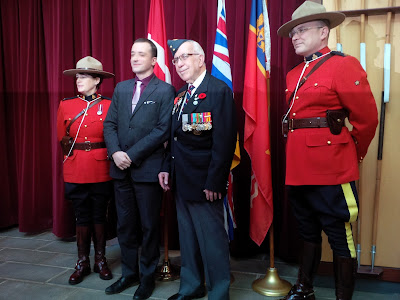
| Consul-General Fluery and Mr. Cumbers with colour guard. |
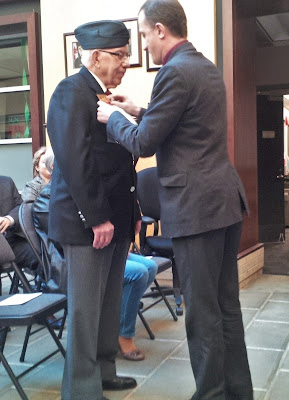
It was with the greatest appreciation that I attended a remarkable ceremony this morning, during which Coquitlam's John (Doc) Cumbers received France's highest honour, the Knight of French National Order of the Legion of Honour. Presenting the medal was France's Consul General in Vancouver, Jean-Christophe Fleury (the text of whose stirring speech is reproduced in full, below).
The ceremony took place at the RCMP's Coquitlam Detachment headquarters next to Coquitlam City Hall in recognition of the fact that Mr. Cumbers is still active in the community as a volunteer at the RCMP's Ridgeway Avenue community office.
According to those in the know, the Legion of honour is the highest national order of Frances and illustrates the country's profound gratitude towards its recipients. "It is awarded in recognition of personal involvement in the liberation of France" during the Second World War.
Sergeant "Doc" Cumbers was a tail gunner with the Royal Canadian Air Force, and is described in historical archives as "a most resolute and gallant air gunner." (After the war, he served in the Canadian Navy, as well.)
The archives continue: "He has taken part in very many sorties and has played a worthy part in the successes obtained. On a recent occasion, when returning from an operaton against Villeneuve-St. Georges, his aircraft was attacked by a fighter. As the attacker closed in, Flight Sergeant Cumbers delivered a burst of fire which struck the enemy aircraft, setting it on fire. His coolness and determination were charactertice of tht which he has shown throughout his tour of operational duty."
Here is the text of Consul-General Fleury's speech:
![]() |
| The medal moment. |
Dear President of
the Legion,
Soon to be Honored Veteran, their family and friends, Distinguished
guests:
It is a real pleasure for me to be given the
opportunity to present an award to John CUMBERS today. 2014 marked the 70th anniversary of the D-Day
landings, and for this occasion, the French government has organized a series
of events that have taken place in France.
Former Prime Minister Stephen Harper and three provincial
Premiers have travelled to Normandy and were officially received by our
President, François Hollande.
To celebrate this anniversary, the French government
has decided to bestow awards upon some of the living Canadian veterans who
participated in D-Day operations.
The Legion d’Honneur is the highest decoration that
France can bestow and, as such, it is equivalent to the Order of Canada.
The law that brought the Legion of Honour and its
governing organization into effect was passed in the Legislative Assembly on
May 19th, 1802, during the reign of Napoleon. It rewards the
outstanding merits of individuals from all walks of life, regardless of their
respective social, economic, hereditary or even national backgrounds.
A number of prominent Canadians have been awarded the
Legion of Honour, such as: Former Governor General Michaelle Jean, Prime
Minister William McKenzie King,
Rear Admiral Leonard Murray (Commander in Chief of Canadian Northwest Atlantic),
former Premier Jean Charest.
There used to be 20 of them, and by the end of the
year, there will be over 1,000.
To the best of our knowledge, there are more Canadian
D-Day veterans still living in Canada, but what is happening now is part of a
truly unprecedented two-year process. This process required a lot of human
resources.
And it would not have been possible without the
support of the Ministry of Veterans Affairs in Ottawa.
The French President signed all the decrees to have
the Legion of Honour awarded to 1,000 D-Day veterans, some of whom are living
in BC. The
campaign is now closed as our human resources do not allow us to continue this
very lengthy process.
Now that I have explained the procedure, let me say a
few words about the meaning behind all of this.
The destiny of all of us is to leave this world. But
there is no rule in this universe that says that a human being should be
deprived of his or her freedom.
It’s good sometimes to come back to the basics so let
me quote the very beginning of the Universal Declaration of Human Rights:
“Whereas
disregard for human rights have resulted in barbarous acts which have outraged
the conscience of mankind, and the advent of a world in which human beings
shall enjoy freedom of speech and belief, and freedom from fear has been
proclaimed as the highest aspiration of the common people, the United Nations
proclaimed that (…)
Art1:
All human beings are born free and equal in dignity and rights. They are
endowed with reason and conscience and should act towards one another in a
spirit of brotherhood”.
Many people in this world made the ultimate sacrifice
to allow their friends and relatives to remain unchained.
This is the sacrifice that more than 45,000 Canadians
made during the Second World War.
The D-Day was this
very first step that enabled liberty, justice and human dignity to break
through. Canadian soldiers were on the front line, and it is with extraordinary
bravery and sacrifice that they landed on Normandy beaches that brought peace
to the continent.
As a young man John,
you left your family and home to cross the Atlantic and participate to the some
of the fiercest battles in modern history, on a foreign soil, far away from
your country, to help the people of Europe to free themselves from the terror and
tyranny. Your accomplishments during the Second World War are a vibrant
reminder of the profound and historic friendship that binds France and Canada.
Our two countries owe each other their very existence as free nations and this
indeed creates a special relationship.
The French people
will never forget the act of bravery that accomplished Canadian soldiers during
Normandy Landing to help restore our freedom.
Sadly, if I may say so, this fight for freedom is not
over: I think you are aware that more than 200 innocent people were killed in
France last November after 17 journalists, cartoonist and Jews have been killed
in Paris before because of their belief and because they exercised their
freedom of expression. Similar events then happened in Danemark and elsewhere
in the world.
Your Premier Christy Clark wrote this to us:
“For
centuries, France has been a beacon of light and example for the world, and
remains one of our closest friends and allies. Tonight, all Canadians stand
with them, both in grief for those who were killed, but also in resolve. Those
who commit such acts of violence want to change us, and our shared values. They
will fail. My thoughts and prayers are with the victims, their families, and
with security personnel who put their lives at risk to keep others safe. Vive
la France.”
Once again, Canada is on the side of France, and once
again, I owe you all my gratitude. Therefore, thank you Canada for being on the
side of France against the Islamic State in Iraq. And if I may add: Thank you
Canada for being on the side of the freedom in Ukraine.
Wednesday, February 17, 2016
Michael Moriarty at the Coquitlam Grill
A very familiar man walked into the Coquitlam Grill just before noon today. It took me but a second to recognize him as Tony-Award-winning actor Michael Moriarty, former star of stage, screen and television, the latter medium providing him his most enduring success in the role of District Attorney Ben Stone in the original cast of Law and Order.
Here is the text of a story I wrote about him for the Western Standard several years ago:
![]() |
| Actor Moriarty |
Michael Moriarty’s reputation precedes him as
he shuffles through a standing-room-only audience at a Vancouver nightclub.
Moriarty, who appeared in such films as Bang
the Drum Slowly and The Last Detail
before rocketing to fame in the early 1990s as assistant district attorney Ben
Stone in the Law and Order television
series, is today more famous for his turbulent personal life than for his
once-considerable dramatic skills. Indeed, it has not been his acting, but his
boozing and multiple court appearances—both as accused and victim—that have
kept the lanky American actor in the public eye for most of the decade or so he
has lived in Canada, the last five in the Vancouver suburb of Maple Ridge.
On this balmy mid-summer’s evening,
however, Moriarty is playing neither drunk nor brawler. Instead, having sworn
off booze, specifically red wine, a year and a half ago, a thoroughly sober
Moriarty takes a seat behind a piano and starts to play some jazz. He’s very
good. He blends his music—standards and original compositions—beautifully with
that of his two sidemen; his face brightens as the audience erupts in applause
after a particularly deft solo. It’s no wonder the trio is working on a new CD.
It’s not the big screen or the Broadway
stage, but it’s just about all Moriarty has these days—that, a Screen Actors
Guild pension, some residuals, and a knot of close friends, including his
manager-cum-common-law wife, Margie Brychka, whom he met in a bar in Surrey,
B.C., and Hollywood icon Burt Reynolds, both of whom are in the audience this
night. In fact, Reynolds eventually joins Moriarty in singing a duet of “Ain’t
Misbehavin’”
In an earlier interview, the 64-year-old
Moriarty recognizes that his Emmy- and Golden Globe-winning days are behind
him. The permanent, booze-induced slur that muddies his once-crisp voice has
seen to that. He also uses a cane to walk. And the boyish good looks that
helped win him so many top roles have now abandoned him. But he insists his
mind is sharper than ever and that he still has one more big role to play.
“I’ve got to complete my run for the presidency,” he declares. You heard that
right. Michael Moriarty wants to act out his final, great, real-life role at
centre stage in the Oval Office. He wants to be President of the United State of
America. Really.
Moriarty also thought about running for the
presidency back in 1994. That was the year he left Law and Order following a meeting with then attorney-general Janet
Reno. He alleged he was dismissed after he threatened to sue Reno, whom he
accused of trying to censor the show. But he has said the departure had at
least one positive effect: it transformed him from a liberal into a
conservative. He soon resettled in New Brunswick (a woman, who became his third
wife, drew him to Canada) and publicly mused about running for the leadership
of the old Reform Party of Canada. Nothing ever came of it. This time, however,
he says he means business. His strategy will be to get on the ballot in the
state of Florida, where he aims to garner five percent of the vote—enough to
give him some leverage to make a difference in what has, for the last two
elections at least, been a tightly-contested state.
But while he says he has opened an office
in the state, Moriarty suggests his campaign, which will be run under the
banner of “Realists 2008,” is as much poetic pie-in-the-sky as political
reality. In fact, asked about his campaign’s infrastructure, he says he will
organize his bid with the help of “divine intervention and a very proven skill
at capitalizing on the authentic arrival of angels.” He also admits he hasn’t
raised any money yet, and has just a handful of supporters, only one of whom is
actually qualified to vote.
Nevertheless, he likens his candidacy to
something in between the quixotic campaigns of the late comedian Pat Paulsen,
who ran for the presidency five times, and the more serious efforts of consumer
activist Ralph Nader, who ran twice for the Green Party. Unlike Paulsen,
however, Moriarty has some serious policies, a fact that becomes apparent as he
spells out his unique political beliefs in a long, oft-times disjointed but
nevertheless compelling soliloquy at a Vancouver restaurant.
Moriarty announced his candidacy in May on
the conservative Web site Enter Stage Right (www.enterstageright.com). He has
stated that his primary goals in running for the presidency are to reduce the
power of the U.S. Supreme Court; to overturn that court’s 1973 Roe v. Wade decision, which legalized
abortion; and to take the U.S. out of the United Nations. In his interview with
the Western Standard, it became clear
that Moriarty’s beliefs spring from a deep conviction that collectivism in all
its forms is evil. In fact, he suggests that the modern world is a vast
battleground between communist and individualist philosophies.
In between alternating sips on a coffee and
Diet Coke, and drags on his Export A cigarette, Moriarty’s ideas arc out like
sparks: sometimes brilliant, sometimes distracting, sometimes irritating.
Here’s one of his typical insights: Pierre Trudeau was the diabolic mastermind
who first fused communism and capitalism though “dialectic materialism.” This
fusion, he once wrote, is related to “the slow and barely discernible
transformation of [the] American Republic into a socialist federation.”
There’s more: Bill Clinton is a Marxist and
Hillary Clinton is a Leninist, under whose direction “the feminist arm” of her
husband’s “third way” presidency “literally expropriated the Supreme Court.” On
terrorism: “Big picture on terrorism, all of it—Jerry Adams is not an Irish
Catholic. Yasser Arafat was not a Palestinian. Osama bin Laden was not Islamic.
They are communist, agent Leninist provocateurs. This idea [communism] will
not work without terrorism.”
On why anti-abortion activists should not
despair: “Sir, sir, the anti-slavery movement was just as lost….But, in the
end, God, reality, put Lincoln into the Oval Office, the way God put Ronald
Reagan into the Oval Office.” On why the UN headquarters should not be in New
York: “No, it should be in Paris. And I’ll order it. If Reagan can order Moscow
to tear down that wall, I can order the United Nations to move it back to
Paris, tear down [Napoleon’s] vainglorious tribute to himself, the Arc de Triomphe,
and put Napoleon’s real achievement [there], which is the United Nations.”
On whether he is still a practising
Catholic. “No, no. I pray all the time in my own inimitable way. My Christ is
not your Christ or anybody else’s Christ. And in the end, we come into an
intimate association with Our Lord. Our Lord shapes himself to you, not the
other way around. Now, there are certain basic Christian fundamentals. Golden
Rule. Honoring our father.” His mouthing the word “father” immediately throws
his thoughts into a new direction. Without so much as a one-word segue, he
declares, “The situation where the Church of the United Nations, they’ve told
us, with the help of the environmentalists, that there is no male divine
principle in the universe. Mother Earth impregnated herself.”
His speech impediment doesn’t make it any
easier to follow any of this, and neither does his southern-gentleman’s accent,
which catches the interviewer by surprise, given the fact Moriarty grew up in
Detroit and was educated in the northeast U.S.
What’s with the drawl, then? “Since I came to Canada, and its increasing
anti-Americanism,” he explains, “I get more and more southern American, because
that’s the most identifiable American accent, it’s southern.” So he does it on
purpose, then? “I am not going to be made ashamed of being an American,” he
continues. “And for me to try to hide it, and don politically correct
Canadianese, I ain’t going to do it.”
The interview ends with Moriarty taking a
drag from his cigarette and once again denouncing Janet Reno. Maybe he’ll
finally get his revenge when he becomes president.
(Photo from www.pbs.twing.com)
Wednesday, February 10, 2016
Kwikwetlem formally claim Riverview, Colony Farm
You might have heard or read that the Kwikwetlem First Nation has, this week, formally claimed a portion of southeast Coquitlam. The KFN announced last summer that it intended to claim the Riverview lands, and now it has followed that up with a formal claim, filed with the Supreme Court, for Riverview, Colony Farm and other associated areas.
I don't plan on commenting on the claim, but I thought it would be useful to share the exact text of what the KFN is saying about its claim. So, here is its press release:
VANCOUVER, Feb. 9, 2016 /CNW/ - Today, Kwikwetlem First
Nation (KFN) filed an Aboriginal title and rights and Charter claim with the
Supreme Court.
I don't plan on commenting on the claim, but I thought it would be useful to share the exact text of what the KFN is saying about its claim. So, here is its press release:
Kwikwetlem First Nation title case aims for fair relationship
VANCOUVER, Feb. 9, 2016 /CNW/ - Today, Kwikwetlem First
Nation (KFN) filed an Aboriginal title and rights and Charter claim with the
Supreme Court.
KFN has filed this claim as a part of KFN's continuing
efforts to ensure its title and rights over key areas in its traditional
territory are properly recognized and protected.
KFN is a small community, with a traditional territory based
around the watershed of the Coquitlam River. KFN's traditional territory has
seen significant development over many years, which is expected to continue.
"Our community has worked hard to be consulted and
meaningfully involved in decisions about the planning and management of our
land for years," said KFN Chief Ron Giesbrecht. "Although
governments have taken some steps to involve us in making decisions about how
our lands will be used, we do not feel our title and rights interests are being
taken seriously. Given there are limited processes for resolving Aboriginal
land claims for a small Nation like ours, this claim is the next logical
step."
The claimed title areas in the case filed today amounts to
less than 1% of Kwikwetlem's core territory, and includes the following lands,
and their surrounding areas:
- Colony
Farm Forensic Psychiatric Institute Lands. The Province of BC is the fee
simple owner of this area, and it is managed by Shared Services
(previously administered by the British Columbia Buildings Corporation).
- Colony
Farm Regional Park. The Greater Vancouver Regional District operating as
Metro Vancouver - is the registered owner of this area.
- Riverview
Hospital Lands. The Provincial Rental Housing Corporation is the fee
simple of this areas. It is managed by the British Columbia Housing
Management Commission.
KFN believes that the case will help to ensure it is
meaningfully involved in decisions made about its lands, a process highlighted
by the Supreme Court of Canada, which called for a consent-based decision
model in its 2014 Tsilhqot'in decision. Chief Giesbrecht stated: "We
hope that the government will follow the advice of the Supreme Court of Canada and
negotiate a fair and respectful resolution to our claim, which will allow us to
build a strong future for our community."
Support from other organizations
BCAFN Regional Chief Shane Gottfriedson
"Our First Nations have always hoped by supporting a meaningful consultations, that it will build a bridge of understanding towards reconciliation and partnership. Our Aboriginal title and rights should be respected and the British Columbia Assembly of First Nations supports Kwikwetlem First Nation and urge BC Government to build a relationship that benefits true reconciliation."
BCAFN Regional Chief Shane Gottfriedson
"Our First Nations have always hoped by supporting a meaningful consultations, that it will build a bridge of understanding towards reconciliation and partnership. Our Aboriginal title and rights should be respected and the British Columbia Assembly of First Nations supports Kwikwetlem First Nation and urge BC Government to build a relationship that benefits true reconciliation."
President of the Union of BC Indian Chiefs Grand Chief Stewart
Phillip
"I applaud Kwikwetlem First Nation's declaration of their inherent Title and for protecting their Rights. It is vitally important for KFN to be truly involved in the management of their territory not as an interested stakeholder but as respected Title holders. The BC Government can no longer pretend KFN Title does not exist nor treat our inherent constitutionally-protected and judicially-recognized Aboriginal Title and Rights as an inconvenient checkbox of doing business in our respective territories."
SOURCE Kwikwetlem First Nation
For further information: Media contacts, CopperMoon
Communications, Laura Taylor, laura@coppermoon.ca, 604 336 8771; Richard
Truman, richard@coppermoon.ca, 778 929 1662
Wednesday, January 27, 2016
Let B.C. info be more completely free
The B.C. government has struck a special committee to review the province's Freedom of Information and Protection of Privacy Act. The public has been invited to submit its input into the review, and so I've taken advantage of the invitation and have just submitted my thoughts, which I've reproduced below. If you are also interested in the subject, the deadline for submission is the end of this week--January. 29, 2016. Click here to access the committee's webpage, which has all the information on how to submit.
My submission:
Summary: To adhere to both the spirit of the freedom-of-information
movement and the stated intent of the B.C. FOI legislation, Section 22.1 of the
Act should eliminated.
Detailed submission:
Triple-deleting of emails, lengthy delays in responding to requests, redacted
information dealing with finances and a general reluctance to share
information: these are the sorts of provincial-government actions and attitudes
that have sparked the most public concern during the current statutory review
of the B.C. Freedom of Information and Protection of Privacy Act.
All such concerns seem to be legitimate and need to be
addressed. But there’s at least one more outstanding issue that, if left
unrectified, can only lead the public to conclude that the provincial
commitment to freedom of information is an illusion. I will detail this in a
moment.
First, though, a reflection on the importance of freedom of
information (FOI). We in the democratic West take it as a given that FOI is an absolute
“good,” both in principle (as an integral part of a free society) and in
practice (as a necessary way for the public and politicians to obtain the
information to make good decisions).
Indeed, this belief is now widespread among advanced nations.
The United Nations Educational, Scientific, and Cultural Organization, for example,
has declared, “The free flow of information and ideas lies at the heart of the
very notion of democracy and is crucial to effective respect for human rights.”
But, of course, this understanding has not always been widespread.
And, alas, it is not a value to which many current governments subscribe.
The enactment of B.C.’s FOI law was a long-awaited and much-celebrated
fulfillment of the aspirations of those who believe transparency in government,
as manifested by a citizen’s right to have free access to government records (as
long as such records do not trample on the privacy rights of other citizens), is integral to a more-democratic government.
Such a noble sentiment arose in the West at a time of great
intellectual growth. Consider these words: “The freedom of a nation cannot be
upheld by laws alone, but also by the light of the nation and knowledge of
their use.” They were written in 1763 by Anders Chydenius, an Enlightenment
thinker and politician whose work helped inspire the first freedom of
information law, in Sweden and Finland in 1766.( www.freedominfo.org.)
Two hundred years later, John F. Kennedy observed, “A nation
that is afraid to let its people judge the truth and falsehood in an open
market is afraid of its people.”
Yet, British Columbia’s FOI law has, since 2001, contained a
censorious and anti-democratic provision that seems to embody President Kennedy’s dark vision of a nation afraid of its people. I refer to Section 22.1, “Disclosure of information relating to
abortion services.”
Under this section, the law makes it illegal for “The head
of a public body…to disclose to an applicant information that relates to the
provision of abortion services.” The effect of this provision is to make it
illegal for authorities to disclose information about the number and type of
abortions being performed in the province, even though these abortions are funded
by the public and often take place in public facilities.
One might appreciate the value of this section if and only
if it prevented the release of personal information that would best be left
private. But this is not the case. Indeed, no one is suggesting that personal
information would be ever divulged.
Rather, the section was made law simply to stifle the free flow of information about a legal, taxpayer-funded procedure which was and remains the subject of legal, medical and moral controversy in the community.
This is certainly contrary to the purpose of B.C.’s FOI act,
which is “to make public bodies more accountable to the public” and to give “the
public a right of access to records” while also protecting privacy.
The censoring of such information has the deleterious effect
of limiting informed public discussion on such important, specific subjects as
sex-selection abortions (usually of females), late-term abortions, and
abortions based on the results of medical or genetic tests.
Further, any informed discussion and debate on the larger and more general subject of the provision of abortion services is also strangled by the censoring of this information.
Therefore, I would urge the committee to recommend the
lifting of the abortion-information ban; this is a simple matter that can and
should be enacted by amending the legislation to eliminate Section 22.1.
Monday, November 30, 2015
Diversity, and then what?
When it comes to the sort of ethnic, cultural and racial diversity of which our country and our community are so proud, can there be “too much of a good thing”? The answer is “yes,” according to Martin Collacott, Canada’s former ambassador to Syria and Lebanon, whose opinion was featured as the “Letter of the Day” in the November 30 issue of the Vancouver Sun.
Is Collacott correct? It’s a timely question, not only for Canadians to consider, but also for Coquitlam residents to ponder as we continue to welcome new immigrants into our community on a regular basis and, more notably, also await the arrival of Syrian refugees in the coming months.
Collacott acknowledges that the increased diversity this country has experienced in recent decades “has made Canadian society more vibrant and interesting in some respects.” However, he continues, “too much diversity can create major problems.” This “has been amply illustrated in the case of more than a few European countries that have begun to discover there are limits to how much diversity they can absorb without harming themselves.”
Canada’s diverse composition may, as Prime Minister Justin Trudeau recently said, be “our strength,” but Collacott answers that diversity is not an unqualified good, in and of itself.
Looking at the question from a common-sense point of view, Collacott makes a good point. Consider the question this way: We may say that “variety is the spice of life,” but there are limits to the sort of variety sane persons will subject themselves to.
Whether it’s in our choice of what we wear (comfortable and warm in winter, not irritating and cold) or what we eat (nutritious and delicious, not poisonous and disgusting), we have boundaries.
Similarly, while we may say that we embrace diversity, most of us would not want to live in a truly diverse community filled with, for example, unrepentant members of Pol Pot’s murderous Cambodian regime from the second half 1970s. Or, of course, with unrepentant members of ISIS. (And, for the most comprehensive look at what ISIS is all about, please click here to see a story from The Atlantic magazine.)
When diversity works in Canada it is not because of the simple fact that the country accepts diversity, and neither is it because of the celebration of diversity; rather, it is because of the fact the new Canadians reciprocate with a commitment to fit into Canada. It’s called integration, and it’s a vital and too-often unacknowledged part of the Canadian success story.
Coquitlam’s official position on diversity is one of unalloyed acceptance, inclusion and celebration. You can read the policy by clicking here. It’s great as far as it goes. But even the city’s own Multicultural Advisory Committee, of which I am vice-chair, is acting of late as if there is more to multiculturalism than celebration of diversity.
Consider, for example, the committee’s successful 2015 Canada Day display which was the subject of a report to council-in-committee on November 23. The display went beyond the usual “tell us where you are from” interactive display and, instead, asked participants to write a message on an “I Love Canada Because…” mural.
For the record, six top themes emerged – natural environment, people, values and culture, safety, family, and general satisfaction with the country. City staff also presented a word cloud, shown at the top of this blog, to illustrate the predominant themes. You can read the full staff report by clicking here.
The real import of the mural is not so much in the answers it found, but in the question it asked: Why do you love Canada? The question springs from an implicit understanding that diversity is a two-way street, that “We’ll accept you, but you have to buy into what Canada is all about, too.”
This represents a real and important maturation in the development of multiculturalism in our country. It’s not just about celebration of diversity. And it’s not even abut embracing the more advanced concept of “inter-culturalism,” which encourages cross-cultural understanding.
Rather, it is about identifying and celebrating those values that we hold in common—the values that are not signs of our diversity but of our unity. And that’s a good thing.
Is Collacott correct? It’s a timely question, not only for Canadians to consider, but also for Coquitlam residents to ponder as we continue to welcome new immigrants into our community on a regular basis and, more notably, also await the arrival of Syrian refugees in the coming months.
![]() |
| Results from "I love Canada because..." mural. |
Canada’s diverse composition may, as Prime Minister Justin Trudeau recently said, be “our strength,” but Collacott answers that diversity is not an unqualified good, in and of itself.
Looking at the question from a common-sense point of view, Collacott makes a good point. Consider the question this way: We may say that “variety is the spice of life,” but there are limits to the sort of variety sane persons will subject themselves to.
Whether it’s in our choice of what we wear (comfortable and warm in winter, not irritating and cold) or what we eat (nutritious and delicious, not poisonous and disgusting), we have boundaries.
Similarly, while we may say that we embrace diversity, most of us would not want to live in a truly diverse community filled with, for example, unrepentant members of Pol Pot’s murderous Cambodian regime from the second half 1970s. Or, of course, with unrepentant members of ISIS. (And, for the most comprehensive look at what ISIS is all about, please click here to see a story from The Atlantic magazine.)
When diversity works in Canada it is not because of the simple fact that the country accepts diversity, and neither is it because of the celebration of diversity; rather, it is because of the fact the new Canadians reciprocate with a commitment to fit into Canada. It’s called integration, and it’s a vital and too-often unacknowledged part of the Canadian success story.
![]() |
| Coquitlam Canada Day activities. |
Consider, for example, the committee’s successful 2015 Canada Day display which was the subject of a report to council-in-committee on November 23. The display went beyond the usual “tell us where you are from” interactive display and, instead, asked participants to write a message on an “I Love Canada Because…” mural.
For the record, six top themes emerged – natural environment, people, values and culture, safety, family, and general satisfaction with the country. City staff also presented a word cloud, shown at the top of this blog, to illustrate the predominant themes. You can read the full staff report by clicking here.
The real import of the mural is not so much in the answers it found, but in the question it asked: Why do you love Canada? The question springs from an implicit understanding that diversity is a two-way street, that “We’ll accept you, but you have to buy into what Canada is all about, too.”
This represents a real and important maturation in the development of multiculturalism in our country. It’s not just about celebration of diversity. And it’s not even abut embracing the more advanced concept of “inter-culturalism,” which encourages cross-cultural understanding.
Rather, it is about identifying and celebrating those values that we hold in common—the values that are not signs of our diversity but of our unity. And that’s a good thing.
Tuesday, November 10, 2015
Picturing a more meaningful Remembrance Day
![]() |
| Beny-Sur-Mer |
It was certainly all that and more, for they stumbled upon information about a grave bearing the inscription: "Lieutenant F.S. O'Neill, the Cameron Highlanders of Ottawa, 26th June 1944."
![]() |
| Arnprior, Ont. |
![]() |
| Peace Tower book. |
Just hours after I first posted this blog, a distant cousin in Toronto came across it and sent me more information about the death--information which came to him by word of mouth from my distant cousin's grandfather. Reportedly, Frank was clearing a farmhouse or gatehouse, inland on the road toward Caen, and was hit in a doorway by light artillery or possibly rocket fire. He was killed instantly.
![]() |
| Lt. Frank Smith O'Neill, RIP |
But there was one image we hadn't found--a photograph of cousin Frank himself.
And so, on the eve of Remembrance Day 2015, I decided to restart my Internet search. It didn't take long for me to find what I was looking for on Veterans Affairs Canada's Canadian Virtual War Memorial website.
There, alongside a photo of his grave marker, and a photo of a Roll of Honour produced by the Bank of Nova Scotia (commemorating employees who died during the Second World War), was a photo of the man himself.
What a difference such a photo makes to our remembrance of this relative who gave his life for his country.
![]() |
| Cameron Highlanders, in Iceland, en route to England. |
And so, Remembrance Day has an especially deep meaning for us this year, as we remember the life that our cousin, whom we can now picture, gave in defence of his country and all it stands for. Thank-you, Frank!
Monday, November 9, 2015
Five schools on four sites
![]() |
| SD43's plan for 5 schools at 4 sites on Burke Mountain |
http://www.sd43.bc.ca/BMSI/Documents/Burke%20Mtn%20Presentation%20Nov%209%202017%20FINAL.pdf
OLDER INFO:
This past January, I posted an item on this blog dealing with the location and timing of schools on Burke Mountain. Well, a fair bit has changed since then (here's a link to a Tri-City News story about the issue, from this past June), so I thought I'd better post a new item.
And so, with the help of School District 43 (from whose staff I confirmed this information), we can say that there are plans for five schools to be built on four sites. (Please see adjoining map and timeline chart for more detail.)
1. First would be the "Smiling Creek" elementary school, the funding approval (from Victoria) for which is being eagerly awaited by the SD (and everyone else, for that matter). If all goes well, the school will open in the autumn of 2018. More on this later.
![]() |
| Latest timeline projections from SD43. |
3. Next would be the "Northeast" middle school, to be constructed on part of the long-established high-school site in the Lower Hyde Creek neighbourhood. It could open in 2023-'24.
4. Following close on the middle school's heels would be the "Burke Mountain" secondary school, in the 2024-'25 time period.
5. Finally, we have the "Marigold Street" elementary school, on the far eastern side of Burke Mountain. It's pencilled in for opening in the 2025-'26 period.
There may be a need for another elementary school, in the Riverwalk area, but that decision-making process has to wait until after the current city-run Northwest Burke visioning exercise is complete.
No official names for any of the proposed schools have been selected.
As for the Smiling Creek school, SD43's Judy Shirra, chair of the board of education, released a letter on Nov. 6 saying the school "continues to be the top priority for this Board on our Five Year Capital Plan recently submitted to government."
Shirra explains, "In anticipation of a funding announcement from the Government of BC, a great deal of work has already been done by the district to prepare for the start of construction. Our staff continue to have numerous conversations with the Ministry of Education regarding this matter, as recently as today, and continue to speak with them on a regular basis with a positive outcome expected soon.
"In support of our commitment, SD43's Board has already invested significant funds upfront to keep the project moving forward to enable us to build and open the school as soon as possible. The school district continues the planning and preparation process including school site preparation, architecture work and other important tasks. Although we have not yet received funding from the Government of BC, no delays have been caused to date."
She also noted that Council recently passed OCP and zoning amendments for the site (which is jointly owned by the SD and the City), and that the district is "prepared to apply for a building permit at the start of December pending provincial funding approval."
So there you have it!
Tuesday, November 3, 2015
A city-wide CAC would worsen affordability problem
What is the
best way for cities to raise funds for amenities that are needed as communities grow? Higher property taxes? Spending-authorization referendums? Increased fees?
Cities in
B.C. raise all their basic money through property taxes and also get to levy Development
Cost Charges against developers to fund some basic infrastructure. But, by
provincial law, those DCCs cannot be used for amenities such as fire halls,
community centres and swimming pools.
In Coquitlam,
we also have a Density Bonus system through which the city collects revenue from
developers who, in exchange, get to build their projects to a more-dense
standard that normally allowed. In the City Centre and Burquitlam areas, this typically
translates into higher condo towers than would otherwise be allowed.
The City
also established a Community Amenities Contribution program in Burquitlam that accepted
even more funds from developers. This money is being used to fund the City’s
share of the proposed new YMCA.
Now, there’s
a plan afoot to extend the CAC program throughout Coquitlam and to have it
apply to all residential development that involves a rezoning, even on a single
lot where, for example, the owner wants to subdivide in order to build two
smaller houses. The proposed charge is about $5,000 for every new lot. All the
details can be found by clicking here.
On Monday,
Nov. 2, Council voted 6-2 to support the plan in principle; it will now go
to the public and to the development industry for its feedback. I was one of the two (along
with Councillor Asmundson; Councillor Reid was absent) who opposed its going
forward. And my main concern is that I believe such a program worsens to the
affordability problem.
Simply put, I
don’t agree with the contention, advanced by staff and strongly supported by
Mayor Stewart, that the CAC charge will ultimately be borne by the person who
sells the land to the developer.
The argument
that CACs do not negatively impact the cost of housing is a fragile one, but is
one that has gained traction throughout Metro Vancouver because of one
consultant who is not an economist, but is a planner. Our staff
cites, on page 10 of the report to council, the consultant’s study concluding
that CACs have not impacted home prices; however, it appears no economic analysis was put
forward to support this conclusion.
Dr. Michael
Goldberg, Dean Emeritus of the UBC Sauder School of Business and one of North America's
most celebrated urban-land economists, has taken a contrary view. He has explained that,
in a mythical, totally-elastic market, where land supply is infinite, the consultant’s claim
that--land prices will fall to account for the CAC burden--could be realistic.
However, Metro’s developable land market is notoriously
inelastic due to geographic and regulatory constraints on land supply, like Metro Vancouver’s Urban Containment Boundary, which I spoke about 10 days ago
at the Metro Council of Council meeting; there, I asked about whether anyone
had studied its impact on housing affordability. Apparently no one has, even
though it surely must have a negative impact on affordability.
Continuing
with Dr. Goldberg, he has said another reason the developable land market is
inelastic is due to the political risk associated with obtaining land-use
entitlements. Since there is a limited supply of developable land, a vendor of
a development site will hesitate in selling if he believes he must discount his
land, resulting in less land available and higher land costs overall in the
market.
At a
macro-economic level, CACs are simply inefficient. Altus Group has done a
number of studies on this over the last decade for the Canadian Homebuilders'
Association. In effect, if the CAC cost is built
into the home price, the homeowner ends up financing that cost in the
residential mortgage market. (In the case of an estimated $5,500 CAC cost, the homeowner repays the original $5,500 plus
$3,405 in interest cost over the life of a 25-year mortgage -- assuming a 4.25% mortgage rate). So, $8,905 is the real cost
of that contribution to civic infrastructure.
On the other
hand, if we, as a municipal government, borrowed through the MFA to finance
that infrastructure, our borrowing costs would likely be 2% to 2.5% lower and we
would amortize the borrowing over the life of the infrastructure – more
like 50 years instead of the limited 25-year amortization of residential
mortgages.
But what
about the political considerations? Yes, it’s easier for a council to charge
CACs than to hike taxes or user fees to pay for a new swimming pool. But this doesn't really represent full disclosure. By hiding this tax burden in the
cost of new housing, we’re fooling taxpayers. We are pretending we are limiting taxes, when we are really hiding part of it and targeting the burden
on a select group of taxpayers.
Mayor
Stewart launched a strong rebuttal to my anti-CAC speech last night. One of his
main points was that, because of market pressures, the added CAC cost will not
be reflected in the selling price of a home. The market is the market is the
market, he essentially said. The
implication is that either the seller of the land or the developer would eat
the cost of the CAC.
I didn’t get
an opportunity to reply to the mayor, but I will do so now with this single
point: if, as the mayor declared, the retail market is the market is the market
(and I don’t completely buy that, of course; instead, I believe the CACs will
drive up the price), then surely the land-sale “market is the market is the
market,” and the price of that land won’t be discounted in response to the CAC
charge.
This being
the case, it will be the developer who must bear the burden of the CAC – yet
another charge, hoop, obstacle, and hurdle with which the developer must cope.
Pity the
developer? No, not really. Instead, pity the prospective home buyer who will
have fewer opportunities to buy a home when a developer concludes,
reluctantly, that the CAC is the straw the breaks the camel’s back, making the
proposed development economically unviable. I hope it doesn’t come to this.
Tuesday, October 27, 2015
Remembering my mother-in-law
May 8, 1922 – Oct. 23, 2015
A
woman of deep faith, an inspiring teacher, a loving wife, a parent of boundless
affection, and a loyal friend to many, Mary (also known as Betty) went to meet the
Lord in the early hours of Oct. 23 after her great heart finally gave out at
Eagle Ridge Hospital in Port Moody. She was 93.
Born
in McMurdo, B.C., Mary was predeceased by her parents, Marguerite Josephine
Chaloner and David Atlee James, by siblings Atlee and William, son-in-law
Richard Bylin, daughter Susan Pummell, and her husband, J. Douglas McKinnon, to
whom she was married for 67 years. She is survived by her older sister Neetta Moriarty
and sister-in-law Ann James.
Her
wisdom and compassion, sense of humour and joy, and religious devotion will long
be remembered and treasured by her seven surviving children and their spouses—Katherine
Bylin, William, Timothy (Ruth), Christopher (Valerie), Mary O’Neill (Terry),
David (Doreen) and Elizabeth Keobke (Brian)—and by her 26 grandchildren and 26
great grandchildren. The life she gave to so many was her greatest gift.
Doug
and Betty started their life together in Surrey, and also lived in Mission, Prince
George, Vancouver, Burnaby, Lake Errock and Port Moody. She taught at the
elementary-school level, primarily in Vancouver, and was celebrated for her exceptional
work with special-needs students. After retirement, she and Doug spent many memorable
winters travelling through the southern U.S. in their RV.
The
family is indebted to the dedicated emergency-service personnel and medical
professionals who supported Mary in her final years.
Prayers
will take place at 7 p.m. on Wednesday, Oct. 28 at St. Clare of Assisi Church, 1320
Johnson St., Coquitlam; a funeral mass will be held at 11 a.m., Thursday, Oct.
29 at the same church. A reception in
the church hall will follow.
Wednesday, October 21, 2015
Warmer weather would help Canadian economy!
For the record, I wrote a controversial cover story for the Western Standard in 2007 which declared that global warming would actually have a beneficial economic impact for Canada. .Cover story is here.
Now, eight years later, the CBC is reporting the same thing. CBC story here.
Just saying....
Now, eight years later, the CBC is reporting the same thing. CBC story here.
Just saying....
Monday, September 28, 2015
Sanctimonious crap'?
If it's true that Justin Trudeau called David Suzuki's views about climate change "sanctimonious crap," then I wonder how Mr. Trudeau would describe the these comments:
- "We are completely misunderstanding the fundamental relationship we have with this planet that sustains us. Our relationship with the natural world needs to fundamentally inform, shape and guide our lifestyles, from the simplest element to the biggest." (Victoria Times Colonist, Oct. 19, 2006)
- "All of our advances in science and everything have led us to this point, and now we're going to have to do something that no civilization has ever been able to do, which is to have certain behaviours, to reach the top, and then suddenly change direction, change our habits, and change our ways away from the very things that brought us here." (National Post, Nov. 8, 2006)
To me, these quotes represent the same sort of environmental apocaplytic rhetoric as anything Dr. Suzuki has ever uttered.
Yet, they were mouthed by Mr. Trudeau himself when he was on the speaking circuit, buffing his image in preparation for his political career.
Something to think about.
Wednesday, July 1, 2015
Kube is in. Why not Byfield?
As head of
the B.C. Federation of Labour in the 1980s, Art Kube was the leader of the
Operation Solidary movement that fought against the Bill Bennett/Social Credit
government’s labour-reform and austerity measures and very nearly sparked a
crippling general strike. That destructive meltdown was averted, however, by
the intervention of IWA leader Jack Munro.
I raise this
today because the nation has just learned that Mr. Kube, now a seniors
advocate, has been named to the order of Canada.
Which leads
to me ask: If firebrand Kube’s history-making radicalism didn’t disqualify him from Order of Canada membership, why has the legendary Ted Byfield’s history-making radicalism as conservative journalist and publisher* apparently disqualified him from membership
in the same august body?
*And, yes, I worked for and with Ted for a decade and a half.
Subscribe to:
Comments (Atom)