
Tuesday, September 23, 2014


Wednesday, September 17, 2014
Truck-route traction
Please bear with me, because this is going to take a few minutes.
You might have heard or read about the big controversy surrounding Council's late-July decision to approve, on a two-month trial basis, a full truck route along the north end of Mariner (essentially, the big, twisting hill from Como Lake to Dewdney Trunk Road) and along the full length of Como Lake Avenue.
Council did this by a 6-3 vote (with Mayor Stewart, Councillor Brent Asmundson and me opposed) even though there had been no public consultation and the GM of Engineering said he couldn't recommend it.
Council took the action following several long and lengthy meetings with Coquitlam Concrete owner Jim Allard, who aggressively pushed for wide-open truck routes through Coquitlam to help his trucks avoid traffic congestion caused by Evergreen Line construction and also to take a more direct route to the Centennial Secondary construction site from his Coquitlam River-area operation on Pipeline Road.
The issue was on a slow boil through the summer until candidate Teri Towner distributed a pamphlet earlier this month alerting the residents to the decision. Then all hell broke loose. The folks in the affected area were of one voice: No Way!
Surprisingly (to me, at least), three councillors who voted for the trial, Lou Sekora, Bonita Zarrillo and Chris Wilson, accused Towner and Mayor Stewart (whom Towner had invited out for a few minutes of door-knocking to see the reaction for himself) of sensationalizing and misrepresenting the issue, but at the same time they could point to no factual error she had made.
Zarrillo and Wilson also alleged that the publicity had tainted the trial-period process--a startling assertion which led me to conclude that they believed the trial period would have been a more authentic one if only people were not aware that the trial was occurring in the first place. It also led me to quip that they were essentially saying that the trial had been "tainted by the truth." Bizarre!
Anyway, after Councillor Zarrillo said during our Committee meeting on Monday that the trial should be abandoned because of the alleged tainting, I quickly moved just such a motion. I originally had trouble getting a seconder to the motion (Councillor Asmundson was absent on personal business and the mayor can't move or second motions), but ultimately I found one, and the motion passed unanimously.
To provide some for-the-record context (and, yes, a little bit of "I told you so"), what follows below are 1) a rough transcript of relevant portions (mainly, my comments) of the late-July meeting which produced the original decision; 2) a rough transcript of my comments on Monday. (My thanks go out to the self-described nerd who provided these transcripts to me!)
July 28 meeting of Council
You might have heard or read about the big controversy surrounding Council's late-July decision to approve, on a two-month trial basis, a full truck route along the north end of Mariner (essentially, the big, twisting hill from Como Lake to Dewdney Trunk Road) and along the full length of Como Lake Avenue.
Council did this by a 6-3 vote (with Mayor Stewart, Councillor Brent Asmundson and me opposed) even though there had been no public consultation and the GM of Engineering said he couldn't recommend it.
Council took the action following several long and lengthy meetings with Coquitlam Concrete owner Jim Allard, who aggressively pushed for wide-open truck routes through Coquitlam to help his trucks avoid traffic congestion caused by Evergreen Line construction and also to take a more direct route to the Centennial Secondary construction site from his Coquitlam River-area operation on Pipeline Road.
The issue was on a slow boil through the summer until candidate Teri Towner distributed a pamphlet earlier this month alerting the residents to the decision. Then all hell broke loose. The folks in the affected area were of one voice: No Way!
 |
| Coquitlam Concrete owner Jim Allard. |
Surprisingly (to me, at least), three councillors who voted for the trial, Lou Sekora, Bonita Zarrillo and Chris Wilson, accused Towner and Mayor Stewart (whom Towner had invited out for a few minutes of door-knocking to see the reaction for himself) of sensationalizing and misrepresenting the issue, but at the same time they could point to no factual error she had made.
Zarrillo and Wilson also alleged that the publicity had tainted the trial-period process--a startling assertion which led me to conclude that they believed the trial period would have been a more authentic one if only people were not aware that the trial was occurring in the first place. It also led me to quip that they were essentially saying that the trial had been "tainted by the truth." Bizarre!
Anyway, after Councillor Zarrillo said during our Committee meeting on Monday that the trial should be abandoned because of the alleged tainting, I quickly moved just such a motion. I originally had trouble getting a seconder to the motion (Councillor Asmundson was absent on personal business and the mayor can't move or second motions), but ultimately I found one, and the motion passed unanimously.
To provide some for-the-record context (and, yes, a little bit of "I told you so"), what follows below are 1) a rough transcript of relevant portions (mainly, my comments) of the late-July meeting which produced the original decision; 2) a rough transcript of my comments on Monday. (My thanks go out to the self-described nerd who provided these transcripts to me!)
July 28 meeting of Council
Councillor Wilson: [Moved] That Council direct the Engineer to issue a general temporary truck route
exemptions for a trial period ending Sept 30, renewable on a monthly basis at
no cost, as follows: Mariner Way between Barnet and Como Lake; And
Como Lake Ave. between Mariner Way and Clarke Rd.
[Seconded
by Councillor Sekora]
Wilson:
So the first trial period would be two months from now to Sept 30, and
renewable after that, but it could be revoked at any time if there are problems
or issues.
Councillor Sekora:
I seconded the motion, but I’d hoped that we went beyond Sept 30, but I’d hoped
that it would be at least three months, maybe even a six-month trial. We’re
too restrictive with two months... [Comments from other councillors and GM
Engineering follow.]
Councillor O’Neill:
I’m going to oppose this, not vote in favour of it. I just still feel
that I’m not in any position to judge all the technical things that come into consideration
in making these decisions. I’m not persuaded that it’s an undue hardship
for trucks to go a longer route and follow the existing truck routes.
But
primarily I’m just not comfortable wading into something where I don’t know
have all the information. I certainly don’t know what the people along
Mariner and Como Lake are going to think of this, and I don’t want to wait to
respond to the avalanche of criticism about a parade of trucks grinding up
Mariner there, and all of a sudden we have to react and there’s the headline,
you know, Council does quick retreat from late-night motion to allow truck
route. [NB: my predictive powers proved to be perfect!]
We’ve
heard that the existing truck routes were based on well-considered criteria
dealing with all sort of technical things. I’ve got to believe that. I
haven’t seen those reports, but I have to believe there’s been significant time
put into that.
If the
GM Engineering decides in his wisdom with access to all that information that
an exemption is warranted, then that’s fine. But he has that technical
expertise and background, and I’d prefer to be in a position to let him use
that. That’s what the bylaw has done, given him more discretion.
And in a
way we’re saying if this motion passes is that, well, we don’t actually trust
our GM of Engineering to make the right decision, so we’re going to make that
decision for him. And I don’t want to be in that position either.
[More discussion follows. Council votes 6-3 in favour of the truck route, with Mayor Stewart and Councillors Asmundson and O'Neill opposed.]
September 15 meeting of Council in Committee
Councillor O'Neill: It’s
really regrettable that this has become so emotional.
You
know, in the first part of my journalistic career, I was quite content to sit back
and record notes.
Basically
“He said this, she said that”, put it in the newspaper and let the readers make
up their minds based on what people said.
Everybody
got cynical about the news then, because the news started to be about who said
the most outrageous thing, whoever acted the most outlandishly, whoever made
the most outlandish charge. So a
reporter that doesn’t try to get through this, to find out what’s really going
on, is really not doing the job...
But to
get to the nub of the issues, you really have to start saying, Well, does that
make sense, is that right, is that wrong? Is that
factual, is that not factual?
The
number one thing that all of this debate hinges on is the allegation that there
was a deliberate or some sort of attempt to stir this thing up and make
political gains on it, but I have not seen a shred of evidence to support that
and as a matter of fact, one of the people who was so offended and shocked by
what’s going on said that, The pamphlet in question circulated was completely
accurate but was misleading, (that’s a
paraphrase), without specifying which ways it was misleading.
It has
been often said around this table that the process, this trial period has been
tainted.
Well, if
that pamphlet is entirely accurate ... then we’re in a position where the process has been tainted
by the truth! Now how
can that be? How can something be tainted by the truth.
If this
is truthful and accurate about what Council did on the last meeting in July, on
a 6-3 vote--allowed this truck exemption to happen on a temporary basis--and if
that’s truthful, then how could the truth taint? This is
what I just really don’t understand
And I’m
disappointed that people think that a process, a trial period in which nobody
knows anything about what’s going on or that the public doesn’t know about a
trial, would somehow be [the better one].
I would
think that if anything were to taint a process, it would be the “cone of
silence” that was over the procedure, that was over the trial. That would
have tainted it. Shouldn’t people have the right to know what’s going
on? Citing from my journalism background again, I’d say Yes.
And in
the matter of setting the record straight here. From the time I’ve been
on Council I’ve been very uncomfortable about moving forward with stuff when I
don’t have all the information, don’t have staff reports.
One of
the very first things that I got really upset about was something that happened
when we were trying to rush through something without, I thought, due
consideration. And that was my point for not going along with this trial
period, because I certainly I understood the logic behind the trial period, I
understood what people were saying, and I understood Mr. Allard’s point of view
as well. [Business owner Jim Allard was pushing for widespread exemptions.] But I didn’t
want to make a decision when we weren’t getting . . . when the engineer
involved was not saying yes, this is something that’s valid, it won’t cause
traffic disruptions in a new sector, it won’t damage the roads, it won’t be a
safety problem and all that sort of stuff. It wasn’t just [the safety issue I was concerned about, as has been said in committee earlier].
That’s
something that the Mayor and Councillor Asmundson may have talked about, I
haven’t looked up the record, I’m not going to speak for them. But I
certainly know what my feeling was; my feeling was just, I’m just not
comfortable going there. I know, we’ve got a lot of big hills in this
community, and we’ve had truck routes that were set out in the past, I wasn’t
persuaded that it was crucial enough for Council to preemptively, without the
proper background, to make a decision to, even for a trial period, to override
those existing routes, in an area as contentious as Mariner.
So mine
was just a matter of process. It wasn’t a matter trying to say that this
would be leading to death and destruction or anything like that.
And I
resent – this is a personal comment – I resent the suggestion that it’s somehow
my responsibility to talk my Council colleagues out of a decision that they
made simply because they have been receiving a lot of negative blowback on it.
I’m
sitting here saying I’m on the side of the angels on this one. Thank
goodness I voted the way I voted. It was no certain thing. I’m
seeing all these emails and letters coming in and I’m saying These guys have to
make their bed and they’ve got to lie in it.
I’m
thinking if they see the need to change this, please go ahead and change
it. I didn’t think any of you would change your mind, but it sounded like
you wanted to end it, I din’t think you wanted to change it because you didn’t
make a motion. But I go the impression that you were were ready to
change, so I said Ok, good, and I made a motion, and no seconder. And I don’t
really get that.
And the
fact that there’s so much angst about this. We didn’t start this fire,
folks. I didn’t start it. The Mayor didn’t start it, Councillor
Asmundson didn’t start this fire. If the fire was started, the fuel was
put there by Council’s decision. Maybe somebody lit a match to that fuel,
but we didn’t put that fuel there, we didn’t start this fire folks...
There
was a quote from Macbeth: “The lady
doth protest too much, methinks.”
Well
what does that mean? Well it’s something about human nature.
You find
it with somebody who’s maybe trying to explain away a decision. And
they’re protesting. No this, no this, no that, no that.
All they
have to do is admit that, "You know, maybe I shouldn’t have made that
decision. I guess I shouldn’t have made that decision in the first place
or taken that action in the first place," instead of accusing this and having
that innuendo that and insulting language there.
If you
still think you made the good decision, stick to it! That’s fine.
I wasn’t
happy with the decision to begin with, it was more a process thing for me, and
I’m still in that position right now.
I told
you I had a conversation with Mr. Allard, after this happened, to let him now
that I voted against what I thought he really really wanted, because I didn’t
want him to find out second-hand. I told
him I voted against it. He said “I don’t blame you. I would have waited
until after the big forum at the end of the month with truckers.” I said
“Oh, good.” I don’t like being shouted at by Mr. Allard any more than
anybody else does. But you know, we all have to live with our decisions,
and I thought I’d face up to mine with Mr. Allard, I’ve known him ... seen
him in the community a lot.
And he’s
all of a sudden saying “I don’t blame you Terry.”...
Did you
make the right decision or not? If you made the right decision, stick to
it by all means.
In the
face of this massive public outcry, stick to it if you think the right
decision, and if you think you’ve made the wrong decisions, second my motion
and let’s end this right now. That’s the way I see it.
Councillor Sekora
(interrupting the last two sentences): What
massive outcry? What are you talking about? Massive outcry. You’re
drinking your own bathwater! Massive outcry. Massive outcry, big deal.
[Soon after, my motion was seconded, and council eventually voted unanimously to end the truck-route trial immediately.]
Monday, September 15, 2014
Making it official: I'm running for re-election
Well, it's official. With the encouragement of countless supporters, friends and family, I've just declared that I'm running for re-election to Coquitlam City Council. I've dropped off my newly designed re-election brochure at the printers and I've distributed a news release to the local news media (text below). I've also re-engaged my completely new and redesigned primary website, www.terryoneill.ca. For the past three years, visitors to that address have been redirected to this blog. For the next couple of months, at least, terryoneill.ca will take you to the campaign website, while this blog can be reached at its direct address, electterryoneill.blogspot.ca. Wish me luck!
.jpg) COQUITLAM – Coquitlam Councillor Terry
O’Neill has announced he will run for re-election in the Nov. 15 general
election. O’Neill, an award-winning writer and editor for 35 years before
entering public life, was first elected to Coquitlam Council in the 2011
general election.
COQUITLAM – Coquitlam Councillor Terry
O’Neill has announced he will run for re-election in the Nov. 15 general
election. O’Neill, an award-winning writer and editor for 35 years before
entering public life, was first elected to Coquitlam Council in the 2011
general election.
“We’ve
accomplished much over the past three years, but it is crucial that the gains
we have made, in areas such as budget restraint, be protected,” says O’Neill,
63, who is not affiliated with a slate. “The taxpayers of Coquitlam cannot
afford to go back to the days of recklessly high annual tax increases.”
Property taxes increased an average of 5.1%
over the three years before O’Neill took his seat on council. Since then, the
rate of increase has declined each year, averaging 2.8% annually, and was just 2.4%
this year. All this, while the city improved roads, added parks and trails, and
built a new fire hall.
“I’ve also worked hard to ensure that the city
moves quickly to meet the demand for new housing,” O’Neill says. “It means more
families can put down roots in our beautiful community. As well, increasing housing
supply is the most efficient way to make housing more affordable.”
O’Neill also points to accomplishments in
the area of democratic reform. His motion led to Coquitlam’s first e-Town Hall meeting. And, when the provincial
government asked for input on campaign-spending reform, he argued successfully
for regulations ensuring a level playing field for all candidates.
“Terry’s hard work as
a City Councillor demonstrates his deep commitment to his constituents,” says Senator
Yonah Martin of Coquitlam, Deputy
Leader of the Government in the Senate. “I am certain that Terry’s
re-election will continue to provide a strong, independent voice on Council
that will greatly benefit the citizens of Coquitlam.”
Council has some
important decisions to make in the coming four years. “With change coming so
rapidly to Coquitlam in so many areas, it is imperative that proper public
consultation occurs before Council takes action,” O’Neill says. “I will work
diligently to do what’s best for Coquitlam. That’s my promise, and you can
count on it.”
Thursday, August 28, 2014
Closing a Riverview loophole. Phew!
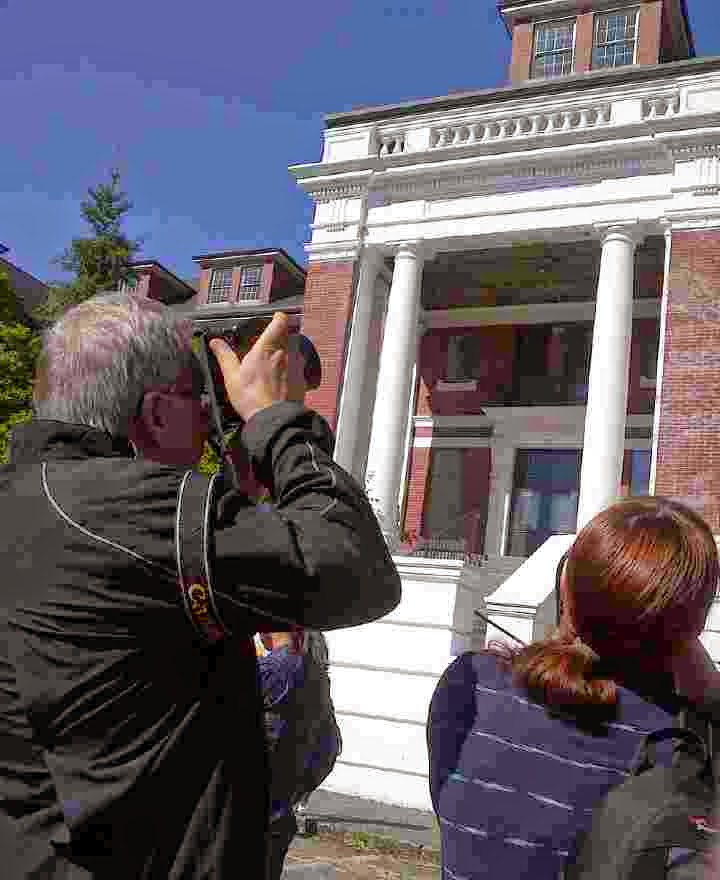 |
| Riverview landmark. (Photo by Terry O'Neill) |
However, when BC Housing's lastest public-consultation summary report was made public last week, I noticed that it made absolutely no mention of Coquitlam's detailed and well-received report -- this, even though Coquitlam's report was distributed during the most-recent period in which BC Housing had collected public input, and even though BC Housing's report summarizes the input it received, not only at open houses and from official advisory groups, but also from additional persons and organizations.
And, so, I set about to find out what exactly was going on and to fix the problem.
First, some background: Written by mental-health expert Dr. John Higenbottam, the City's report recommends the establishment of a health-and-wellness campus on the grounds.
Immediately after the report was made public in mid-June, city staff circulated it to all interested parties, including various departments of the provincial government.
And so, after noticing that the report wasn't mentioned in BC Housing's latest summary of the input it has received, I messaged the organization coordinating BC Housing's visioning exercise, Brook Pooni Associates Inc. The company answered that BC Housing's Consultation Summary Report "includes all the communications material that has been officially [emphasis added] submitted to BC Housing to date."
Yes, the City's vision had been received by BC Housing and was being reviewed and considered by the provincial body, the company added. However, "It [Coquitlam's report] was not ... submitted to be included in the report."
My immediate reaction upon reading this can be summed up in one word: Yikes! My more-detailed thought was: Well, we'd better take steps to close this little loophole, in order to ensure that the City's report becomes part of the official record.
The message from Brook Pooni ends with these sentences: "The next set of Open Houses will take place at the end of September. We would be happy to include the City's Vision report as part of our next Consultation Summary Report following the upcoming events."
Yes, I think that would be exactly what the City would want to happen, and I have now taken steps at City Hall to ensure that this does, indeed, take place.
I would hate to think that provincial decision-makers, who may very well be buried in paperwork, might downgrade (or, worse yet, not even be aware of) Coquitlam's report because it hadn't gone through official channels.
In the end, it's looking like "no harm, no foul." And thank goodness for that.
AUGUST 29 UPDATE: The folks at Brook Pooni have sent me an email saying that, in the interim (that is, until the City report can be officially submitted), they will place on the Renewing Riverview website either the full Coquitlam report or a link to that report. Most appreciated!
Saturday, August 16, 2014
Never Evergreen for Skytrain line?
 |
| Evergreen Line construction tour. (Photo by Terry O'Neill) |
However, I learned several months ago that Translink might abandon the Evergreen name in favour of something else, but I didn't discuss it in public because the decision was not final and I didn't want to do or say something that might hurt the chances for the Evergreen name to remain.
However, now that the Tri-Cities Now has broken the story about the possible change, the coast is clear to delve into the issue.
The problem began when the Evergreen Line changed from being a spur off the Millennium Line to a continuous service with the Millennium. Under the old model, eastbound travellers from Vancouver to Coquitlam would have had to disembark at Lougheed Station and board a distinct and separate line from Lougheed into Port Moody and Coquitlam. Having a separate name--Evergreen--made ultimate good sense under that model.
But at least three years ago, the model changed to one that would see the Millennium and Evergreen lines merged into one continuous whole. Folks travelling, for example, from Broadway-Commercial to Coquitlam's Lincoln Station would enjoy one continuous, uninterrupted ride. And that's good, of course! (But not so good for commuters used to travelling with no transfers from, for example, Broadway-Commercial to Braid in New Westminster; they'll have to disembark at Lougheed and get on a new eastbound train to get to Braid.).
When, about two years ago, I confirmed the new configuration, I said in public that it would provide a great service to Coquitlam residents but that it would also create a naming problem for Translink. This is because it would be very confusing for commuters riding eastbound on the Millennium Line to, once they had passed Lougheed station, suddenly find themselves on the Evergreen Line. The new, merged and continuous line would have to have one new, merged and continuous name, I told Translink. (This discussion took place in an open council meeting called to provide council input into the name of the Coquitlam stations -- input that Translink took to heart, by the way.)
Given that both the Millennium and Evergreen names were quite firmly established, I suggested a compromise: turn "Evergreen" into an adjective to describe the "Millennium," and name the entire Vancouver-Coquitlam line the Evergreen-Millennium.
The Now story suggests that Translink thinks the name is too long. And there would undoubtedly be extra costs involved in changing all the existing Millennium Line signs to make them read "Evergreen-Millennium," but I think it's the best option we have. Otherwise, I fear that we'll be stuck with the "Millennium Line" along the full length of the Vancouver-Burnaby-Port Moody-Coquitlam service.
You can let the Translink board know what you think by clicking here. And you can contact the the provincial government's Evergreen office by clicking here.
AUGUST 25 UPDATE: The Vancouver Sun is reporting that the Evergreen Line will keep its name after all! Read the full story by clicking here.
Wednesday, July 2, 2014
Big country, friendly people
 |
| Swiss vacationer Lustenberger. (Photo by Terry O'Neill) |
I noticed this fellow (see photo) in the parking lot. It looked like he was at the end of a long bike ride, and so I asked him about his journey.
Sure enough, he was in the final day of a five-week, two-day ride from Montreal to Vancouver. The man's name is Rene Lustenberger, and he's a retired office worker from Switzerland. And the mammoth ride was his vacation!
He spent most nights in campgrounds but had to resort to motels three times because of inclement whether (as in torrential rain).
Rene's "best" day was 222 kilometres, which he achieved while riding through Saskatchewan.
His impressions of Canada? "Big country" and "friendly people." I couldn't have said it better.
Congratulations, Rene, and have a safe journey home!
Tuesday, June 17, 2014
Griping about GVRD governance
 Ok, so here's what bugs me about the way the GVRD (aka Metro Vancouver) governance system works. 1. A candidate gets elected to a local council and is soon sworn in, pledging to do what's best for his or her community. 2. A few of those councillors and mayors are then selected by their councils to represent their community on the GVRD board of directors, where they are then sworn in, pledging to do what's best for Metro.
See the problem? You can't serve two masters. It's as simple as that. Yet, that's what's being asked of Metro directors. Not only are they not directly accountable to any electorate, they also find themselves in situations where, if they're doing what's best for Metro, they might not be doing what's best for the community that elected them.
This is why I tabled a Notice of Motion at last night's council meeting (seconded by Councillor Asmundson), seeking council backing to ask the provincial government to review GVRD governance. My motion follows a similar one passed last month at the BC Chamber of Commerce AGM.
You will find the text of my Notion of Motion below, as well as the background paper from the Victoria Chamber which explains the BC Chamber's motion.
I expect that Coquitlam council will deal with this issue at its next meeting.
NOTICE OF MOTION
Whereas concerns about the democratic accountability of the
Board of Directors of the Greater Vancouver Regional District (Metro Vancouver)
have arisen involving board members’ twofold roles as, first, politicians directly
elected to serve their communities on local councils and, second, as
representatives who are later selected by their respective councils to sit on
the GVRD board; and
Whereas, at its May 2014 AGM, the B.C. Chamber of Commerce, citing issues related to the need for increased accountability and better local decision-making at the regional-government level, called on the provincial government to conduct an independent study of urban and rural regional governance models to identify best practices and efficiencies and determine the feasibility of implementing those in B.C.
Therefore, be it resolved, that Coquitlam Council call on
the provincial government to conduct a study of regional governance models, not
only to identify best practices and efficiencies but also to increase
democratic accountability, so as to determine the feasibility of implementing these
goals in B.C..; and that Council’s resolution be forwarded to the next meeting
of the Union of B.C. Municipalities for its consideration and endorsement.
Here is the text from
the Victoria Proposed Policy Resolution that was adopted during the BC Chamber
AGM in May 2014. The final version of the policy statement is currently
being edited, but this is the resolution as it was passed.
REVIEW OF REGIONAL
GOVERNANCE MODEL IN URBAN AREAS
In 1966, the B.C. government established the regional
district concept of local government in hopes of dealing with problems that
transcended traditional municipal boundaries. These regional governments operate
throughout the province as a local form of government, governed by the Local
Government Act. Prior to the introduction of regional districts, land use and
planning were done directly by the Province, whereas local services (such as
fire protection and water management) were provided by independently
incorporated improvement districts or municipalities under contract with the
Province.
Today, there are 162 municipalities in B.C., plus 27
regional districts. Most regional districts inhabit primarily unincorporated
rural areas (electoral areas). However, some urban areas, which have been
deemed regionally unregulated because of numerous neighbouring municipalities,
have become dependent on regional districts for certain regional
responsibilities. In the Greater Victoria area alone, there are 13
municipalities with one encompassing Capital Regional District (CRD), serving a
population of over 350,000. In the Lower Mainland the regional district, Metro
Vancouver (Metro) represents 24 members including 22 municipalities, one
electoral area, and one treaty First Nation and serves a population of 2.3
million.
The purpose of regional districts is three-fold: they are
regional governments that deliver regional services; they are inter-municipal
and provide a political and administrative framework for the delivery of
services on a partnership basis; and they can offer local government services
for unincorporated areas.
The CRD and Metro are both somewhat considered regional
district anomalies because of their highly-populated urban areas. In these two
districts, the regional governments primarily provide fully regional services
like water supply and air quality management. In contrast, less populated
regional districts are more focused on providing local services like planning,
and fire protection. While both the CRD and Metro share regional problems, the
province deals them with quite differently. Most notably, accessing capital and
transportation management are two key issues handled legislatively in a different
way from one another.
In 1988, the legislature adopted the Greater Vancouver
Transportation Authority Act, which was the result of extensive negotiations
between the province and the regional district. This was significant in a
number of respects: it gave the GVRD new powers in transit, major roads, air
care and Transportation Demand Management; and provided revenue sources to
match. Significantly, it removed hospital financing as a regional district
responsibility as one of the swaps necessary to achieve a balanced and mutually
acceptable package. In contrast, the CRD, which is experiencing significant
transportation challenges, has no governing transportation body overlooking the
region.
The Municipal Finance Authority Act was created in 1971 and
took advantage of the emergence of regional districts and mandated that all
municipalities - with the exception of the City of Vancouver and special boards
- had to borrow through their regional districts. This allowed local
governments, through their regional districts, to pool their assets and
borrowing requests and collectively approach the marketplace producing benefits
in lower borrowing costs. Thus, while the CRD’s primary city, Victoria, must
borrow money through its regional district, Metro’s primary city, Vancouver, is
not mandated to do the same.
Metro’s unique agreements with the province have allowed
some of its main issues to be somewhat mitigated. Particular areas of BC have
grown and will continue to grow at unprecedented rates since the establishment
of regional districts, including the CRD, Regional District of Central
Okanagan, Regional District of Nanaimo, and Regional District of Fraser-Fort
George. As these urbanized regions escalate, they may also benefit from similar
agreements that the province holds with Metro.
A continuing concern of many residents in urban areas is the
question of representation on regional district boards. Residents of electoral
areas elect a representative to sit on the regional district board. Meanwhile,
representation of municipal areas on the district’s Board of Directors is
supposedly ensured by directors who are members of municipal council and
appointed by their councils for terms of three years. In other words, municipal
voters have no direct voice in deciding which of their elected representatives
will be on their regional district’s Board of Directors.
A recent example of this need for increased accountability
and better local decision-making is the concern over the proposed property tax
increases outlined by BC Transit and the Victoria Regional Transit Commission
in the coming years, echoing the concerns raised in the lower mainland over tax
increases by Translink in 2010. While other regions are also experiencing
unsustainable increases, the CRD’s example illustrates the problem most
vividly. As published, the increases reflect a more than doubling of the
property tax portion from just over $60 million in 2009/10 to over $113 million
in 2015/16, increases that will hit businesses in the region particularly hard.
While the business community supports the goals of public
transportation and the principles of sustainability, there are significant
concerns that such increases are financially unsustainable. This most recent
example continues to call for the formation of a regional transportation
authority, one that encompasses all transportation modes and provides for
increased accountability and local decision-making.
It appears the regional governance model does not serve the
majority of districts well. The fine- tuning of the regional governance
structure to meet the needs of particular areas is too short term an approach
and longer-term solutions are required. The solution also needs to address the
different issues and concerns facing both rural and urban regional districts.
The regions need to be treated fairly and appropriately and review of this
important governing body and its role is needed.
THE CHAMBER RECOMMENDS
That the provincial government conduct an independent study
of urban and rural regional governance models to identify best practices and
efficiencies and determine the feasibility of implementing those in B.C.
Kiddie play areas should be dog-free
 |
| Spirit Square (photo from bynettconstruction.com) |
Even the most responsible dog owner, who dutifully scoops up his pet's doggy-doo, can't possibly remove the film of stinky residue that's left behind. Moreover, there's no clean-up possible when a dog does Number One.
A dog doing its business isn't much of a problem when it takes place in a big forested park or wide-open median. But when the dirty business takes place in a pocket park, like the highly used Spirit Square adjacent to the Glen Pine Pavilion, it's a significant issue.
Go there most any morning and you'll see all sorts of dogs running around, doing their morning business. And go there in the evening, and you'll see all sorts of young families whose children are running and rolling around on the grass. Something doesn't add up.
That's why I raised the issue at the end of Council in Committee yesterday afternoon. And I'm very pleased to report that, as a first step, council agreed that the City should begin posting signs around Spirit Square informing dog owners that the park is a children's play area and that they shouldn't let their pets dirty it.
I will watch to see how this trial works out. Down the road, we may want to look at bylaw banning dogs from pocket parks, children's play areas, and maybe even sports fields. Several communities in North America (Raleigh, North Carolina, for example) have instituted such rules, and I'm thinking that Coquitlam might want to, as well.
UPDATE: Here's a link to a Tri-Cities NOW story about this issue.
FURTHER UPDATE (July 2): The City has now installed signs on Spirit Square, asking the public to keep their dogs out of the area. Here's a photo of one of the signs:

Wednesday, June 11, 2014
On second thought, NO
UPDATE: At its June 16 meeting, Coquitlam Council voted unanimously to, "Request the Ministry of Transportation and Infrastructure to clarify their [sic] position publicly regarding a potential connection between the South Fraser Perimeter Road and Highway 1 at the Port Mann Bridge; and 2. Take no action on City of New Westminster's request to support a new connection between SFPR and Highway 1/Port Mann Bridge until the Province responds to Council's request; and 3. Direct staff to forward a copy of the council report [upon which recommendations 1 and 2 were based] to the Ministry of Transportation and Infrastructure, City of Surrey and City of New Westminster."
Significantly, that staff report concluded by declaring that an SFPR-Port Mann connection "does little to improve street connectivity in areas in the region where it is most needed....[and that the project] has little, if any merit..." In addition, both Mayor Richard Stewart and Councillor Brent Asmundson said that the presentation made to council last week by the visiting New West politician was very misleading. I agree.
There's a story in today's Tri-Cities Now about a visit to Council on Monday by a delegation from the City of New Westminster. The story notes that the delegation asked for Coquitlam's support of New West's bid to push for a direct connection from the new South Fraser Perimeter Road to the Port Mann Bridge at a cost of up to $400 million.
Significantly, that staff report concluded by declaring that an SFPR-Port Mann connection "does little to improve street connectivity in areas in the region where it is most needed....[and that the project] has little, if any merit..." In addition, both Mayor Richard Stewart and Councillor Brent Asmundson said that the presentation made to council last week by the visiting New West politician was very misleading. I agree.
There's a story in today's Tri-Cities Now about a visit to Council on Monday by a delegation from the City of New Westminster. The story notes that the delegation asked for Coquitlam's support of New West's bid to push for a direct connection from the new South Fraser Perimeter Road to the Port Mann Bridge at a cost of up to $400 million.
 |
| South Fraser Perimeter Road (green), with current access points (blue). |
Currently, the SFPR runs under the bridge but does not connect to it. New West would like the connectiion added, though, because it believes such a link would reduce traffic travelling across the Pattullo Bridge.
The New West delegation provided us with some seemingly common-sense arguments favouring the connection, and so New West's presentation ended with a feeling that Coquitlam would support the Royal City. There was no formal declaration or motion to that effect, though.
And that turned out to be a good thing because, shortly after the crew from New West left the building, our staff started doing some digging and came up with a 2013 study, that was conducted by the Delcan group for the provincial Ministry of Transportation and Infrastructure, in response to New West's belated push for an SFPR-Port Mann connection. Significantly, that study painted an entirely different picture from that sketched by the New West delegation.
Here are some key quotations from Delcan's 2013 study:
1.1 Background
A study conducted in 2001 (South Fraser Perimeter Road Planning and Preliminary Design Study - Associated Engineering) examined the feasibility of a connection between the South Fraser Perimeter Road and Highway 1 at 152 Street as an alternate to the connection at 176 Street / Highway 15. The study concluded that such a connection to Highway 1 at 152 Street was not preferred due to the serious community severance impacts, significant community displacement issues, traffic capacity and operational shortfalls, noise impacts, as well as others issues.
With the nearly completed construction of the South Fraser Perimeter Road, the City of New Westminster has questioned if providing a direct connection between the South Fraser Perimeter Road and Highway 1 at the Port Mann Bridge could divert traffic away from the Pattullo or Alex Fraser Bridges. The City of New Westminster has thus requested the BC Ministry of Transportation and Infrastructure to re-examine the feasibility of this connection. ...
The study then re-evaluated the information and came to the same conclusions as the 2001 study had:
....In summary, providing a connection between the SFPR and Highway 1 at the Port Mann Bridge involves high implementation costs, significant community impacts, and only results in minor diversion from the Pattullo Bridge. Furthermore, a significantly low benefit cost ratio of 0.25 indicates that the proposed connection would yield no value to the region.
In short, this study completely rejected New West's idea. With this information now in hand, I feel that Coquitlam Council should not write a letter or pass a motion in support of New West's bid to add what would be a costly, disruptive and, ultimately, almost-useless connection.
Monday, June 2, 2014
Increasing supply makes housing more affordable
 |
| Proposed Miller Avenue quadruplex: Helping on housing affordability. |
The issue is almost always on our minds here in Coquitlam, as we slowly work our way through a process to update our Affordable Housing Strategy. The last public iteration of the plan saw the presentation, in committee, of a draft Housing Affordability paper about a year-and-a-half ago. A good summary of the City's efforts to date can be found by clicking here.
But just because there's no movement on the official housing-affordability-update front doesn't mean that the issue doesn't arise in other forms. At last Monday's council meeting, for example, we were presented with two initiatives that both had the potential to ease the housing-affordability crunch. Both issues received majority support from council, but the sad fact is that both initiatives attracted opposition as well.
Before I describe the specific council issues, I want to share a little bit of background about the political landscape surrounding the "affordable-housing" issue. On one side, we see the interventionists and big spenders who favour strong local government financial action to support market rental housing, not just housing for the hardest cases. On the other side -- my side, in fact -- we have the more market-oriented types who understand that the best way to ease the price crunch for market housing and rents is to increase the supply.
And that brings us to last Monday, when Council was presented with two items which had the potential to increase housing supply, thus lowering the upward pressure on price.
The first dealt with a preliminary report for an application to rezone a residential property at 763 Miller Avenue from RT-1 Two-Family Residential to RT-3 Triplex and Quadruplex Residential. Council was being asked to give the bylaw First Reading and to forward the issue to a Public Hearing.
The proposed development would see the construction of four compact homes on one large residential lot, upon which there is currently a single home. The City allows such densification in this area under its Housing Choices policy, which encourages smart densification because it embodies better land use, is more environmentally friendly and, importantly, provides more opportunity for more people to afford to live in this community. (See the illustration, above, for a view of what the four compact homes would look like.)
Under the terms of the bylaw allowing this, each unit has to be accompanied by a minimum of 1.5 parking spaces. Practically speaking, most Council members also look to the surrounding neighbourhood to ensure that on-street parking is available, as well.
Anyway, last Monday, Council voted 6-1 in favour of moving the matter to a Public Hearing. Ironically, however, the lone vote in opposition came from a Councillor who often speaks very passionately and sincerely in favour of the City taking more action on the housing-affordability front. His vote against the Miller Avenue proposal was based on his concern that not enough parking was being provided. Fair enough. But it seems to me that the very important issue of housing affordability should be a major factor in our thinking on this.
Of course, we'll all be keeping our minds open on the issue as we head into the Public Hearing, and we won't make our final decisions until that hearing ends.
The second issue we dealt with last Monday concerned a text amendment bylaw regarding lot-area calculation. This amendment allows developers to build to the full, allowable density on their properties, and not to be penalized in making that calculation by way of the land they lose in building lanes or roads surrounding their property.
It's a complicated issue, but, in some cases, it might come down to a developer being allowed to build a 22-floor condo tower instead of a 20-floor one, for example. During our discussion of the issue at the fourth-and-final-reading stage, I said I supported the amendment because it would have the beneficial effect of increasing housing supply, thus easing upward price pressure. My comments came in response to one of my council colleagues who complained generally about the way the city deals with high-density developments, but whose comments didn't address what I thought was the most compelling issue in support of the text amendment--how it would have the effect of increasing supply, thereby easing upward pressure on prices.
Ultimately, this motion passed by a 6-1 vote as well, so no damage was done.
My final comment on this is to urge everyone on Council, at City Hall and in the community to take a broad view of the housing-affordability issue, so as to recognize that much can be done without using the heavy and expensive hand of government intervention.
Tuesday, May 27, 2014
If it ain't broke, don't fix it
If it ain't broke, don't fix it.
The above, in a nutshell, is my down-home philosophy when it comes to deciding on whether to support initiatives designed to change the way the City does business. In other words, if there's no evidence that the current way the City is going about its business is failing, then there's no good reason to enact a new policy or program to change.
And this is one of the main reasons why, at last night's council meeting, I opposed Councillor Bonita Zarrillo's motion to have the city adopt some sort of ill-defined "buy-local" policy. Thankfully, Councillors Asmundson, Reid and Hodge agreed with me, while only Councillors Wilson and the Councillor In Permanent Opposition sided with Ms. Zarrillo, so her motion failed.
Nowhere in the lengthy preamble to her motion and, moreover, nowhere in her lengthy prepared speech supporting her motion did Ms. Zarrillo present any evidence to suggest that local businesses did not support the City's current procurement policy--a policy that seeks to find the best value for the City of Coquitlam through open and competitive bid opportunities.
As our manager of financial services, Sheena MacLeod, said last night, it is proven that such competition leads to lower prices.
Moreover, as I pointed out in my speech on the matter, enacting some sort of buy-local campaign could actually end up hurting local businesses. This would occur because such an initiative would spark a mini trade war, one that would see other local municipalities enacting buy-local initiatives as well, thus limiting business opportunities for Coquitlam companies.
It's also clear to me that a "buy-Coquitlam" policy would add red tape to the City's procurement policy, placing onerous, time-consuming and expensive burdens on staff time. Ironically, the only jobs a "buy-Coquitlam" policy might, then, create would be within City Hall's administrative staff.
During her speech, Councillor Zarrillo expanded on her initial motion by suggesting that it implied that a "buy-local" policy would only kick in "when all things were equal." Well, if she meant that, she should have said so in the first place.
But, even if she had, I pointed out that "all things being equal" was either an extremely subjective criterion or, if it applied merely to the exact figure in a bid, likely to occur very rarely indeed. This being the case, it was hardly a compelling reason to support the motion.
The bottom line is that the current "best value" policy ensures that the City gets the best bang for the taxpayers' buck, while also creating a market in which good local suppliers can succeed both near to and far from home.
Here's a link to the Tri-City News' story about the debate. And here's a link to the Tri-Cities Now's story.
The above, in a nutshell, is my down-home philosophy when it comes to deciding on whether to support initiatives designed to change the way the City does business. In other words, if there's no evidence that the current way the City is going about its business is failing, then there's no good reason to enact a new policy or program to change.
 |
| Coquitlam business. (from coquitlam.ca) |
Nowhere in the lengthy preamble to her motion and, moreover, nowhere in her lengthy prepared speech supporting her motion did Ms. Zarrillo present any evidence to suggest that local businesses did not support the City's current procurement policy--a policy that seeks to find the best value for the City of Coquitlam through open and competitive bid opportunities.
As our manager of financial services, Sheena MacLeod, said last night, it is proven that such competition leads to lower prices.
Moreover, as I pointed out in my speech on the matter, enacting some sort of buy-local campaign could actually end up hurting local businesses. This would occur because such an initiative would spark a mini trade war, one that would see other local municipalities enacting buy-local initiatives as well, thus limiting business opportunities for Coquitlam companies.
It's also clear to me that a "buy-Coquitlam" policy would add red tape to the City's procurement policy, placing onerous, time-consuming and expensive burdens on staff time. Ironically, the only jobs a "buy-Coquitlam" policy might, then, create would be within City Hall's administrative staff.
During her speech, Councillor Zarrillo expanded on her initial motion by suggesting that it implied that a "buy-local" policy would only kick in "when all things were equal." Well, if she meant that, she should have said so in the first place.
But, even if she had, I pointed out that "all things being equal" was either an extremely subjective criterion or, if it applied merely to the exact figure in a bid, likely to occur very rarely indeed. This being the case, it was hardly a compelling reason to support the motion.
The bottom line is that the current "best value" policy ensures that the City gets the best bang for the taxpayers' buck, while also creating a market in which good local suppliers can succeed both near to and far from home.
Here's a link to the Tri-City News' story about the debate. And here's a link to the Tri-Cities Now's story.
Wednesday, May 14, 2014
Conscience first, politics second

Tuesday, May 13, 2014
The essential nature of the humble fact
 |
| Mowat exposed as a fabricator of 'facts.' |
Of course, knowing absolutely what is true is beyond the scope of we mere mortals; nevertheless, I've long believed that we humans should strive for the truth, and that truth does exist. (In stating this, I am deeply at odds with moral relativists.) We strive for the truth, I say, by collecting facts and then organizing them into a coherent whole--a coherent whole that we might describe as providing at least a window on the truth.
This issue comes to mind with the recent death of writer Farley Mowat, the much-lauded Canadian writer who had a rather different view on telling "true" stories. As revealed in an historic Saturday Night cover story, Mowat made up substantial parts of one of his most famous "true" accounts of living in the North.
When confronted with this fact, Mowat's answer was that his story was still "true" in that it conveyed a view of the world that he considered to be the correct and true one. In other words (his own, as a matter of fact), he never let facts stand in the way of a good story.
Here's how one recent obituary described his approach to story-telling:
"My métier lay somewhere in between what was then a grey void between fact and fiction," he wrote.
He delivered an even stronger defence during a
1999 Harbourfront International Festival of Authors discussion with
Peter Gzowski, the then CBC host who passed away in 2002.
When Gzowski challenged Mowat about the volume of facts
needed in writing non-fiction, the passionate writer declared: "F--k the
facts!"
I would argue, however, that Mowat was wrong and that one is doomed to fail in one's attempt to tell a true story or make a true assertion if one attempts to do so by building one's arguments on a foundation of distortions, falsehoods and, well, lies.
Consider two builders setting out to construct a brick home. One has bricks that are sound and well-formed, the other uses bricks that are shoddily made and irregular. I don't need to tell you whose house will be "truer".
Getting the facts right is essential. A reader or an audience member should not trust a conclusion (that is, an assertion of truth) if it is known that the facts that support that conclusion are fantasy.
Monday, May 5, 2014
Cory Sater and the existence of evil
We learned last week that a judge had sentenced Cory Sater--the drunkard whose monumental selfishness led him to drive without a licence, to drive while inebriated, to run over and kill Charlene Reaveley and Lorraine Cruz as they stopped to help someone at the side of the road along Lougheed Highway, and then to flee the scene of the accident--to 7 1/2 years in jail. So egregious was Sater's criminal actions that even a major newspaper in Great Britain reported on the sentencing.
The conclusion of this sad and terrible case reminded me of a column I wrote at the time of the killings--a column about one particular social scientist's repulsive ruminations about why the then-unknown motorist might, essentially, be excused for having fled the scene of his crime. Ultimately, of course, the sentencing judge had a completely different take on Sater's criminal responsibility. Here's that column from three years ago:
The conclusion of this sad and terrible case reminded me of a column I wrote at the time of the killings--a column about one particular social scientist's repulsive ruminations about why the then-unknown motorist might, essentially, be excused for having fled the scene of his crime. Ultimately, of course, the sentencing judge had a completely different take on Sater's criminal responsibility. Here's that column from three years ago:
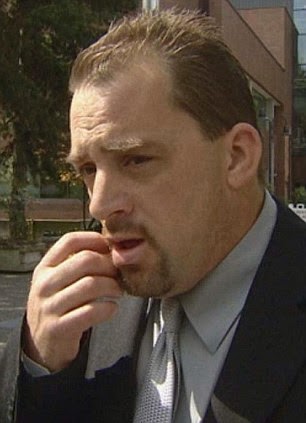 |
| Convict Cory Sater. (DailyMail.co.uk) |
Does anyone other than a dwindling minority
of procrustean traditionalists recognize evil anymore—personal evil, that is?
Oh, sure, there’s plenty of the geopolitical variety to go around these days,
especially in North Africa. And there’s more than enough being identified on
the national stage by perpetually outraged critics within this country too, most
notably by those on the political left, who eagerly attach the E word [Evil!] to
everything from corporate profits and free trade to the oil sands and Prime
Minister Stephen Harper’s piano playing.
But we rarely hear about individual
Canadians doing “bad” things, exhibiting sinister behavior, acting wickedly, or
carrying on immorally, let alone sinning.
Instead, there’s always some sort of exculpating
explanation for bad behaviour. Shoplifters suffer from kleptomania; corrupt
officials have succumbed to stress or have manifested a previously undiagnosed
psychiatric disorder; prostitutes are victims of the patriarchy, poverty or
both; juvenile delinquents are the recipients of inadequate parenting; inner-city
gangsters are victims of racial discrimination; and thieves are impoverished or
addicted, and, if the latter, are surely not responsible for the burden of the
illness under which they are labouring. You get the picture.
Look at the website promoting the recent
Pink Shirt Day/anti-bullying campaign—a cause that should easily give rise to
descriptions of bullies acting wickedly, etc.—and you’ll see therapeutic
twaddle aplenty along with much vigorous exhortation to get to the root of the
problem, etc., but nothing about the plain and simple fact bullies are acting
immorally.
Which brings me to Exhibit A, otherwise
known as the spark that gave life to this particular column. You might have
heard of a horrible hit-and-run accident in Coquitlam, B.C., two weeks ago
which left two young women dead. In covering the aftermath of the crash, which
included the laying of several charges against a suspect, including two counts
of impaired driving causing death, a local newspaper turned to a clinical
psychologist from Simon Fraser University for some “insight” into “what might
lead someone to flee the scene” of a serious accident without giving help.
Dr. Joti Samra is quoted thusly: “Assuming
that it’s a true accident, the reality is… even from the perspective of the
person that caused the accident, it can be quite traumatic and cause an acute
stress reaction.” Got that? Acute stress
reaction.
The good doctor goes on to explain that the
brain could be flooded with information and emotion that would cause a person
to act unusually. “The fight or flight response is something we’re exposed to
when we are faced with extreme traumatic events,” Dr. Samra concludes. “Our
body kind of goes into a shock, it doesn’t know what to do.”
Notice the focus on the culprit’s body and
not his mind? I suppose it’s true that this human-as-hormonal-machine answer is
what you’d expect from a clinical psychologist, whose business, of course, is
to produce exactly this sort of pseudo-scientific analysis. But there’s no
excuse for the news media to limit their probing into human behaviour to “experts”
such as Dr. Samra. Why not someone with some grasp of the profundity of human
existence, someone like a novelist, a moral philosopher or a religious leader--
someone who recognizes we’re more than just pre-programmed biological machines?
To my mind, it would be a welcome
relief—and far more enlightening—to hear some real insights into moral character, the dark origins
of personal cowardice, or the nature of evil in circumstances such as these.
And so, for example, when asked why a driver might flee the scene of an
accident in which he had struck two innocent people, a priest might comment
that such a person had become alienated from God, had too easily succumbed to
temptation, and had become a sinner in need of redemption.
This would be really useful information as
far as I’m concerned, and might also help many readers reflect more deeply on
their responsibility—indeed, their duty—to act in a moral fashion.
But, of course, in this secular, humanistic
era of ours, we see very little serious discussion about evil in the public
square. Perversely, one is more likely to find scintillatingly descriptive
words, purring about the concept of evil, in advertisements attempting to
induce a consumer to indulge in some sort of deliciously sinful wickedness for
an affordable price. Moral inversion to sell chocolate pudding.
A recent full-page newspaper advertisement
for Volvo is a perfect example of this lamentable trend. Emblazoned above an
image of a shiny red S60 model, the ad copy informs us, “There’s more to life
than a Volvo. Like raising a little hell
with 300 horses, spanking corners
with your all-new sport-tuned chassis. And feeling
a little dangerous in a car tricked out with safety technology. That’s why
you drive the all-new naughty Volvo
S60.” (Emphasis added.)
A 16th-Century proverb holds,
“Evil doers are evil dreaders.” Today, however, evil doers are either the next
patient for the couch or a target market.
Saturday, April 19, 2014
Flowers to Eagle Ridge Manor residents
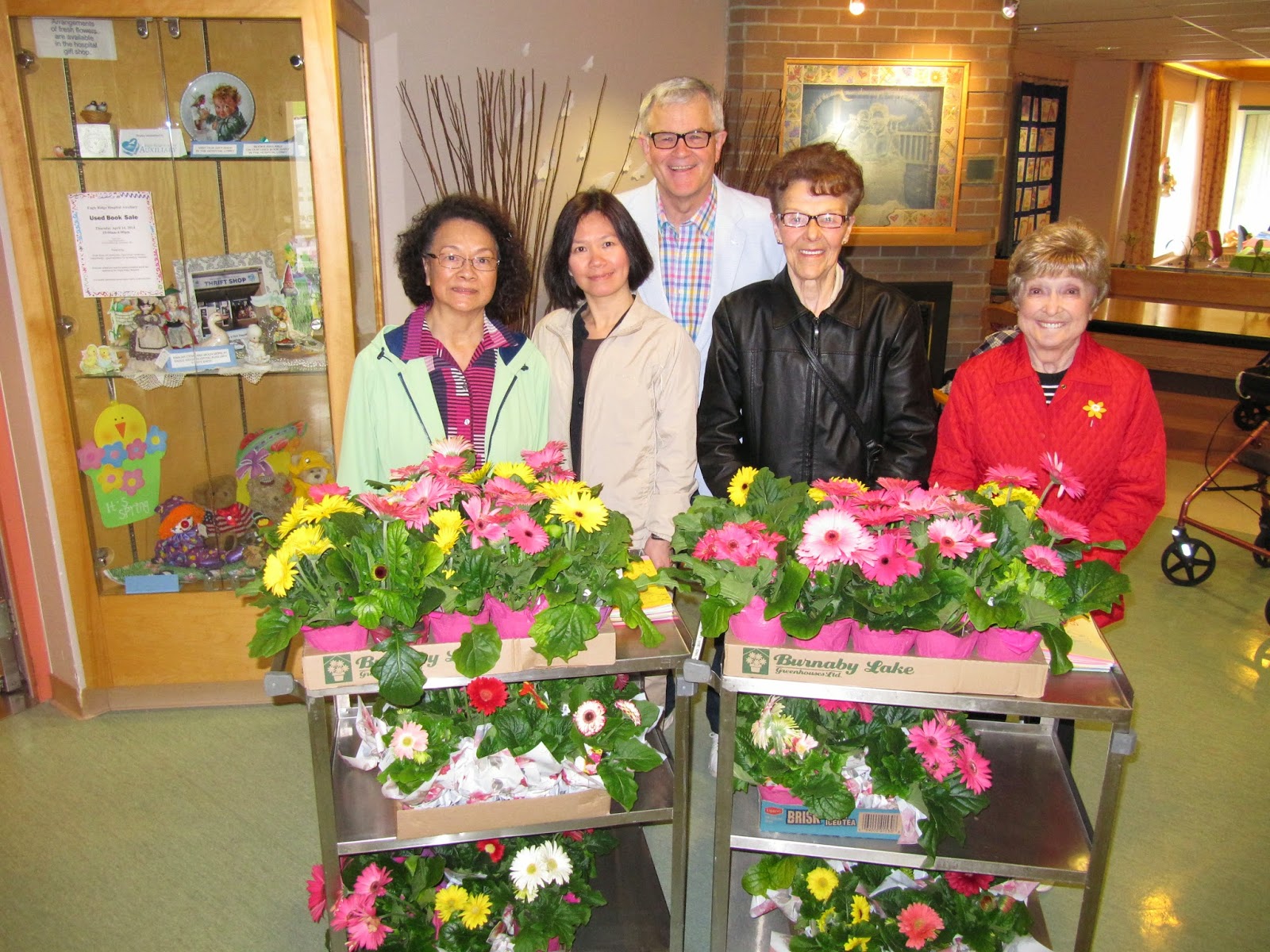 |
| Our volunteers for 2014: (l-r) Dora, Catharina, Jaci, and Irene. |
I put forward the idea that it might be nice to show our respect for the sick and aged by visiting them over the Easter weekend (a time of the year in which we celebrate life, of course!), presenting them with flowers and greetings.
Everyone agreed that it would be a good idea, and then one of the group looked at me with arched eyebrows and said, "Well...." I took that to mean that, since the flowers-project was my idea, I would be responsible for making it come to life. And the rest is history.
For 20 years now, I've been organizing a group of parishioners every Easter to visit the residents of a long-term care facility, Eagle Ridge Manor in Port Moody, bringing them a little Easter cheer of flowers and fellowship. Over the years, we've seen some of the participants grow from little children to young adults. Some others have moved away. A few others have passed away. But every year, we have no difficulty attracting between a half dozen and two dozen volunteers to keep our Easter Flowers project alive.
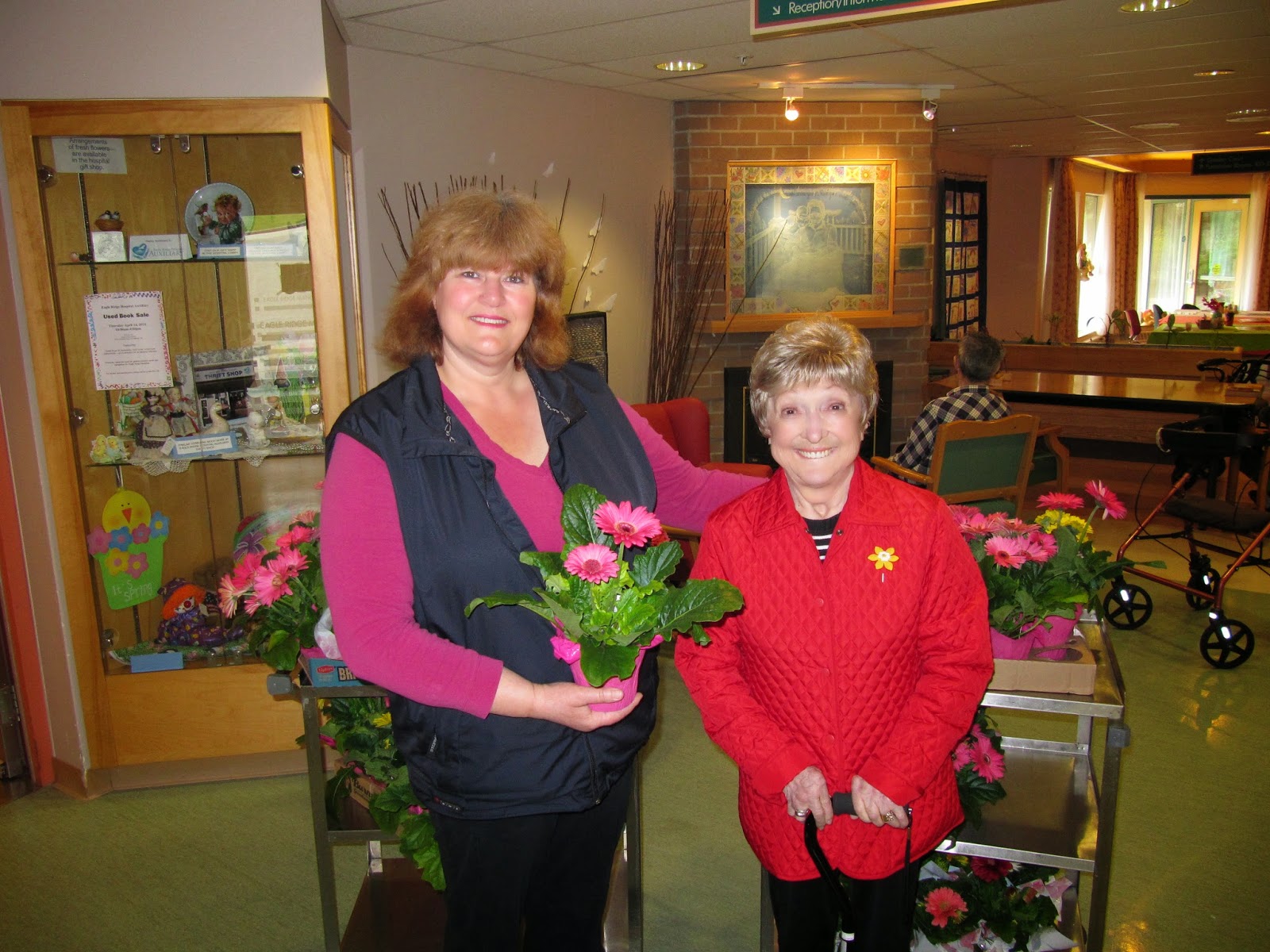 |
| The Manor's Charlotte Stewart and volunteer Irene Munro, 83. |
I've just returned home now from Eagle Ridge Manor and it was another memorable morning, as the flowers, cards (made by children in the parish) and visits really cheered the residents. Family members and staff also expressed their gratitude for our visit.
I'd like to thank Charlotte Stewart, the Manor's recreation therapist, for helping make our visit run smoothly this year, and for taking to a microphone at the end of the morning to give us a special "thank-you." After 20 years, it feels pretty good!
I'd also like to thank Wim Vander Zalm, of Art Knapp's in Port Coquitlam, for faithfully donating the plants each year. The total is now well over 1,500 flowering plants, by my reckoning. Thanks, Wim; we couldn't have done it without your support.
Tuesday, April 15, 2014
Come July 1, recycling will still be weekly
Big changes are coming to the way trash (aka "garbage"), green waste and recyclables are picked up in Coquitlam. But, despite the fact the City has put a lot of time, effort and expense into explaining how the system will change on July 1, the information has a rather large gap in it relating to recyclables. To get right to the point, the information that is missing on the City's website*, in the pamphlet it sent to every household in Coquitlam this month, and in the four-page FAQ flyer is this: your "blue box" will be picked up every week, on the same day that it is currently picked up now.
 |
| Current garbage and recycling system in Coquitlam. |
I need to point this out because the pamphlet does not refer to the frequency of recycling, and the FAQ flyer states confusingly that recyclables will be picked up on the same day as household garbage is picked up. And since household garbage is being picked up every second week, and not weekly, this information has led many to conclude that recyclables will be picked up every second week as well.
I have talked about the information-gap with City managers and communications staff, and they have told me they will move quickly to clarify to issue. The reason the problem arose in the first place is directly related to the fact that the City will no longer be picking up recyclables as of July 1. Instead, the contractor will be hired by Multi-Material B.C. (MMBC), a manufacturers' organization working under provincial law that has been tasked with the responsibility for recycling.
The City did not find out until quite recently who that contractor would be, what schedule the contractor would operate with, and what exactly MMBC would enable the contractor to pick up.
The good news is that the City learned within only the past few weeks that MMBC has awarded the recycling contract to Smithrite, the same company the City now has under contract to do recycling pickup.
Furthermore, MMBC says Smithrite will adhere to the same weekly schedule that it has with the City, and that it will pick up the same mix of newspapers, other paper and cardboard materials, plastics and even glass, the latter having been up in the air for several months. I understand that glass might have to be placed in a separate container, however, and might also be picked up less frequently. That's still to be determined.
As for all the other changes, including bi-weekly (every second week) trash pickup, weekly green-waste pickup, cart-selection options, etc., please refer to the City links I have provided above. Note: you have until April 25 to let the City know whether you want to increase or decrease cart size.
*After I raised the issue yesterday afternoon, the website was updated with current information about recycling.
*After I raised the issue yesterday afternoon, the website was updated with current information about recycling.
Thursday, April 3, 2014
Some action on chronic, prolific offenders
Justice Minister Peter MacKay was busy today defending his victims'-rights legislation, which will give to crime victims some statutory rights in the criminal-justice system. With justice reform in the news, I thought it would be a good time to update my campaign seeking tougher laws against chronic, prolific offenders.
 |
| Photo: The Tri-Cities Now |
Well, since then, we've heard from both the FCM and Mr. MacKay himself in response to the motion. First, on April 1, the city received a letter (dated March 17) from Mr. MacKay informing us that his office had received the motion, and that he had shared our correspondence with "appropriate departmental officials."
"I would like to take this opportunity to commend the Council for its efforts to help ensure the safety of residents in the Coquitlam community," Mr. MacKay continued. "Our government is committed to strengthening the criminal justice system. I can assure you that Department of Justice Canada officials work closely with their provincial and territorial counterparts, as well as municipalities and police services, to address the issue of chronic offenders."
He then went on to explain how Ottawa is currently reviewing the bail regime in Canada. However, he did not specifically say he would embark on any new initiative designed to define "chronic, prolific offender" in the Criminal Code so that the current revolving-door in the courtroom can be slammed shut. When a chronic, prolific offender with 100 theft convictions gets the same slap on the wrist that someone with half a dozen convictions receives, it's just not right. Let's hope that that tackling the chronic-, prolific-offender issue is high on Mr. MacKay's to-do list.
Meantime, on March 24 Coquitlam received an e-mail from Diane Belanger, the FCM's administrative and resolutions coordinator, who advised us that our resolution was considered by an unspecified FCM committee which, in turn, recommended to the board in March that the resolution be sent back to staff for further analysis. The board concurred, and the motion will now be brought back to the September board meeting.
All in all, it's about as much action as I would have expected at this point. I'm pleased that both the FCM and Mr. MacKay have considered the motion seriously and have responded to us. Frankly, I don't expect to hear much more from the federal government on this, but will keep my fingers crossed that, in September, the FCM's board will decide to move the motion to the floor of the next FCM convention.
Friday, February 21, 2014
I'm actually a big supporter of the 'Citizen Budget'
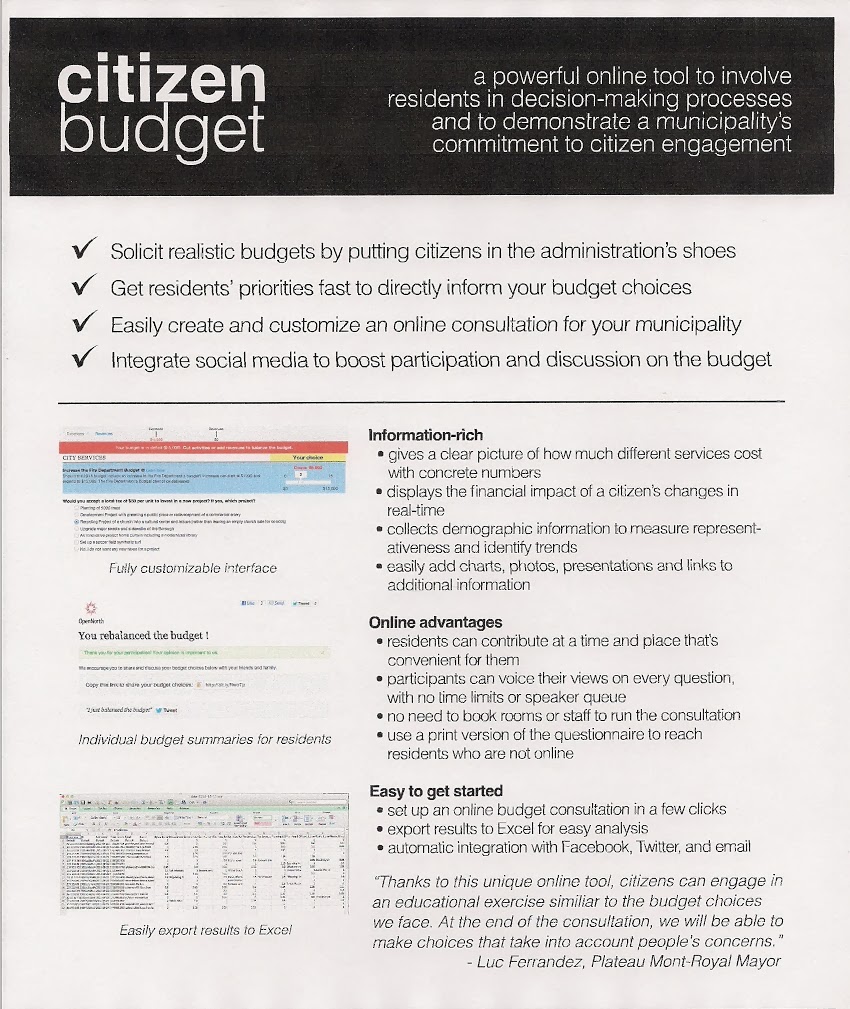 |
| Citizen Budget: Tri-City News left the impression I oppose it. |
First, some background. You've all heard public figures complain about inaccurate and out-of-context reporting. It's a staple of political theatre.
And I must admit that, having spent more than three decades as a full-time journalist, I've been the target of some of those complaints--even, on rare occasions, justifiably.
But in my two-plus years as a Coquitlam City Councillor, I haven't had much reason to do any complaining myself. For the most part, the reporting of my activities on Council has been both fair and accurate, albeit never as thorough as I would like.
On this latter subject, now that I'm on the "inside," it often pains me to see how a complex subject, such as a neighbourhood plan or a new strategy of some sort, that council has spent several hours discussing and on which staff has clearly spent many dozens or even hundreds of hours working, is boiled down to eight-to-ten paragraphs by a reporter.
Nevertheless, when the boiling-down captures the essence of both the content of the report and the discussion around it, there's really not much to gripe about.
That said, I must now declare that the top story on the front page of the Feb. 21 issue of the Tri-City News has somewhat misrepresented my position on a bold, new public-opinion-gathering exercise that the City will likely adopt in the next round of budget consultations.
My colleagues and I on Council discussed the Citizen Budget initiative at the Feb. 19 meeting of the Finance Standing Committee. The initiative would allow interested citizens to express their opinions about such budget-related issues as revenue and expenses, and programs and personnel by way of an interactive, easy-to-understand website.
Now, those of you who have been following my political career to date will know that I have been a big supporter of new ways to engage citizens. In fact, it was my initiative that led to Coquitlam holding its first-ever E-Town Hall meeting.
Understandably, then, I'm a big supporter of the Citizen Budget initiative, and said so in my presentation at Committee. However, I also pointed out that the on-line opinion-gathering apparatus would be just one way that Councillors could and should gather information; others include our own research, face-to-face interactions with the community and the annual Ipsos Reid poll.
And on the subject of polls, I noted that, unlike the Ipsos Reid one, the on-line initiative would not be scientific, and so its results would have to be taken with a grain of salt.
Ultimately, though, I opined that the Citizen Budget initiative would be beneficial, not only for its ability to sample public opinion and obtain more budget feedback, but also for the very fact that it sends the message to all residents that the City really does care what they think.
After all that, however, Tri-City News lumped me in with "a few Coquitlam councillors [who] voiced concerns about the program's lack of controls," reporting that, "Coun. Terry O'Neill said while the Citizen Budget could capture the mood of Coquitlam's 139,000 residents, 'this has to be taken with a grain of salt' as the results aren't as scientific as those from the Ipsos Reid poll." (The story does not appear to be posted online yet.)
True enough, as far as it goes. But, of course, the problem is that story doesn't go nearly far enough, in that it leaves the impression I am opposed to the plan when, in fact, the exact opposite is true.
And there you have it. It's more of an exasperated quibble than an angry complaint. But, on a subject (voter and citizen engagement) on which I have devoted so much attention, it's important that the complete story be told.
Subscribe to:
Posts (Atom)