Monday, June 3, 2013
Some perspective on the FCM
One of my colleagues on Coquitlam Council is in the news today, complaining that he was the only Coquitlam Councillor, who attended the big Federation of Canadian Municipalities conference in Vancouver that has just wrapped up, who chose to commute to the event rather than stay in a hotel downtown.
His complaint is getting a lot of traction, judging by the comments that follow this story on CKNW's website.
Since I am one of the five Council members who chose to stay downtown for three nights, I feel I must get several things on the record and provide some context.
First: this is the second such conference I have attended in a month. A few weeks ago, I travelled to Harrison to attend the Lower Mainland Local Government Association's annual convention. As well, I did not attend last year's FCM conference in Saskatchewan, and so this was my first FCM convention.
Second: Since it was taking place in Vancouver, I considered it my public duty to attend this conference, to attend the speeches, to study the resolutions, to vote on the resolutions, to attend as many of the seminars as I could, to vote for delegates and representatives, and to attend the many evening receptions that are hosted by industry representatives and other cities.
Third: Given that attendance at these conventions is not mandatory, I suppose I could have acted selfishly and or lazily and chosen not to attend--spending my time at home to work on my own personal business, visit friends and family, or simply relax and recreate. This past weekend would have been a great one for a walk in Mundy Park or a ride along the PoCo trail, but I spent it indoors, instead, at the FCM.
I could have also chosen not to stay for the evenings, but I was told (correctly, as it turned out) that these evening gatherings were important. My colleague who is complaining has been in public life for 40 years, and so most likely has all the political insights and acquaintances he will ever need, but this is just my second year in office, so I am still attempting to soak in as much information as I can.
Again, as I said above, I considered it my duty to fully participate in this conference. I will share, below, some of my notes from the FCM.
Fourth: As Mayor Richard Stewart has suggested in the CKNW story, it is next to impossible, from a physical stamina point of view, to attend all aspects of conference and also commute early in the morning and late at night. The agenda is simply exhausting. The official, working part of the events at the FCM typically started at 8 a.m. and concluded in the late afternoon. The receptions, social, and formal dinners took up the evenings well into the night. I found the networking and casual, unplanned discussions to be very important to the whole experience, providing new contacts, new insights and fresh ideas.
(Incidentally, while many out-of-town delegates took advantage of "study tours" throughout the convention, it is my understanding that our Coquitlam delegation did not enroll in any of the tours--such as "New Urbanism Bike Tour;" "Vancouver Heritage Tour;" "Housing Tour," "Port Metro Operations Centre Tour," etc.--but chose instead to attend the less-exciting my substantially more important working sessions.)
On Sunday, for example, I was at the convention hall at 7:45 a.m. for Green Party leader Elizabeth May's speech at 8:05 a.m. (on which I commented on my Facebook page). The day continued with a speech by Liberal leader Justin Trudeau, an award ceremony, the AGM (I lost count of the speeches) and election of officers of the FCM, then election of regional chairs; these tedious but necessary elections (complete with speeches from eight candidates and then a long delay because of a mechanical problem with a voting machine) lasted until well in the afternoon. I was very happy to have a hotel room to repair to, to allow me to refresh myself, change my clothes, and get ready to attend the final dinner, at which Councillor Craig Hodge played formal hosts to a table that attracted representatives from Winnipeg, Nakusp, and Saanich.
Yes, it was a lovely night, but it was yet another extremely long day that ended at 11 p.m. If I had started the day with a commute from Coquitlam, I don't think an exhausted, grumpy Terry O'Neill would have made a very good impression on my new acquaintances from the three aforementioned communities.
So, what benefit did my attendance at the FCM have? I will conclude this posting by sharing some of my rough notes from Friday and Saturday's events:
Friday
Extractive industries workshop
First presenter is from Teck, David Parker.
Mining operations have to earn and maintain a Social Licence, not just a legal permit
Issues of trust and Transparency .
Have to plan for end of project.
Six key sustainability focus areas: materials stewardship, water, biodiversity, energy, people at centre, community overall.
Re community: focus on community benefit.
Corporate sponsorship presentation
Www.sponsorshipcongress.ca is October in Calgary. Also look to sponsorshipgroup.ca which specializes in linking up minis and sponsors. Brent@sponsorshipgroup.ca.
Munis account for one third of their business now. They are consultants. Not doing the sale.
In one building there can be hundreds of assets to sell rights to. U can raise money without selling outright naming rights. Have to show value to the buyers.
New stats: since 2006, the industry has grown 43percent. Even thru recession.
A$1.6 billion industry in Canada. 20percent is spent locally. The big boys may have one thousand properties. 70percent is cash. 30percent of brand marketing is in sponsorship or experiential marketing.
Greatest growth has been in fairs festivals and annual events. Sports is declining.
Don't do it ad hoc. Go All the way or not. Make sure you know what constituents want. In Edmonton, eg, they were not OK with selling naming rights to exterior of park or building, but OK with selling off inside bits and pieces... Procurement can be integrated with sponsorship
U have to be in true partnership...be concerned that the companies make their money.
The centre for excellence for public sector marketing, exists.
One. Build case external and internal
Two. Develop policy
Three. Asset I'd and valuation
Four. Procurement policy
Five. Sales team external or internal? External to start, then internal... All professionally
Rick Hansen speech
Check into Planat app to rate facilities for accessibility.
James Moore speech
95percent of Nat Museum material is not on display. Moore wants to allow local museums to borrow and get access! Maybe Coquitlam can get fed help for an actual museum!
Saturday
Delivering Smart Services session
Services and citizen interaction seminar sponsored by CISCO. Ned is speaker, from Cisco.
How to put technology to use to achieve public policy objectives.
two big ideas: a. the Internet of everything; b. ubiquity of video
A. 99percent of things still aren't connected. But people, process, data and things can be. IE process, delivering the right info to make right decisions.
Even connecting tree to Internet so u can monitor output of oxygen, need for water..
B. video changes the game re how we interact with each other. Can we add Skype to town hall meetings?
Cisco sponsors the video networking index. In Canada there will be 33million Internet users in four years.
We are using video at home. People are going to start to expect same video in city services.
It's no longer going to be enough to simply set up a website without a face to face video.
There's no reason our staff can't meet with citizens, etc, using video, if quality is outstanding and the security has to be outstanding.
Cisco has remote site box that can be set up to provide face to face video. Printer sign dox. Scan it and send it back. "you can consume a govt service without having to go to a govt office."
Mayor of Newmarket
The city tweets.
They have produced several videos, avlb on Internet website, to explain and promote the city. (Coquitlam could do more or this). They reached out and communicated on budget. Feedback from 1000 people thru social media.
Problem is how to many multiple points of entry.
Also, customers are expecting 24 hr service.
Info officer from Newmarket appears be video linkup
They have a centralized customer service call centre. Service requests can be sent to crews in the field, and they can msj back. System allows for a full start to finish tracking. The original call receiver owns the call start to finish. Thru this customer service initiative, front counter positions were eliminated-shifted to customer service centre.
Idea for Coquitlam: A direct one line connection to a city number, from which caller could select numbers one to eight to select one councillor. It will connect directly to the councillors cell phone.


Monday, May 20, 2013
Christy Clark's secret weapon
 |
| Christy Clark: A woman's edge? (Photo by Terry O'Neill) |
First, though, Brian Hutchinson in Saturday's National Post and Michael Smyth in Sunday's Province have provided extremely interesting insights into how the Liberals' superior polling told them that their dual focus, on Adrian Dix's doubtful leadership abilities and the NDP's potentially harmful economic and environmental policies, was working.
Indeed, both writers report that chief pollster Dimitri Pantazopoulos told party leaders four days before the election that the BC Liberals were on track to win 48 seats; currently, their total stands at 50. Just a few hours ago, a piece by the Canadian Press's Dirk Meissner shows how oblivious the NDP were to their looming electoral catastrophe.
Apparently, the NDP's own polling data had them winning--and winning big. The party did not realize that Dix's campaign was falling flat on its face and that Dix's mid-campaign reversal, in which he announced his opposition to the Kinder Morgan pipeline expansion, was a big vote loser. (Smyth dubs Dix's announcement as the "Kinder surprise." Nice!)
I was pleasantly surprised when I heard, on election night, from a construction-industry acquaintance of mine that the shop steward at his operation had urged his fellow blue-collar union member not to vote for the NDP because their policies would kill economic growth in the province. This is something I've long believed, but had not appreciated the fact the message had gotten through to workers.
I have to think that some of this must be credited to Barbara Yaffe's tremendous mid-campaign Vancouver Sun column, "All green economy would bleed red," in which she itemized, in what the NDP must have considered excruciating detail, the many resource-related and other development projects the party opposed.
It's also emerging that voters didn't think Dix projected a leadership-type aura. Personally, I've seen him speak several times and was always impressed by his grasp of policy, the ease with which he can recall facts and figures, and the eloquent way he speaks. However, he also comes across as rather goofy sometimes; this never bothered me, but it apparently bothered a great many voters, especially those who saw him during the campaign's lone televised debate, in which he was slouching and looked rather shabby.
And much has also been made about what a campaign-trail trooper Christy Clark was: about her charisma, her energy and her ability to connect with people. The lone time I saw her in person over the past month was at a late-in-the-campaign, early-morning stop at the office of Coquitlam-Maillardville B.C. Liberal candidate Steve Kim.
Clark was on message and on fire, taking time not only to rally the troops and deliver key election messages, but also to warmly greet some moms and school kids who showed up for the event. At the time, I wondered why the Liberals were bothering to deploy their leader in a riding that was "obviously" and "clearly" one they had no chance of winning. Ha! How wrong I was! (Actually, the end-of-month final count, in which absentee ballots will finally be counted, could reverse the outcome in Coquitlam-Maillardville. I'm predicting that Kim's lead over the NDP's Selina Robinson will, at the least, be cut. A full recount is likely.)
This last anecdote about Clark's ability to connect with people leads me to an observation about the BC Liberals' win that no one that I am aware of has yet to express, and that's that another factor in the victory might have been Clark's gender. It's not something I'm necessarily proposing myself, but it must be noted that recent political research in the U.S. shows that, essentially, voters are more likely to support a woman than a man.
The May edition of The Atlantic has an interesting item about this subject. Here are a few of the most pertinent sections:
"Evidence suggests that [anti-female] double standards may have once applied but don't any longer.... [Voters] tend to assume women are more trustworthy, less corruptible, and more in touch with everyday concerns... [Women] are harder to criticize than men. Sharp-edged attacks, particularly by male rivals, risk running afoul of the societal bias against, essentially, hitting a girl."
The latter declaration suggests that, even if the NDP had decided to launch attack ads against Clark, to counter the BC Liberals' attack ads against the NDP and Dix, those ads might very well have backfired.
And so, it may well be that the NDP was a "dead party walking" even as the campaign began.
Friday, April 26, 2013
The truth about taxes
 |
| Graphic from FraserInstitute.org |
The mayor noted at last weekend's E-Town Hall meeting that an equal number of participants seemed to be calling for more expenditures as were calling for cuts to spending. He did not express surprise.
Indeed, my colleagues on council and I often find ourselves performing a balancing act, trying to figure out how much we can control spending before the "we want more services" public gets restless, and/or trying to determine how many new services we can provide before the "we want lower taxes" sector makes its concerns known.
Often when these issues arise, I find myself going back to the basic issue of affordability; that is, whether a cash-strapped, mortgaged family really can afford what is being proposed. I keep reminding my colleagues and the public that the government does not necessarily have to play such a large role in everyone's life.
This is why I have decided to share with you recent news from the Fraser Institute--news about the large percentage of people's income that goes to government. It's important stuff, and I would urge readers to click here to visit the FI site to access to the full report.
Here's the summary, as recently released by the FI (the bold-faced emphasis, below, is mine):
The Canadian Consumer Tax Index 2013
The Canadian tax system is complex and no single number can give us a complete idea of who pays how much tax. This Alert examines what has happened to the tax bill of the average Canadian family over the past 51 years. To do this, we have constructed an index of the tax bill, the Canadian Consumer Tax Index, for the period 1961 to 2012.The Canadian Consumer Tax Index reveals that there has been a dramatic increase in the average family’s tax bill from 1961 to 2012. Among those factors is a sizeable increase in incomes over the period: 1,382 percent since 1961. Even with no changes in tax rates, the family’s tax bill would have increased substantially; growth in family income alone would have produced an increase in the tax bill from $1,675 in 1961 to $24,828 in 2012. Second, the average family faced a tax rate increase from 33.5 percent in 1961 to 42.7 percent in 2012. It is clear that taxes have become the most significant item in family budgets, and that taxes have grown more rapidly than any other single item.
In 1961, the average family spent 56.5 percent of its cash income to pay for shelter, food, and clothing. In the same year, 33.5 percent of the family’s income went to governments as tax. By 2012, the situation was reversed: the average family spent 36.9 percent of its income on the necessities of life while 42.7 percent of its income went to taxes.
The results show that the tax burden faced by the average Canadian family has risen compared with 51 years earlier. The total tax bill, which includes all types of taxes, has increased by 1,787 percent since 1961, and the tax bill has grown more rapidly than any other single expenditure item.
Monday, April 22, 2013
Coquitlam Happy with E-Town Hall Turnout
The City has issued a news release about Saturday's successful E-Town
Hall meeting, Here's the full text, below:
COQUITLAM, BC, Monday, April 22, 2013 – Coquitlam's first E-Town
Hall Meeting went off without a hitch over the weekend. The meeting, which went
an extra half hour to answer all the questions, saw about half its inquiries
come from online participants.
"By all accounts, the E-Town Hall went very well," said Coquitlam
Mayor Richard Stewart. "Engaging the public is a challenge in every city.
By adding electronic and internet-based outreach, we can engage more residents,
and can get higher levels of public input into important issues. People have busy
lives, and we need to adapt to make sure that we can engage them where they
are, and on their schedules."
The initiative, which was brought forward by Councillor Terry O'Neill, allowed
Coquitlam residents to submit questions through email, Twitter or Facebook. The
answers were then presented to Council in the meeting and answered via the
webcast online.
"I am very pleased the public responded so positively to Council’s E-Town
Hall meeting. As our population grows and becomes increasingly diverse, it is vital
that we continue to seek new and better ways to facilitate such two-way
communication with voters," said Councillor O'Neill. "We all want a
healthy democracy, but democracy cannot thrive without the nourishment of
meaningful citizen engagement."
Coquitlam residents who were unable to watch or attend the meeting on Saturday
can watch the archived footage from the webcast online at
coquitlam.ca/webcasts. Moving forward, City staff will be reviewing the process
to determine whether additional changes or adjustments could be made to the
process for future Town Hall Meetings.
-30-
For more information, contact:
Dan McDonald
Manager Corporate Communications
604-927-3019
dmcdonald@coquitlam.ca
The City has issued a news release about Saturday's successful E-Town Hall meeting, Here's the full text, below:
COQUITLAM, BC, Monday, April 22, 2013 – Coquitlam's first E-Town Hall Meeting went off without a hitch over the weekend. The meeting, which went an extra half hour to answer all the questions, saw about half its inquiries come from online participants.
"By all accounts, the E-Town Hall went very well," said Coquitlam Mayor Richard Stewart. "Engaging the public is a challenge in every city. By adding electronic and internet-based outreach, we can engage more residents, and can get higher levels of public input into important issues. People have busy lives, and we need to adapt to make sure that we can engage them where they are, and on their schedules."
The initiative, which was brought forward by Councillor Terry O'Neill, allowed Coquitlam residents to submit questions through email, Twitter or Facebook. The answers were then presented to Council in the meeting and answered via the webcast online.
"I am very pleased the public responded so positively to Council’s E-Town Hall meeting. As our population grows and becomes increasingly diverse, it is vital that we continue to seek new and better ways to facilitate such two-way communication with voters," said Councillor O'Neill. "We all want a healthy democracy, but democracy cannot thrive without the nourishment of meaningful citizen engagement."
Coquitlam residents who were unable to watch or attend the meeting on Saturday can watch the archived footage from the webcast online at coquitlam.ca/webcasts. Moving forward, City staff will be reviewing the process to determine whether additional changes or adjustments could be made to the process for future Town Hall Meetings.
-30-
For more information, contact:
Dan McDonald
Manager Corporate Communications
604-927-3019
dmcdonald@coquitlam.ca
Tuesday, April 16, 2013
E-Town Hall Meeting on Saturday
Staff at City Hall are
in the final stages of preparing for this weekend's E-Town Hall meeting at City
Hall, and have just issued a detailed note reminding Coquitlam residents how
they can participate. Here's the full text, following. I hope to see you there
-- or at least hear from you on Saturday.
 E-Town Hall Meeting
Your Views Are Important
To Us
The City of Coquitlam is
hosting its first ever E-Town Hall Meeting!
Setting priorities in
the ever-changing municipal environment presents both opportunities and
challenges - making it more important than ever that we hear from members of
the community regarding the changes taking place in our city.
With this in mind, Mayor and Council invite interested Coquitlam residents to share their ideas and views and provide input at a Town Hall Meeting to be held on:
Date: Saturday, April 20, 2013
Time: 1:30 p.m. to 4:30 p.m.
Place: Council Chambers, Coquitlam City Hall, 3000 Guildford Way
How to Participate
In Person
You can attend the meeting in person and pose your questions to Council at a microphone set up in Council Chambers.
Online
Watch the Town Hall meeting online and submit your questions through one of these online methods. The online webcast of the meeting can be accessed on the City’s website at coquitlam.ca/webcasts, but the live webcast will not be accessible until 15 minutes prior to the meeting.
Note: Council will be responding to questions on the live webcast, not in direct response via Twitter, Facebook or Email.
With this in mind, Mayor and Council invite interested Coquitlam residents to share their ideas and views and provide input at a Town Hall Meeting to be held on:
Date: Saturday, April 20, 2013
Time: 1:30 p.m. to 4:30 p.m.
Place: Council Chambers, Coquitlam City Hall, 3000 Guildford Way
How to Participate
In Person
You can attend the meeting in person and pose your questions to Council at a microphone set up in Council Chambers.
Online
Watch the Town Hall meeting online and submit your questions through one of these online methods. The online webcast of the meeting can be accessed on the City’s website at coquitlam.ca/webcasts, but the live webcast will not be accessible until 15 minutes prior to the meeting.
Note: Council will be responding to questions on the live webcast, not in direct response via Twitter, Facebook or Email.
·
Email - submit questions
for Council via email (townhall@coquitlam.ca), Council will answer questions
via the web broadcast for those submitting questions online.
·
Facebook - Residents can
submit questions via Facebook. A Facebook event will be set up, residents can
register with the event to participate. 15 minutes before the meeting begins,
the wall will open for comments to be submitted. Council will answer these
questions via the web broadcast (not directly on the Facebook page).
·
Twitter - Residents can
submit questions via Twitter using a hashtag that will be posted one hour
before the event. Council will answer these questions via the web broadcast
(not directly in response to Twitter postings).
More information on this
new Town Hall Meeting format and guidelines regarding creating a respectful
conversation may be found online at coquitlam.ca/townhall or by contacting the
City Clerks Office at 604-927-3010 or email clerks@coquitlam.ca.
Monday, April 1, 2013
Coffee, Tea, Milk Bone?
I was especially interested when I noticed a few hours ago that Maclean's had just published a big story on how Canada has quietly become a world-leading destination for unwanted dogs. The reason for my interest was twofold:
First, while the story's headline, "How Canada became a haven for the world's unwanted dogs," is rather straightforward, the web address for the story, "macleans.ca/2013/03/28/give-us-your-mangy-masses/," is quite comical; and
Second, the Maclean's piece provides a nice bookend to an op-ed I wrote in January 2011 for the National Post after I noticed the first ripples of news coverage regarding this doggie-rescue phenomenon. The Post published my column, which I'm reproducing below, under the headline "Coffee, Tea, Milk Bone?," and provided a memorable graphic, also reproduced below, to illustrate the piece.
Brace yourself. A newspaper in Colombo, Sri Lanka recently
reported that two smuggling syndicates in that
 |
| Andrew Barr's brilliant illustration for my National Post op-ed. |
Not to take anything away from these Sri Lankans, but
there's another migration issue -- this one involving the sponsored transportation
of alleged persecution victims from Taiwan -- which raises even more vexing
questions about the duty that prosperous Westerners owe to less-fortunate
inhabitants of far-away nations.
According to a little-noticed news report published late
last year, volunteer workers "rescued" more than a dozen sick and
abandoned youngsters from Kaohsiung City in December, took them by train to
Taipei and then flew them and their escorts to Seattle. Kindred Souls
Foundation, an organization based in Washington State, claims to have found
loving homes for over 60 of these specimens in just one year.
North of the border, a trans-Pacific "rescue"
organization in Richmond, B.C., is involved in similar work. All in all,
volunteers have saved some 1,470 suffering souls from Taiwan since 2004 and
placed them in new homes in Canada and the United States. Many of those rescued
were in such poor condition that they needed specialized psychological and
medical treatment.
Did I mention that the Richmond organization is called Ocean
Dog Rescue and that, as with the Kindred Souls group, all the "individuals"
it rescues are stray dogs? Bet you didn't see that coming. (You did? Oh well, I
guess the illustration gave it away.)
I've got nothing against dogs and their owners, but devoting
thousands of hours and spending tens of thousands of dollars on transportation,
medical and other services to fly some mutts half way around the world strikes
me as a massive misuse of resources. And just think of the global-warming
paw-print!
Yes, it does appear that Taiwan very poorly enforces its
relatively new animal-protection laws, with one result being that the average lifespan
of a stray is just two years. And, yes, dogs there are routinely slaughtered
for their meat -- all of which gives PR-savvy dog-protection groups, including
PETA, plenty of grist for their rescue campaigns.
But, at a time when there is still so much human misery in
the world, this strikes me as a blatant example of misplaced priorities.
Humane treatment of animals is one thing, but it is another
to take extravagant measures to save the lives of homeless dogs so they can
"regain a sense of self," as the Kindred Souls folks would have it.
Somewhat disturbingly, I find myself in agreement with
otherwise unhinged Iranian President Mahmoud Ahmadinejad, who made a valid
point when he declared -- in reaction to news that West Germans were feting an
octopus that correctly predicted the outcome of last summer's World Cup games
-- that the clamour over such a creature was a symbol of cultural decadence and
decay.
The transoceanic canine airlift might not be so disconcerting
were it not for other recent instances of squishiness in our thinking about
animals, especially the cute kind. We learned a few days ago, for example, that
a Vancouver outfit called A Better Life Dog Rescue is on the receiving end of
an undoubtedly expensive bi-monthly shipment of unwanted dogs from California.
And who in B.C. can forget the interminable debate over how
best to rid the campus of the University of Victoria of a plague of feral
rabbits? In that case, protesters succeeded in preventing the use of
traditional pest-eradication measures, leading to the deployment of several relocation
efforts. According to one report late last month, the final 75 of the rabbits
to be "rescued" were being held in a livestock barn in Vancouver,
awaiting shipment to an outfit called "the Precious Life Animal
Sanctuary" in Washington State, where they will presumably pass the rest
of their lives in hare heaven.
To which my only response is to quote the great G.K.
Chesterton. "There are some desires," he wrote, "that are not
desirable."
Thursday, March 14, 2013
Maximize freedom of expression
 |
| Korean and English signs, North Road/Austin. |
Thanks for your note re foreign-language signage. We read about language issues
most often in relation to Quebec's stringent pro-French laws. Whenever I think
about the situation there, I recall the fundamental principle of freedom of
expression that is embedded in our Charter. Quebec has skirted the Charter,
however, by invoking the notwithstanding clause, which is any province's
right.
Here in BC, I think we have a greater respect for free speech, free
expression and free thought, and we are not so threatened by "other" languages.
Personally, I also like to see free markets at work, and do not want to
micromanage people's businesses. I therefore would view any attempt to force
business operators to advertise in English as an unjustifiable assault on some
of the basic freedoms that we so cherish in Canada.
UPDATE (March 15): Some Richmond residents are in the news this morning, complaining there's too much Chinese-language signage in that community. They will be appearing before Richmond council next week, armed with a 1,000-name petition, calling for mandatory English or French content.
UPDATE (March 15): Some Richmond residents are in the news this morning, complaining there's too much Chinese-language signage in that community. They will be appearing before Richmond council next week, armed with a 1,000-name petition, calling for mandatory English or French content.
Thursday, March 7, 2013
Horne stands with Clark
You might have seen a story in yesterday's Coquitlam Now, headlined with the declaration that BC Liberal MLA Doug Horne was refusing to support Premier Christy Clark. The exact words were, "Horne won't back premier." I was quite surprised to see those words, and in carefully reading through the text of the story, I concluded that there was a strong possibly Horne had been misunderstood.
Today, Horne, who represents the riding in which I live, made it clear that he continues to support Premier Clark. He has now released the text of a letter he has sent to the editor of the Now, setting the record straight. Given the import of this issue, I have concluded that it would be in the public interest for me to share the full text with readers of this blog, so here goes:
Today, Horne, who represents the riding in which I live, made it clear that he continues to support Premier Clark. He has now released the text of a letter he has sent to the editor of the Now, setting the record straight. Given the import of this issue, I have concluded that it would be in the public interest for me to share the full text with readers of this blog, so here goes:
 |
| Horne released this photo today to show his support for Clark |
I
feel that it is important for me to set the record straight and clarify my
position. The headline that appeared on the front page of Wednesday’s NOW is
misleading and simply not true. I do support Premier Christy Clark and our
Party. I am and will be the BC Liberal Candidate for Coquitlam – Burke Mountain.
Based upon my record of service to our community, including the Evergreen Line,
new and expanded schools, more beds at Eagle Ridge Hospital and funding for
local arts, sports and community organizations , I hope to be re-elected May
14th and have the privilege to continue to serve as your MLA in
Victoria.
Douglas
Horne, MLA Coquitlam – Burke Mountain
Tuesday, March 5, 2013
Celebrate Coquitlam River success
 |
| Page from the City's Coquitlam River Water Quality Monitoring Report |
Ponderous, doom-and-gloom predictions from the sky-is-falling
eco-hysterical crowd are routine fare in the mainstream media, even as
increasing scientific evidence shows that we have reason for optimism. I’ve
been chronicling many of the good-news reports over the past year on my Facebook page. And I certainly hope to add
another link to this list of good-news stories tomorrow, when our two local
newspapers publish. [Yup, here's a link to the Tri-City News' story. And here's a link to the Now's story.]
That’s because the City of Coquitlam has just released a
report finding that, contrary to the impression left by the annual ritual of
naming the Coquitlam River to the list of the province’s “most endangered
rivers,” the river is actually exceedingly healthy.
I personally am gratified with this finding because, as
chair of the Coquitlam River Aggregate Committee (which seeks to balance the
needs of the important gravel-extraction operations along the river, with those
of the environment), I stuck my neck out last spring when Mark Angelo, Rivers Chair of the Outdoor
Recreation Council, once again slapped the “endangered” label on the river.
I responded by saying that everything I was hearing at the
committee—from groups as diverse as our own environmental experts to the federal
Department of Fisheries and Oceans—had led me to conclude that the river was not, in fact, endangered. My decision to speak up, for the good work that had
been done by the committee and many others, led to no small bit of controversy.
It also led directly to my decision to press the City to
conduct its own, unique water-quality tests. After all,
the City has a great many storm-sewer outfalls that pour water directly
into the river; it only made sense that we should know what’s coming out of
them.
Yesterday, we found out. The Coquitlam River Water Quality Monitoring Update report declares that “sampling results for
the 2012 Coquitlam River water quality monitoring program indicate overall
positive watershed health, with the majority of parameters being achieved at
all locations during both dry and wet weather conditions.” Significantly, the few problems that were
identified (slightly low dissolved oxygen levels throughout the river and an
elevated dissolved-copper level in the Riverbend area) cannot be attributed to
the aggregate operators.
Let there be no misunderstanding: this is great news! It
shows that the gravel operators are acting responsibly; it shows that
committed, focused efforts by government workers, environmentalists, nature
lovers and ordinary volunteers can make a difference; and it shows that the
Coquitlam River is alive, vibrant and healthy. Truly, this is something to
celebrate.
Thursday, February 28, 2013
The cult of the pink shirt

Well, I
survived Pink Shirt Day yesterday without wearing pink. But that doesn't mean I
wasn't thinking about the pernicious practice of bullying and also about the
troublesome aspects of the current anti-bullying climate. I'm glad to see that
the Province newspaper is also on my wavelength; its
front-page featuring of Jon Ferry's column (which I Facebooked about yesterday) was right on the
mark.
Tellingly, at
a meeting of a local organization yesterday, a pink-shirt-wearing board member
congratulated me on the nice pink shirt I was wearing. He did it with such a
straight face that I thought for a moment that maybe I had made a mistake and
had actually worn one. Turns out he was just ribbing me, but it was the sort of
"kidding on the straight" or "happy-faced criticism" that
is designed to make a point.
But what
exactly is going on when this sort of thing happens -- when you know you're
taking a brave step by not wear a pink shirt? And where is it leading? On the
latter question, I think that, given the direction we're going, popular culture
will soon be treating bullying victims as quasi-celebrities. And, perversely, that
will only encourage more vulnerable people to assume the mantle of victimhood.
Can we be far from the day when emotionally needy teens willingly take on the
role of bullying victims so they can be "special" and stand out?
Remember: "that which you celebrate you encourage."
And given
this, can we be far from the moment when we see a youngster strolling in the
mall wearing a button reading: "PROUD to be a victim of BULLYING."
It seems far-fetched, but it may yet come to pass.
Ever since
the media frenzy over Amanda Todd's suicide, I have been increasingly concerned
about the simplification, sensationalization and politicization of the bullying
issue. One of the concerns, specifically related to Todd, was a possible unintended
consequence of publicizing teen suicides -- that of perversely persuading
teens to contemplate taking their own life. Call this the contagion effect.
On the
general issue of bullying, I sense we are in the midst of some sort of moral
panic, in which everyone is running around with their pants on fire, united only
by their hyperventilated mantra that “we have to do something”. As one
writer put it recently, this has consumed all too much “cultural oxygen.”
Do we really
think that wearing a pink shirt will do much more than increase the ratings of
the sponsoring radio station and pad the bottom line of clothing retailers? Oh
yes, we’ll be seen to be “taking a stand”. But what will we do back home, in
the workplace, at the community centre, or in school on the other 364 days of
the year?
Slate.com
editor and New York Times writer Emily Bazelon has written an
important new book called Sticks and Stones: Defeating the Culture of
Bullying and Rediscovering the Power of Character and Empathy. In a recent interview with the National Post, Bazelon said she believes people
at large are ready for a more nuanced discussion about bullying and less
hysteria. “I feel like [it] was so overblown and sensationalized that
there’s a pushback. [Bullying] is a serious problem; it’s just not an
epidemic,” she said.
So what’s the
discussion we need to have that goes beyond the simple pink-shirt message of
“standing up to bullies and stopping bullying when we see it happening”? Is it
looking into whether we should enact a bylaw allowing police officers to ticket
people who are being impolite or offensive – the sort of talk that could be
construed as bullying? A neighbouring city is looking at just such a bylaw. But
I, for one, think such a bylaw smacks of Big Sister, nanny-state-ism that sends
exactly the wrong sort of message.
What we need
to encourage is not rules from on high about how to be polite to each other,
but personal responsibility and character-building. And that starts
at the home, and then in community gathering places such as churches,
synagogues and temples, and then in schools and the workplace. Respect and love
others as you respect and love yourself. Do unto others as you would have
them do unto you – that’s the golden rule, and that’s a fundamentally moral
stance that we -- and by we, I especially mean mothers and fathers – have
to inculcate in our children.
So, join the
throngs and wear a pink shirt the next time the big day rolls around, if you
must. But if you want to do something truly positive, a better bet would be to
follow the example of a group of students from Maple Creek Middle School who
visited Council a few weeks ago, and perform a Random Act of Kindness.
Saturday, February 23, 2013
All hail rationality and nuance
The popular culture is drowning in sentimentality and simplification. As an adherent of rational and nuanced thinking, this disturbs me. And it should disturb you, too.
From the gross simplifications surrounding the alleged bullying epidemic to the brainless pap we are constantly fed about climate change, the public understanding about key issues is woefully poor.
This is why I was heartened, when reading the offerings of two leading Canadian newspapers this morning, to see some clear thinking on the two issues I mentioned above. The National Post's interview with author Emily Bazelon about bullying (not on-line yet, but to be found on A3 of the print edition) is a must read in advance of Pink Shirt Day on Feb. 27. (And, you're correct: I won't be wearing a pink shirt on Wednesday.)
And Margaret Wente's column in the Globe and Mail, about the surprising health of the polar bear population, provides a powerful antidote to the nauseating Coca Cola-WWF save-the-polar-bears commercial pap that's routinely consumed by an easily duped public.
On this latter subject, I wrote an article for the Western Standard six years ago that comes to the same conclusions Ms. Wente has now come to. Here's the link to the story.
Ultimately, the truth will out.
Here's the full text to my polar-bear story:
Canada
From the gross simplifications surrounding the alleged bullying epidemic to the brainless pap we are constantly fed about climate change, the public understanding about key issues is woefully poor.
 |
| Coke's nauseating campaign. (photo from wwf site) |
And Margaret Wente's column in the Globe and Mail, about the surprising health of the polar bear population, provides a powerful antidote to the nauseating Coca Cola-WWF save-the-polar-bears commercial pap that's routinely consumed by an easily duped public.
On this latter subject, I wrote an article for the Western Standard six years ago that comes to the same conclusions Ms. Wente has now come to. Here's the link to the story.
Ultimately, the truth will out.
Here's the full text to my polar-bear story:
The bear facts
Patterk Netser killed his
first polar bear when he was 14, bagged about 30 more over the three decades since,
and plans to keep shooting even more until he’s no longer able to hunt – come
global-warming hell or Arctic Ocean high water.
The hunt makes an Inuit male whole, Netser explains, and it’s just too bad for
southern politicians and environmental activists who worry that the polar bear
is threatened with extinction. “We are going to continue our hunting, yes,”
affirms the soft-spoken Inuit, who lives in Coral Harbour , Nunavut
Netser’s opinions on this
increasingly controversial subject are important because he just happens to be Nunavut
That the campaign against
global warming is an emotional one should go without saying. Most environmental
campaigns are. Witness the fact that environmental groups have long focused on
big-eyed mammals to pluck the right emotional strings in the hearts of
prospective donors. That’s why campaigns against the Newfoundland
And so it is that
environmental groups such as the World Wildlife Fund have begun using images of
the polar bear to draw the world’s attention to the global warming issue. Their
argument goes something like this: 1. Humans should cut back on their emissions
of greenhouse gases because, 2. Those gases are warming the atmosphere at an
alarming rate, which means that, 3. Temperatures in the Arctic are rising,
which causes, 4. Sea ice to form less frequently, which in turn means that, 5.
Polar bears are losing the icy platforms from which they can hunt for seals,
which means, 6. The bears might die off because of global warming, which leads directly
to the grand finale, which is a plea to, 7. Give us money so we can fight
global warming and save the polar bear.
Peter Ewins, the WWF’s
Toronto-based director of species conservation, believes polar bear are,
indeed, threatened, and makes no apologies for the fund’s new anti-global-warming
campaign, in which polar bears are given a starring role. “You can call it an
icon, a flagship or a canary in a coal mine,” Ewins says. “This is an indicator
of some impact of something that humanity is doing, something that is going on,
and it’s expressed in a simple way by the polar bear.”
However, all that’s known for
sure about the world’s polar bear population is that it is in flux. It is
stable in many areas, decreasing in a few and increasing in a few others,
according to a new status table compiled by the Polar Bear Specialist Group of
the World Conservation Union. Lily Peacock, the government of Nunavut Canada Nunavut
Concern over the polar bear is
directly linked to a single study of one isolated population in western Hudson U.S. Nunavut
Sport hunting accounts for
only about 17 percent of the annual polar-bear harvest. The rest are taken by
Inuit hunters for food and the sale of furs, which can fetch about $150 per
foot, says Wenzel. This hunt is threatened too, but Netser says his people will
never give it up because of its profound cultural value to the Inuit. “It gives
you a sense of pride on being able to hunt, and I can’t really put it in words,
but it is so very important to our culture and society,” he says.
Netser explains that the Inuit
have always used their intimate knowledge of their harsh land to manage the
polar bear hunt wisely, and they will continue to do so, regardless of outside
influence. Their on-the-ground observations tell them that polar bear continue
to be plentiful, he says. He acknowledges that the North does seem to be
warming: freeze-up comes later and the spring melt comes earlier. But he says
the Inuit have always been an adaptable people, and they’ll adapt now. Likewise,
he believes the polar bear will adapt too. “In one of the zones, the population
is increasing and they seem to be benefiting from the climate change,” he
declares.
How so? “They spend more time
on land. And there are an abundance of birds nesting in cliffs and in rock. And
they hunt them during the summer.” As well, the bear sneak up on seals and
walrus that might be basking in the sun. “So they’ve adapted really well.”
After all, he agrees, adaptation is the natural way. Science tells us the polar
bear themselves used to be land-bound creatures, but adapted to northern climes
and to hunting from ice. And so Netser believes there’s no reason they simply can’t
adapt again.
Tuesday, February 12, 2013
Coquitlam loses a cherished citizen
 One of our dear friends, Sue Haberger, passed away a few days ago. Cancer took her away at the relatively young age of 65. I've decided to write about her passing here because Sue was well known in the community in a variety of capacities: as a standout a math teacher at Centennial for many years and then, after "retirement," at Coquitlam College; as a singer with several community groups and as a solo artist with a "genius" memory for lyrics; and, most recently, as a passionate advocate for preservation of the Riverview lands. It was in that context that she and her mom, Liz Rowley, were featured in this Tri-City News story last year. Sue was awarded a Queen's Diamond Jubilee medal last month, but her illness prevented her from accepting the award in person.
The picture I've reproduced here shows Sue (centre) with her daughter Kristina and mother at Liz's 90th birthday party last month. Sue is survived by those two and her son Erik. Sadly, Sue's husband, Achim (Kim), died last fall, also of cancer. May they rest in peace.
UPDATE: The Tri-City News has now published a lovely remembrance of Sue.
UPDATE: The Tri-City News has now published a lovely remembrance of Sue.
Wednesday, January 30, 2013
Regional policing? Show me the evidence
 |
| Tri-Cities 'regional policing' meeting. Photo by Terry O'Neill |
You might have heard that members of the three Tri-Cities councils gathered for a closed-door meeting last night in Port Coquitlam to hear a pair of luminaries speak about regional policing. PoCo Mayor Greg Moore, who organized the meeting (and is chair of Metro Vancouver), blogged about the meeting this morning, so I now feel free to put my oar in the water, as well. And that oar will most definitely splash some cold water on the regional-police idea.
Neither of the two speakers, Wally Oppal QC, a former BC Attorney-General and head of last year’s Missing Women Commission of Inquiry (which recommended a regional police force), nor Dr. Rick Parent, a former police officer who is now a professor at SFU’s Criminology Department, mounted anywhere near an effective argument in favour of regional policing.
In fact, while several of my colleagues and I entered the meeting with open minds on the subject, we left having been persuaded that there was precious little to support the idea of regional policing. I doubt that this outcome was the intent of the meeting, but it was surely the result among the Coquitlam Council members with whom I discussed the proceedings.
Mr. Oppal himself admitted, “a regional police force is not a panacea for everything, and they can make mistakes;” nevertheless, the many systemic communication and investigatory failures associated with the Missing Women case made it clear to him that a regional force is needed.
I asked Mr. Oppal whether he actually had any evidence to support this contention—whether it was a theoretical supposition he was making that a regional force would perform better than the Integrated Homicide Investigation Team that is now in place regionally (albeit without the participation of Vancouver, Port Moody and Delta*). He offered no evidence, but did argue that a regional force would at least have a proper civilian oversight body in place.
Similarly, Dr. Parent was short on objective information. When he asserted that current “best practices” argued for regional policing, I said that “best practices” was one thing, but I was more interested in outcomes. I asked what the comparative outcomes are. He had no answer.
The fact that the professor’s PowerPoint presentation contained some annoying spelling errors (“two-tired” instead of “two-tiered,” for example), certainly didn’t help his case.
And neither Mr. Oppal nor Dr. Parent’s cause was helped by Assistant Commissioner Norm Lipinski, head of the RCMP in the Lower Mainland, who took it upon himself at meeting’s end to walk to the front of the room and provide some detailed information about the many steps undertaken by the RCMP in recent years to improve communication and coordination—integrated teams dealing with homicides, and the PRIME information-gathering system being in the forefront.
He also explained that a provincial intelligence centre now exists and that, in April, a Real Time Intelligence Centre will open, similar to New York’s increasingly famous Real Time Crime Center.
The bottom line is that much has already been done to modernize policing in the region, and that much of this modernization deals with issues that might be handled by the proposed regional police force. In light of this, and in light of the high approval rating that our police force receives in Coquitlam, not to mention the very good value-for-the-dollar, the ever-decreasing crime rate, and the excellent relationship Council has with our detachment, I’m prepared to declare that I am opposed to regional policing at present.
*I learned later that West Vancouver is also not participating in IHIT.
*I learned later that West Vancouver is also not participating in IHIT.
Monday, January 28, 2013
Towards housing affordability
Well, we were hard at it again this afternoon, talking yet again about affordable housing in response to this report. I had originally planned to deliver a formal speech in response to the report, but the discussion ended up being directed towards six specific questions, so I put my speech aside and dealt with the questions one by one. Much of the content of my address paralleled the speech I had prepared, however, so I've decided to reproduce it here. I should add that I was quite satisfied with the direction our discussion took this afternoon, as it is clear that council supports a move away from the vision statement I critique below, and also embraces the idea that we should focus our attention on "housing affordability" instead of the creation of subsidized "affordable housing." Progress is most definitely being made.
 |
| Graphic created with wordle.net |
“The Reformer is always right about what's wrong. However,
he's often wrong about what is right.” ― G.K.
Chesterton
So here we go again. This is at least the third time we have
been asked to have a wide-ranging discussion on affordable housing – albeit,
one of those occasions being centred on the more defined issued of rental
housing. We have heard many broad policy
philosophies and just as many narrow policy points from staff and from around
the council table. Now is the time to refine our discussion even further.
Let’s start by looking at the framework in which we operate.
It is important to note that, constitutionally, we are creatures of the
Provincial Government, and our particular provincial government has enacted the
Local Government Act. In turn, this act says that every community such as ours
must have an Official Community Plan, and moreover, that every Official
Community Plan must include local government policies for affordable housing,
rental housing and special needs housing. [Interestingly, Table 1, on Page
nine, the “municipal scan” shows that several municipalities, including our
immediate neighbor to the east, do not have Affordable Housing Strategies.] The
LGA does not, however, say what those policies must be.
A previous council here in Coquitlam adopted an Affordable
Housing Strategy in 2007, and it is that document we are now revisiting. There
is much good in that strategy and I congratulate those who came before me –
some of whom are still here on council today – for their fine work.
However. …..I believe that the 2007 policy has a fundamental
flaw at its very heart – and that is its vision statement, which envisions a
community in which, QUOTE, “All residents of Coquitlam will be able to live in
safe, appropriate housing that is affordable for their income level.” The discussion paper before us today asks
whether this is still an appropriate vision to have. My answer, in a word: NO.
It is completely unrealistic, wholly untenable, absolutely
unreachable – as long, that is, as we living in a free society in which our
residents are taxed at a reasonable rate, and in which our desire to serve the
less fortunate in our community is balanced with our ability to pay,…. and with
our desire NOT to bring havoc to natural market forces that give birth to our
economic prosperity and quality of life.
This vision statement is actually dangerous. Dangerous, not
only because it would make micro-managing activists of city planners and cash
cows out of taxpayers, but also because, in its breathtakingly broad
imprecision, it blinds us to more practical, more targeted and, ultimately more
attainable goals.
It is clear to me that, as it now stands, the vision
statement would have the City enact a strategy that would see the city waste
time and energy trying to reach a Utopian goal. Let’s back up for a minute and
put this into context: Land prices are very high in Metro Vancouver. Our land
supply is limited because of two natural and two man-made barriers, the natural
being the ocean to the west and the mountains to the north, the man-made being
the US border to the south and the agricultural land reserve, primarily to the
east.
The problems associated with our limited land supply are
exacerbated by our temperate climate and pleasing geography. Simply put, people
want to live here, it’s getting crowded, and land values are skyrocketing
because of it. In a healthy economy, as ours
is, this is entirely natural and unavoidable.
Where such circumstances lead to decreasing affordability, I
suggest that there are limited actions that a municipal level government can
and should embark upon, and one of them certainly isn’t to strive to ensure
that, essentially, anyone at any income level who finds themselves in Coquitlam
should be able to live in “appropriate housing” – whatever that means.
Moving forward with such a Utopian policy would have many
adverse effects: it would surely put upward pressure on property taxes; it
would surely divert resources from areas which are a city’s proper field of
endeavor; and it would distort the social fabric of our community.
Why the latter? Because, it seems to me that it is
inevitable that the burden of paying for an aggressive housing-affordability
scheme would be shouldered by average-income property owners. But we know that
the property-tax burden is already straining our typical homeowner’s resources.
Adding to that burden will only make living in Coquitlam that much more
unaffordable for them. Ultimately, it
will drive evermore middle-income families out of Coquitlam.
A further distortion occurs regarding land use. Every parcel
of land that we give away or subsidize to allow “all residents to live in
appropriate housing” will be taken out of the free market. Those parcels of
land that are left in the market will, of course, be that much rarer, and, as a
result, their price will rise.
Another way of looking at this is to recognize that if the
market is deprived of downward pressure (which would normally be provided by
lower-income people, but would have now left the market because their needs
would have been met by subsidized housing), then prices on open-market lands
will be higher, thus making them even more unaffordable for middle-income earners.
I am also concerned about the diversion of resources away
from projects and programs that are more properly in the civic purview. I’m
speaking here of such fundamental things as police services, fire protection,
parks, recreational and cultural facilities, and maintenance of transportation
networks.
Look at our annual Ipsos Reid poll. These are the areas the
people of Coquitlam want us to focus our energies on. We should do what we were
elected to do, not carry out the schemes of social alchemists.
So what do I see a commonsense Affordable Housing Strategy
entailing? The primary answer is already alive and well in Coquitlam, and that
is the city’s densification and housing-choices policies. Our recent decision
to reduce parking-stall requirements for two-bedroom apartments in
rapid-transit zones will also help. We
can do more. We must redouble our efforts to reduce red tape in all areas of
civic endeavor. Time is money, and, for
example, the more efficiently homebuilders can do the job in Coquitlam, the
more affordable housing will be. Finding ways to fast-track a non-profit
agency’s plan for an affordable rental project is a great example of the work
we should be doing.
Let’s also take a fresh look at how we can encourage the
construction of secondary suites in our community. We’re already doing a pretty good job of it,
but tapping more deeply into this resource could prove to be a bonanza. I support
the report’s suggestion to explore “lock off suites”.
At the same time, we can and should continue to help the
most vulnerable and needy in our society. Our donation of the property at 3030
Gordon, for a homeless shelter and transition home, is the best example of a
well-targetted, well-intentioned, well-delivered action. So too the Como Lake
single-mothers’ building being run by the Y.
And this leads to a related point. The city is growing an
affordable-housing fund which has now reached $1 million. Yet, this fund
remained untouched while the city participated in the two projects I just
mentioned. I don’t understand why. Could not the fund have been used to reimburse
the city – that is, the taxpayer – for the land it donated to the two
aforementioned projects?
It’s also important to note that the discussion paper before
us today suggests that even if the fund were to reach $25 million or so, it
would be able to make only a very small dent in the affordability issue. Perhaps,
then, the best course is to collapse the fund, move the monies into general
revenue for the benefit of all citizens, and concentrate our direct efforts
elsewhere. I think the time has come to see how this money can be put to better
use – in the service of all Coquitlam residents and for the common good.
Monday, January 21, 2013
Eagle Ridge Hospital to open new thrift shop
Passing along info about a new charitable enterprise in the Tri-Cities:
This business venture is in addition to the many current projects undertaken by the Auxiliary and, for that reason, numerous additional volunteers are needed beyond our current membership base.
Volunteering at the thrift shop will provide an opportunity to give back to the community, work in a friendly environment, receive job training, develop and practice work skills and be given the opportunity to experience a variety of duties.
THE THRIFT SHOP
OPENINGS FOR ALL SHIFT POSITIONS
VOLUNTEER TODAY! - PLEASE CALL 604-939-9594
Please note that we are not able to accept donations until approximately the
first week of February. Please call Vivian at 604-544-1470 if you wish to
be contacted when we are ready to take donations.
THINGS TO SAVE FOR DONATION: Housewares (no cracked or chipped); Clothing clean, gently used, no tears or stains; Small appliances (clean and in working order); Baby and children clothing (no cribs or car seats); Pictures, frames, games, toys, sporting goods; Lamps, books, records, CDs, jewelry, purses
Greeting cards, wrapping paper, stationery; Craft supplies, fabrics, sewing accessories
Sheets, blankets, comforters, TV Trays; Pet dishes, small furniture and more.....
No electrical items (TVs, DVD players, etc.); No computers or monitors; No microwaves; No baby car seats, cribs, walkers or strollers; No sofas, upholstered chairs or mattresses; No large furniture (entertainment units); No pillows.
VOLUNTEERS WANTED FOR NEW EAGLE RIDGE HOSPITAL AUXILIARY
THRIFT SHOP
For 37 years, Eagle Ridge Hospital Auxiliary has been
diligently raising funds to support the equipment and patient comfort needs at
Eagle Ridge Hospital.
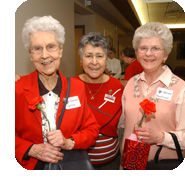 |
| Hospital Auxiliary members. |
The Auxiliary will be opening a Thrift Shop business in
Port Coquitlam as a means of expanding funding resources to meet some of the
increased funding that will be necessary for the planned expansion of Eagle
Ridge Hospital.
This business venture is in addition to the many current projects undertaken by the Auxiliary and, for that reason, numerous additional volunteers are needed beyond our current membership base.
Volunteering at the thrift shop will provide an opportunity to give back to the community, work in a friendly environment, receive job training, develop and practice work skills and be given the opportunity to experience a variety of duties.
THE THRIFT SHOP
Location: 2811B Shaughnessy Street, Port Coquitlam, BC
OPENINGS FOR ALL SHIFT POSITIONS
Cashier,
Customer Assistant (Floor Clerk), Sorting Clerk, Pricing Clerk. Shift Hours
Tuesdays to Saturdays 9:30-1:00 or 1:00 4:30 pm and Sundays from 11:30-3:30. No
Experience Necessary Training Will Be Provided As Needed
VOLUNTEER TODAY! - PLEASE CALL 604-939-9594
Please note that we are not able to accept donations until approximately the
first week of February. Please call Vivian at 604-544-1470 if you wish to
be contacted when we are ready to take donations.
THINGS TO SAVE FOR DONATION: Housewares (no cracked or chipped); Clothing clean, gently used, no tears or stains; Small appliances (clean and in working order); Baby and children clothing (no cribs or car seats); Pictures, frames, games, toys, sporting goods; Lamps, books, records, CDs, jewelry, purses
Greeting cards, wrapping paper, stationery; Craft supplies, fabrics, sewing accessories
Sheets, blankets, comforters, TV Trays; Pet dishes, small furniture and more.....
No electrical items (TVs, DVD players, etc.); No computers or monitors; No microwaves; No baby car seats, cribs, walkers or strollers; No sofas, upholstered chairs or mattresses; No large furniture (entertainment units); No pillows.
Friday, January 18, 2013
Local gov't AG opens office
Good news from the Province. Most of the current Coquitlam council did not support the establishment of this office, but I was -- and remain -- a big supporter.
Auditor General for Local Government opens office
 |
| Basia Ruta |
SURREY - British Columbia's first office of the Auditor
General for Local Government (AGLG) has opened its doors, announced Minister of
Community, Sport and Cultural Development Bill Bennett today with B.C.'s first
AGLG Basia Ruta alongside.
Recommended by the five-member Audit Council that oversees
the office and subsequently appointed by government, Ruta took up her position
on Jan. 15. The AGLG will conduct performance audits of local government operations
and provide recommendations regarding economy, efficiency and effectiveness.
The opening of the office fulfills a commitment made by
Premier Christy Clark as part of her Families First agenda. It is also an
example of how the government listens to British Columbians, as the idea was originally
suggested by B.C. business groups to provide an additional level of
accountability and transparency for taxpayers.
The first audits will begin by April 30. It will be up to the
AGLG to choose what local government operations to focus on within the framework
of the Auditor General for Local Government Act.
The AGLG will publish an annual service plan that will lay
out the goals and objectives for the coming year and the following two years. The
annual service plan will include the criteria used to determine the need for
and priority of performance audits.
Quotes:
Bill Bennett, Minister of Community, Sport and Cultural
Development -
"This office is going to make a difference for B.C.
families by making sure local governments are maximizing taxpayers' hard-earned
tax dollars. The bottom line is that it's about accountability to taxpayers.
Basia Ruta is highly qualified and will be an asset for local governments. I look
forward to the benefits Ms. Ruta's work will bring to local governments and
taxpayers alike."
Basia Ruta, auditor general for local government -
"I'm excited to get started in this important and
challenging position. I intend to make sure the AGLG is a valuable and
objective resource for all of British Columbia's local governments, helping
them provide the greatest possible value for every tax dollar they spend. Under
my leadership, this office will be independent, accessible, fair and transparent
as we carry out performance audits of local governments."
Laura Jones, executive vice-president, Canadian Federation
of Independent Business -
"B.C.'s business owners are pleased the government has
shown leadership by establishing an independent Office of the Auditor General
for Local Government. Taxpayer accountability is always welcome. We are hopeful
that municipalities will recognize the opportunity to provide British Columbians
with greater transparency on how their tax dollars are spent and focus on
providing the best value possible."
John Winter, CEO, BC Chamber of Commerce -
"Taxpayers and local governments will see real tangible
benefits with the establishment of the Office of the Auditor General for Local Government.
Taxpayers will see increased transparency and accountability on how their tax
dollars are spent while local governments will have a resource to enhance their
decision-making process through the sharing of best practices."
Peter Fassbender, mayor of Langley -
"As a mayor of a local community I look forward to
working with the new Auditor General for Local Government as we find ways to
validate and improve the efficiency of local government finances. I know local governments
are doing a good job and this office will show their commitment to serve all
taxpayers and citizens interests!"
Learn More: www.aglg.ca
Tuesday, January 15, 2013
Multi-generational consultation
 |
| Concept sketch, from Coquitlam.ca |
With neighbourhoods along the western slopes already well underway (and experiencing some growing pains too, I might add), it's important that the city gets Partington Creek, a good chunk of which the city itself owns, done right.
When the draft Neighbourhood Plan was unveiled late last fall, planners told Council they would present the plan to various stakeholder groups. But the thought struck me that all the usual suspects, including builders and residents' associations, weren't actually going to be the people living in Partington Creek; those folks are now in their teen or early 20s.
I therefore suggested that our planning department engage local high school and college students; let's hear what they have to say about shaping the future of Coquitlam.
With all this in mind, I was pleased that a list of upcoming public open houses, released this week, includes consultation meetings with both high school and college students, including a meeting at Douglas College. It will be very interesting to hear what they have to say.
Here is a list of some of the upcoming consultation events regarding the draft Partington Creek Neighbourhood Plan:
- Tonight (7 pm-9 pm, Council Committee Room): staff meeting with the PCNP Neighbourhood Working Group (staff will present the draft PCNP for feedback, similar to the presentation to the Dec. 10 2012 Council-in-Committee meeting).
- Thursday, January 17 (7 pm-8 pm, Victoria Hall): North-East Coquitlam Ratepayers Association meeting - staff have been invited to present the draft PCNP.
- Tuesday, February 19 (4 pm to 8 pm, Victoria Hall): Public Open House #1
- Thursday, February 21 (11 am to 3 pm, Douglas College atrium): youth/student-focused Public Open House #2 (emphasis on engaging Douglas and Pinetree Secondary students)
- Thursday, March 7 (4:15 pm-5:15pm): staff meeting with Coquitlam Youth Council.
Tuesday, January 8, 2013
What those assessments mean
 |
| Central Coquitlam residential high rises. (Photo by Terry O) |
As appreciative as I was of the compliment, I had to tell him that the increased assessment of that magnitude also likely means that he will be facing a higher-than-average property-tax increase this year -- not in the realm of Port Moody's average 6.65% jump, mind you, but still above the average 3.34% hike that Coquitlam homeowners will face this year.
He seemed a bit confused by my comment, so I did some explaining. And the thought then struck me that many other homeowners may be somewhat perplexed by our property-tax system as well, so here's an explanation.
When I joined with the majority on Council in the late fall in voting 8-1 in favour of adopting our most recent budget (more about which I'll discuss below), I did so knowing full well that the 3.34% residential increase would be applied exactly against only those whose property value rose (or fell) by the exact same figure that the average residential property's value in Coquitlam rose (or fell). And it turns out that the average Coquitlam home enjoyed an increase of 5.59% in its value, according to assessment figures made public earlier this month.
With this assessment figure now in hand, and with the knowledge of what its ultimate revenue needs for the year are, the City will now set one universal residential mill rate (which is amount of tax payable per dollar of the assessed value of a property) and apply that rate evenly against all residential properties. Follow the logic, and you'll see that if your home rose in value more than the average 5.59%, your tax increase will be more than 3.34%, and if it rose less (or even fell somewhat), your increase will be less or maybe you'll even enjoy a decrease.
I'm guessing that my friend's $60,000-plus assessment increase represents something like a 7% or 8% increase in assessed value, so his property-tax increase will be greater than the 3.34% average. For my part, our now-long-in-the-tooth Eagle Ridge home recorded an assessment increase of just under 1%, which means our property-tax increase will be lower than the 3.34% average.
(You find more details about the City's five-year financial plan here.)
And, while we're on the subject of the budget, I'd like to take this opportunity to get a few more things on the record. First, Council actually passed a budget increase of 2.95%. The average homeowner faces the higher, 3.34% increase, because Council embraced a one-point "tax shift" that sees the commercial/business sector facing an increase of only 2.34%. We did this because the business-tax rate in Coquitlam is among the highest in the region, and we are attempting to lower it to somewhere around the middle of the pack.
Some readers might recall that, in the last election, I signed the Canadian Federation of Independent Businesses' pledge, promising to work towards business-tax reductions. I am happy to report that, for the second year in a row, the majority of Council has voted for a one-point tax shift.
I am also pleased that, for the second year in a row, we have reduced the overall rate of property-tax increase in the City -- another one of my promises. As stated above, the average increase for 2013 is 2.95%; in 2012, it was 3.16%; and in 2011, it was 3.18%.
I believe we are headed in the right direction, and I will continue to work towards greater fiscal responsibility and a lower rate of property-tax-increase growth, while also meeting the legitimate needs of Coquitlam residents.
Subscribe to:
Posts (Atom)